
Photo: DCollins1812 / Wikimedia Commons (CC BY-SA 4.0)
German sits in FSI Category II, one step harder than Spanish or French but nowhere near the difficulty of Japanese, Korean or Arabic. The US Foreign Service Institute estimates around 750 class hours, roughly 30 to 36 weeks of full time study, for an English speaker to reach professional working proficiency. What makes German feel harder than that number suggests is grammar, not vocabulary. English and German share a huge amount of everyday vocabulary, but German's cases, genders and word order are genuinely unfamiliar territory for most English speakers, and they show up in lesson one rather than lesson fifty.
Short answer: German is moderately hard, FSI Category II at around 750 hours to fluency, harder than Spanish or French but far easier than Japanese, Korean, Mandarin or Arabic, which sit at 2,200 or more hours. The vocabulary is often easier than expected thanks to shared Germanic roots with English. The grammar, especially noun cases and gender, is the part that actually earns German its reputation.
The Foreign Service Institute trains US diplomats and has spent decades tracking how long it takes English speaking adults to reach professional working proficiency in different languages, roughly a CEFR B2 to C1 level. Its five category system, from Category I (easiest) to Category V (hardest), is the most widely cited difficulty benchmark in language learning, precisely because it is based on tracked outcomes rather than opinion.
German lands in Category II on its own, the only language in that tier. Category I, at 600 to 750 hours, includes Spanish, French, Italian, Portuguese and a handful of others closely related to English through Latin. Category II, at around 750 hours, is German alone. Categories III through V climb steeply from there, topping out at Category V languages like Japanese, Korean, Mandarin and Arabic, which the FSI estimates at 2,200 hours or more, roughly three times the commitment German requires.
That single-language tier is telling. German is close enough to English, both being Germanic languages, that it does not belong with the truly hard languages, but its grammar is different enough from the Romance languages that it does not slot in with Category I either. It occupies a middle ground that is genuinely its own thing.
Hour estimates vary by source and by what "fluent" is being measured against, but the ranges below, drawn from FSI data and the Goethe-Institut's own course level guidance, give a realistic picture for a self study or part time learner rather than someone in a full time intensive classroom.
| CEFR level | What it means | Approx. hours from zero |
|---|---|---|
| A1 | Basic phrases, introductions | 60 to 150 |
| A2 | Simple everyday conversation | 150 to 260 |
| B1 | Conversational, can get by unsupported | 350 to 500 |
| B2 | Comfortable in most situations | 500 to 650 |
| C1 | Professional working proficiency | 700 to 900 |
The Goethe-Institut's own intensive courses, running four to five hours a day, typically take students from A1 to B1 in six to eight months. Part time learners doing five hours a week should expect that same journey to take roughly a year and a half to two years, simply because the total hours do not change, only how quickly they accumulate.
Spanish and French, both Category I, are genuinely easier for an English speaker, mostly because of grammar rather than vocabulary. Spanish has two noun genders instead of German's three and no case system at all. French sidesteps cases entirely too. Both benefit from centuries of shared Latin vocabulary with English on top of that, which German's Germanic roots cannot fully match for the more formal or academic parts of the language.
Against Japanese, Korean or Mandarin, the comparison flips heavily in German's favour. Those Category V languages use entirely different writing systems, have no shared vocabulary base with English to lean on, and in Japanese and Korean's case involve social and grammatical structures with no real English equivalent at all. Three times the estimated study hours reflects a genuinely different order of difficulty, not just a harder version of the same challenge German presents.
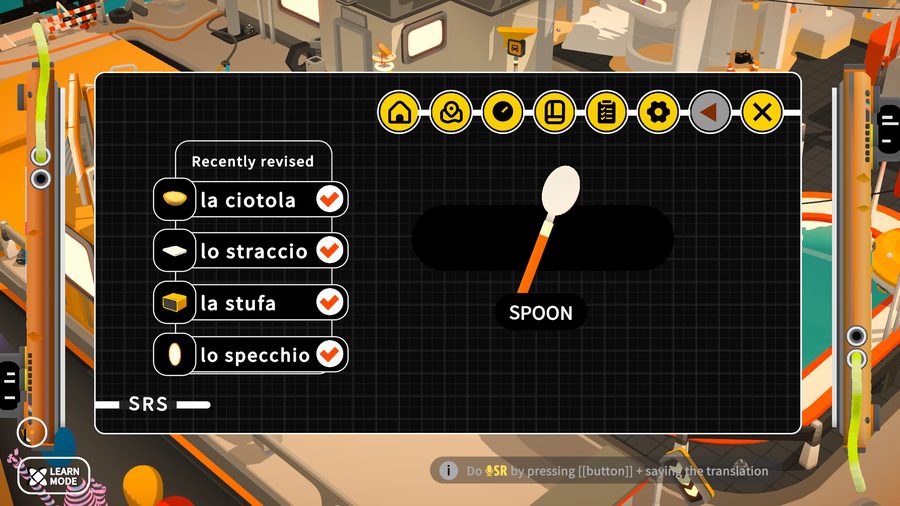
Screenshot from the Noun Town Steam store page, showing the spaced repetition review screen that reinforces noun gender from first exposure
Most of what makes German feel hard is front loaded into the first few months, before a learner has built up enough vocabulary to make the grammar feel worth the effort. A few adjustments make that stretch considerably less painful.
Learn each noun with its gender attached from day one, rather than learning the word first and the gender as an afterthought. Der, die and das feel like extra homework bolted onto vocabulary study if they are taught separately, but they cost almost nothing extra if they are learned together from the very first exposure to a word. This is the exact principle Noun Town builds around: every German noun in the Noun Town language learning game is introduced inside a 3D scene with its article and native speaker audio attached, so gender becomes a habit rather than a rule to memorise separately later.
Prioritise listening early, even before grammar feels solid. German's consistent spelling means that once the ear is trained, reading tends to follow naturally, and listening comprehension gives a much faster sense of progress than grammar drills do in the first few months.
Finally, treat the case system as a long term project rather than something to master before moving on. Native speakers make case mistakes casually in speech and are rarely bothered by a learner doing the same. Fluency in being understood arrives well before fluency in getting every case ending technically correct, and chasing the second before the first tends to slow learners down rather than speed them up.
Start building German vocabulary the way it sticks, gender included.
Try Noun Town on SteamAccording to FSI, yes. Spanish and French are Category I languages at around 600 to 750 hours, while German is Category II at around 750 hours. The gap is smaller than most people expect, and German's shared vocabulary with English closes some of it back up in the early stages.
No, not by FSI's measure. Japanese and Korean sit in Category V at 2,200 hours or more, close to three times the estimate for German. German uses the same alphabet as English and shares a huge amount of core vocabulary, which Japanese and Korean simply do not.
Mostly because of grammar, not vocabulary. Three grammatical genders, four noun cases, and verbs that split apart and move to the end of the sentence are genuinely unusual for an English speaker, and they show up early, before the learner has had time to build confidence elsewhere.
Conversational ability, roughly CEFR B1, typically takes 350 to 500 hours of study for an English speaker, which works out to six to eight months of consistent daily practice for most learners, faster with immersion.
For being understood, less than you would think, since context usually carries the meaning even with an imperfect case. For sounding natural and passing any formal assessment, yes, cases matter a lot and are worth learning properly rather than skipped.
Yes, more than most learners expect. English and German are both Germanic languages, so words like Haus, Wasser, Buch and Hand are recognisable on sight. Estimates vary, but a large share of everyday German vocabulary has a direct or near cognate in English.
Front load vocabulary and listening before grammar rules. Learning nouns and their gender together from the start, rather than bolting gender on afterwards, avoids having to relearn hundreds of words later. Consistent short sessions beat occasional long ones for retention.
Yes, particularly for vocabulary and listening, which are the foundation everything else sits on. Noun Town teaches German nouns with their gender built in from the first exposure, using native speaker audio and spaced repetition, so the hardest part of German grammar gets absorbed early rather than retrofitted.
Noun Town focuses on vocabulary, listening, and speaking practice through spaced repetition inside a 3D world, rather than replacing a structured grammar course. Most learners pair it with grammar-focused study, since a strong vocabulary base makes grammar rules far easier to absorb.
For most goals, yes. German is the most widely spoken native language in the European Union, opens up a large jobs market, and its logical, rule based grammar becomes an advantage once the initial cases and gender are learned, since the language rarely has silent exceptions the way English does.