
Photo: Terfili / Wikimedia Commons (CC BY-SA 4.0)
Short answer: Beginners build usable Mandarin vocabulary fastest by learning each word together with its tone rather than as an afterthought, and by working through frequency-based word lists instead of random ones. Roughly 1,000 to 1,500 of the most common words cover most everyday spoken Chinese, and the HSK 3.0 exam's entry tier alone is built around 300 words. Pinyin and characters are best learned side by side, and short, consistent daily sessions matter more than occasional long ones.
Chinese vocabulary works differently to most languages English speakers try to learn, because two things carry meaning at once: the character itself and the tone it is spoken with. Get the character right but the tone wrong and a native speaker may hear a completely different word. That is not a minor detail, it is one of the main reasons beginners plateau early. The good news is that vocabulary building in Mandarin still follows the same underlying principles as any language, frequency, context and repetition, just applied to a script and sound system that looks unfamiliar at first.
This post covers what actually moves the needle for beginners: which words to prioritise, how to handle tones and characters without letting either slow you down, what measure words are and why they matter, and how long it realistically takes to build a working vocabulary.
A common beginner mistake is working through whatever vocabulary list comes first in a textbook or app, in whatever order it happens to appear, rather than prioritising the words used most often in real speech. That wastes early effort on words you might use once a year instead of words you'll use daily.
The HSK exam, China's standard proficiency test, gives a useful frame of reference for this, even if you never plan to sit it. The current HSK 3.0 structure is cumulative, meaning each level's word count includes everything below it.
| HSK 3.0 level | Cumulative words | What it roughly covers |
|---|---|---|
| Level 1 | 300 | Greetings, numbers, basic verbs and everyday nouns |
| Level 2 | 496 | Simple daily conversation topics |
| Level 3 | 988 | A realistic beginner-to-intermediate conversational base |
You don't need to be studying for the exam for these tiers to be useful. They're a ready-made, frequency-ordered curriculum, and reaching level 3's roughly 1,000 words puts most learners in a genuinely usable place for everyday conversation.
Standard Mandarin uses four main tones plus a neutral tone, and the tone is not decoration on top of a word, it is part of the word. Learners who treat tone as something to fix later, after the "real" vocabulary is memorised, tend to build habits that are genuinely hard to unlearn.
The classic illustration is the syllable "ma," which means something completely different depending on the tone used to say it.
| Pinyin | Tone | Meaning |
|---|---|---|
| mā | 1st, flat and high | mother |
| má | 2nd, rising | hemp / numb |
| mǎ | 3rd, dipping | horse |
| mà | 4th, falling | to scold |
The fix is simple in principle even if it takes practice: when you learn a new word, learn the tone in the same breath as the sound and the meaning, ideally from spoken native audio rather than a written tone mark alone. Written tone marks are a helpful memory aid, but your ear needs to recognise and reproduce the tone, not just your eyes.
Pinyin, the standard romanisation system, gives you a word's sound almost instantly, which makes it tempting to lean on it exclusively early on. The problem is that pinyin alone doesn't build reading ability, and characters that look completely unfamiliar at first become far more manageable once you understand how they're built.
Most Chinese characters are made up of smaller components called radicals, roughly 214 traditional building blocks that often hint at a character's meaning or pronunciation. Learning a few dozen common radicals early gives you a set of recognisable pieces to spot inside new characters, which makes memorisation noticeably faster than treating every character as a brand new shape.
In practice, most learners do best treating pinyin and characters as two views of the same word rather than a sequence to work through in order. See the character, hear and read the pinyin, hear the tone, and attach it all to a meaning at the same time. Delaying characters for too long in favour of pinyin alone tends to create a gap that gets harder to close the longer it's left.
Chinese has no grammatical gender, no verb conjugation and no plurals, which genuinely does make parts of the grammar lighter than many European languages. What catches beginners out instead is measure words, also called classifiers, small words placed between a number and a noun.
English does something similar in a handful of cases, like saying "a sheet of paper" rather than just "a paper," but Chinese requires a measure word almost every time you count or specify a noun. 个 (gè) is the closest thing to a default and will get you understood in a pinch, but many common nouns pair with a specific one: 只 (zhī) for animals, 张 (zhāng) for flat objects like paper or tables, 本 (běn) for bound items like books.
A flashcard reading "书 = book" works, but it's a thin memory. A word encountered inside a sentence, attached to an image, or heard spoken by a native speaker in a specific scene, gets stored with far more surrounding detail, and that extra detail is what makes recall easier later.
This is part of why games and immersive tools have become a serious complement to traditional study methods. In Noun Town, Chinese words are attached to objects and characters inside an explorable 3D world rather than presented as a bare list, with native speaker audio for every word and speech recognition so you're producing the tone and sound, not just recognising the character. That contextual repetition is closer to how vocabulary actually gets absorbed than a stack of index cards.
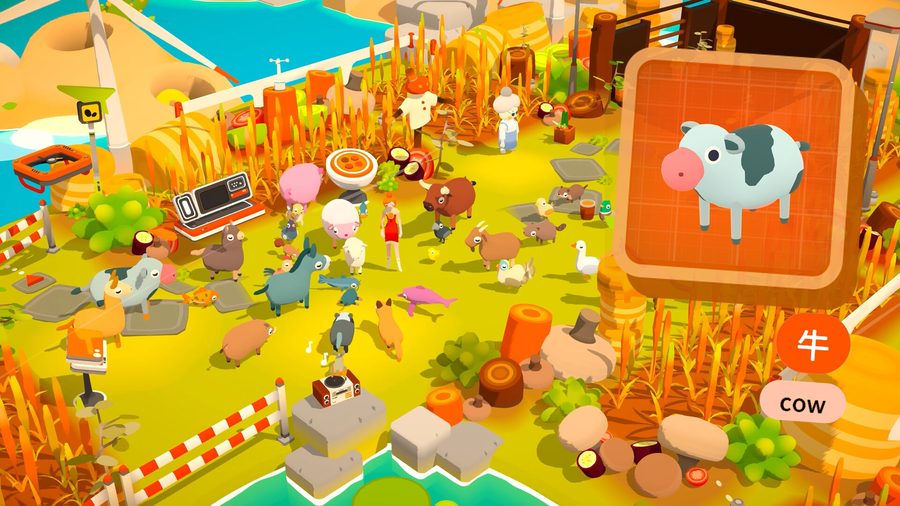
Screenshot from the Noun Town Steam store page
New vocabulary decays quickly without review, this is true in every language, but it's especially punishing in Chinese, where a forgotten character can't be sounded out phonetically the way a forgotten Spanish or French word often can. Spaced repetition systems work by resurfacing a word right before you're statistically likely to forget it, rather than on a fixed daily schedule, and they're one of the few study techniques with strong, consistent evidence behind them.
Ten words reviewed properly across two weeks will almost always beat fifty words seen once and never revisited. If you take one habit from this whole post, make it this one: review old words before adding new ones, not after.
Mandarin sits in the hardest category the U.S. Foreign Service Institute tracks, requiring roughly 2,200 hours of classroom instruction for a native English speaker to reach professional working proficiency, several times longer than French or Spanish. That figure covers full fluency though, not a working beginner vocabulary, and it shouldn't be discouraging.
With consistent short daily sessions, most beginners reach a genuinely useful vocabulary in the 500 to 800 word range within two to three months, enough for basic conversations, ordering food and simple exchanges. Reaching the roughly 1,000-word mark that HSK 3 represents typically takes several months of steady practice beyond that. As with most language learning, consistency matters far more than total hours crammed into fewer sessions.
Want to see Chinese vocabulary taught this way in practice? There's a free demo on Steam.
Try Noun Town on SteamThe fastest reliable method pairs each new word with its tone from the very first encounter, then reviews it with spaced repetition rather than cramming long lists. Learning words attached to a picture, sentence or spoken example also builds stronger recall than translation drills alone.
Roughly 1,000 to 1,500 of the most frequent words cover the bulk of everyday spoken Mandarin. For reference, the HSK 3.0 exam's entry level, HSK 1, is built around 300 words, and HSK 3 covers 988 cumulative words, a level many learners treat as a realistic basic-conversation milestone.
Yes. Mandarin has four main tones plus a neutral tone, and the tone is part of a word's identity rather than an optional pronunciation detail. The syllable ma said with different tones can mean mother, hemp, horse or a scolding, so skipping tones creates real misunderstandings, not just an accent.
Most learners benefit from learning both together rather than choosing one first. Pinyin gives you the sound of a word immediately, while the character gives you meaning and, eventually, reading ability. Leaning on pinyin alone for too long tends to delay character recognition, which becomes harder to catch up on later.
Around 2,000 to 3,000 characters cover most everyday reading material such as newspapers and general websites, though full literacy is often put closer to 3,000 to 4,000. Characters combine into thousands of words, so recognising a smaller set of characters unlocks a much larger working vocabulary.
Measure words, also called classifiers, sit between a number and a noun, similar in spirit to saying a sheet of paper instead of just a paper. Nearly every Chinese noun pairs with a specific measure word, so beginners get the most value from learning nouns and their measure word together, not as a separate grammar rule.
Yes. Games that attach words, tones and native audio to objects and characters inside an explorable world give vocabulary more context than a typical drill screen, and research into digital game-based learning generally shows better retention for words learned this way compared with isolated memorisation.
Yes, Mandarin Chinese is one of the twelve languages included in Noun Town, taught through a 3D open world with native speaker audio, spaced repetition and speech recognition, playable on PC and Mac via Steam.