
Photo: Tookapic / Wikimedia Commons (CC0)
Short answer: Yes, flashcards are optional. Contextual reading, native audio, conversation practice and well-designed games all build vocabulary, often more durably than a flashcard deck, because the word arrives attached to meaning instead of sitting alone on a card. Pick a method that keeps you coming back, since consistency matters more than which specific technique you use.
If you have opened a flashcard app, stared at the two hundredth card of the session, and felt nothing but fatigue, you are not doing it wrong. Plenty of people find flashcards genuinely dull, and dullness is a real problem in language learning, because the method that gets abandoned after two weeks is worse than any method you actually stick with.
The good news is flashcards were never the only route to vocabulary. They became popular because they are cheap, simple to build, and easy to scale into an app. That does not make them the only, or even the best, way to learn a word.
A flashcard, in its classic form, presents a word on one side and a translation on the other. It works reasonably well for short-term recall, and pairing it with spaced repetition, reviewing a card right before you are likely to forget it, does improve retention over cramming. Plenty of learners genuinely get on well with this format.
But a bare translation pair is thin. "Ventana - window" tells you nothing about how the word sounds in a sentence, what it looks like in a real scene, or when a native speaker would actually say it. Your memory has very little to hold onto beyond the raw fact itself, which is exactly the kind of information that fades fastest without constant repetition.
For a lot of people the bigger issue is simply motivation. Reviewing dozens of disconnected cards a day, with no story or scene tying them together, starts to feel like a chore fairly quickly. If a method makes you dread opening the app, it stops mattering how theoretically efficient it is.
The main alternative to flashcards is contextual learning, meeting new words inside sentences, scenes, or situations instead of as isolated items. A word encountered in a sentence carries extra information along with it: grammar cues, tone, the words around it, sometimes an image or sound. All of that extra material gives your brain more to latch onto.
This lines up with what vocabulary acquisition research generally finds: words met repeatedly in meaningful context tend to be recalled more accurately and for longer than words drilled in isolation. The catch is that contextual learning usually takes more initial exposure time per word than a flashcard, since you are absorbing a whole sentence rather than a single pair. It trades short-term speed for longer-term durability.
Contextual learning also scales naturally into things you already enjoy. Watching a show with subtitles in your target language, reading a graded reader pitched slightly below your comfort level, or listening to a podcast aimed at learners are all contextual by nature, and none of them require a single flashcard.
Well-designed language games sit in an interesting middle ground. They still track what you know and resurface weak words, similar to spaced repetition in a flashcard app, but the words themselves are introduced through a scene, a character, or an object in a world you are exploring, rather than as an isolated card.
In Noun Town, for example, a new word usually shows up attached to something visible and interactive: a cow standing in a farmyard, a spoon sitting on a kitchen counter, spoken aloud by a native voice actor rather than a robotic pronunciation guide. You are not memorising a translation pair so much as picking up a label for something you just saw and heard. The review screens that follow use spaced repetition to bring back the words you are weakest on, but that review builds on a memory that already has a scene attached to it, not a bare fact you are trying to hold onto from nothing.
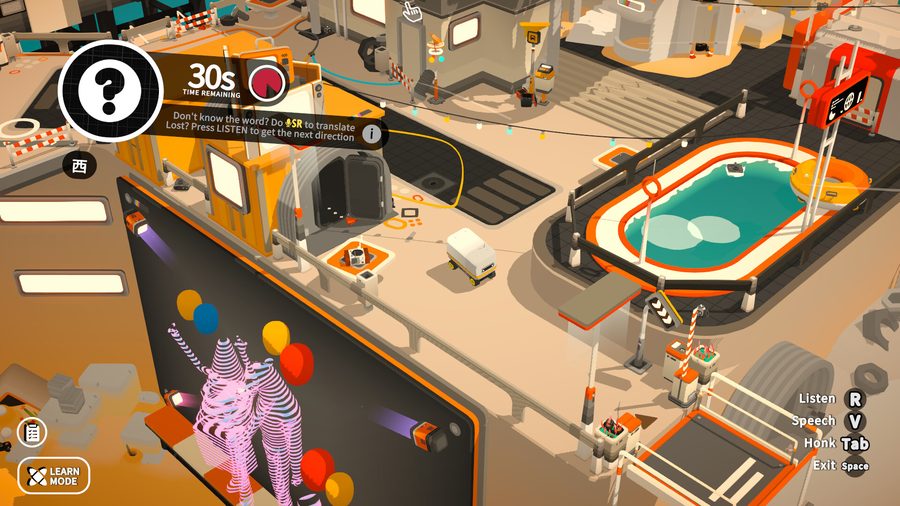
Screenshot from the Noun Town Steam store page
This is part of why the game exists in the first place. The team used the major mobile apps before building Noun Town and found the constant flashcard-style drilling, on top of ads and paywalled lesson tiers, wore thin fast, a frustration heard from thousands of other learners too. Noun Town is a one-time Steam purchase, $19.99, with a free demo if you want to try the approach before buying, and nothing gets locked behind a second payment once you own it.
Nothing forces active vocabulary recall quite like a real conversation, where you cannot pause to look up a word and have to reach for whatever you actually remember. This is uncomfortable at first, which is exactly why so many learners avoid it, but that discomfort is doing real work.
You do not need a fluent conversation partner to get value from this. Language exchange platforms, structured tutoring sessions through services recommended by bodies like the British Council, and even talking to yourself out loud in your target language while describing your surroundings all force the same kind of active retrieval that passive flashcard review never quite matches.
Speech recognition tools, including the kind built into some language games, offer a lower-pressure version of this. You get to practice actually producing the word, not just recognising it, without the social stakes of a live conversation partner watching you fumble.
Pure listening, without any visual or written support, is a slower way to build new vocabulary from scratch, because you cannot always tell where one word ends and the next begins, let alone what an unfamiliar one means. It works best once you already have a base of a few hundred words, at which point immersion starts reinforcing and expanding what you know rather than trying to build it from nothing.
Framework references like the Common European Framework of Reference for Languages are useful here for calibrating your expectations. A true beginner benefits more from paired audio and visuals, of the kind games and labelled environments provide, while an intermediate learner can get real mileage from unstructured listening to podcasts, radio, or shows in their target language.
None of this means flashcards are bad, only that they are not mandatory. A workable routine without them might look like fifteen minutes in a contextual game or graded reader most days, a short weekly conversation session, and background listening during a commute or chores. None of that requires a single card, and all of it reinforces vocabulary from a different angle.
If you do want to keep some flashcard-style review in the mix, using it as a light maintenance layer for words you have already met somewhere meaningful tends to work better than using it as your only source of new vocabulary. The method matters less than whether you actually keep showing up, week after week, and contextual learning tends to be the easier one to stick with precisely because it does not feel like drilling.
Curious what contextual vocabulary learning actually feels like? Try the free demo on Steam.
Try Noun Town on SteamYes. Flashcards are one tool among several, not a requirement. Contextual reading, listening, games, and conversation all build vocabulary too, and for many learners they build it more durably than isolated flashcard drilling because the words arrive attached to meaning rather than as bare translation pairs.
Flashcards strip a word down to a bare translation pair, disconnected from any sentence, sound or situation. That works for short-term recall but often fails to build the deeper, contextual memory that lets you actually retrieve and use a word in real conversation. The repetitive drilling format also causes fatigue for a lot of learners.
It means encountering new words inside sentences, stories, conversations or scenes rather than as isolated items on a card. The surrounding context gives your brain extra cues, like grammar, tone and situation, that help the word stick and make it easier to recall correctly later.
For vocabulary retention, research into game-based learning suggests they often work better, since words encountered through an engaging activity tend to be encoded more deeply than words seen only as a flashcard. Games are typically weaker at explicit grammar instruction, which flashcard-based grammar apps sometimes handle more directly.
Listening alone helps with pronunciation and rhythm but is slow for building active vocabulary unless you already have some foundation, since you cannot look up unfamiliar words mid-sentence. It works best paired with a visual or written anchor, so you know what a new sound actually means.
Reading exposes you to vocabulary in its natural sentence structure, repeatedly and at your own pace. Graded readers, aimed at your current level, are particularly effective because you meet the same common words often enough to absorb them without constantly stopping to look things up.
Yes, and many learners get the best results doing exactly that. Flashcards are efficient for quick review of words you have already met elsewhere in context. The mistake is using them as your only source of new vocabulary, rather than as a maintenance tool for words you have already encountered meaningfully.
Noun Town uses a spaced repetition system, but words are first introduced inside a 3D world, spoken by native speakers and tied to real objects and scenes, not presented as a bare flashcard deck. The review screens exist to reinforce words you have already met in context, rather than being the primary way you learn them.
The team used the major mobile language apps themselves before building Noun Town and found the ads and paywalled lesson tiers frustrating, a complaint heard from thousands of other learners too. Noun Town is instead a single one-time purchase on Steam, $19.99, with everything included and nothing gated behind a second payment.
For complete beginners, a contextual method that pairs images or scenes with native audio tends to be the fastest, since it builds recognition and pronunciation together from the first session. Reading and podcasts become more useful once you already have a base of a few hundred words to build on.