
Photo: U.S. Marine Corps / Wikimedia Commons (Public domain)
Short answer: Beginners build Japanese vocabulary fastest by learning hiragana and katakana in the first couple of weeks, then studying words through spaced repetition combined with real audio and context rather than flat translation lists. Kanji comes later and grows mostly through repeated exposure, not memorisation drills. Around 800 to 1,000 words covers basic conversation, while comfortable fluency needs somewhere near 3,000 to 5,000.
Japanese has a reputation for being one of the harder languages for English speakers to pick up, and a lot of that reputation comes from vocabulary specifically. Three writing systems, no shared alphabet with English, and thousands of kanji looming somewhere down the road. None of that is wrong exactly, but it also scares people into approaching vocabulary the wrong way from day one.
This is a practical look at what actually helps beginners retain Japanese words, based on what tends to work across language learning research and what we have seen building a game around this exact problem.
Romaji, Japanese written using the Latin alphabet, feels like a shortcut at first. You can read "arigatou" without learning anything new, and that comfort is exactly why it becomes a trap. Every word you learn only in romaji has to be relearned later once you switch to actual Japanese script, and by then you have built pronunciation habits based on English letter sounds that do not map cleanly onto Japanese.
Hiragana and katakana, the two phonetic kana systems, take most learners somewhere between one and three weeks to learn well enough to start reading basic text. That is a small upfront cost against months of vocabulary study, and it means every word you learn afterward is learned in a form you will actually keep using.
Katakana specifically is worth prioritising early if you are focused on vocabulary. A large chunk of Japanese loanwords, food terms, tech terms and brand names are written in katakana, and recognising it quickly makes a surprising number of words feel familiar almost immediately.
Kanji is where most beginners get discouraged, often for the wrong reason. There are around 2,136 jōyō kanji, the set designated by the Japanese Agency for Cultural Affairs as commonly used in everyday writing, and trying to learn them as a prerequisite before speaking any Japanese is a slow, demoralising way to start.
A more sustainable approach treats kanji as something that builds gradually alongside vocabulary, not before it. Furigana, small kana printed above a kanji character to show its reading, is the tool that makes this possible. It lets you read real sentences with real kanji in them from an early stage, without needing to already know every character on the page.
We learned this directly while building Noun Town. The game originally displayed romaji throughout its Japanese content, on the theory that it would be less intimidating for total beginners. The feedback on that was mixed, more experienced learners in particular pushed back, saying it was actively holding their reading development back. We switched to showing furigana above kanji instead, and that change was received much better. Worth noting: Noun Town does not try to teach kanji as a dedicated system in the way a tool like WaniKani does, that is genuinely a different job done well by a different kind of tool. What the game does instead is let kanji recognition build incidentally, through repeated exposure with furigana support, while the main focus stays on spoken vocabulary and listening.
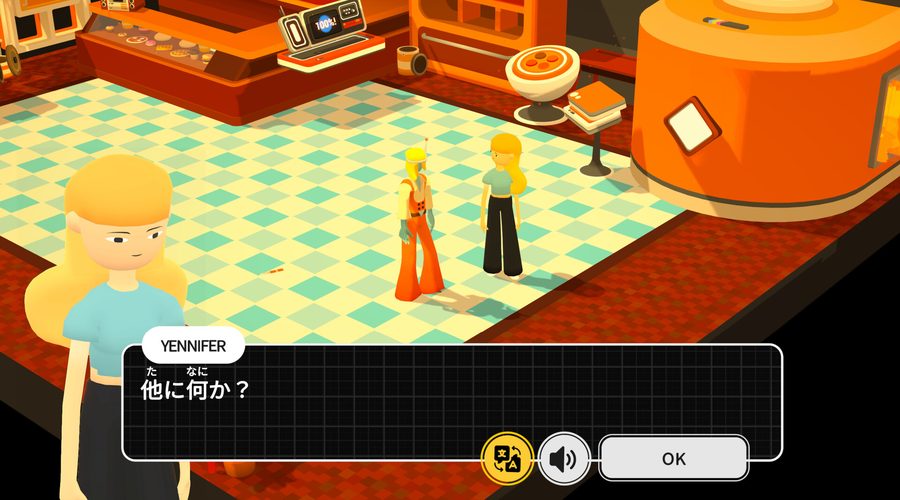
Screenshot from the Noun Town Steam store page, showing furigana displayed above kanji in dialogue
If there is one technique worth taking seriously above everything else, it is spaced repetition. The idea is simple: review a word right before you are about to forget it, rather than at a fixed daily interval regardless of how well you already know it. This makes study time dramatically more efficient than repeatedly rereading a static vocabulary list from the top.
Most dedicated Japanese study tools, from Anki decks to WaniKani to the SRS systems built into vocabulary games, are built around this principle. The exact algorithm varies, but the underlying logic is consistent across all of them, and it is one of the more well evidenced ideas in vocabulary acquisition generally.
Where beginners tend to go wrong is trying to add too many new words per day. Twenty new words reviewed properly over a week beats seventy new words crammed in one sitting and half forgotten by the next morning. Slower, steady exposure with proper spacing consistently outperforms intensity.
A word sitting alone on a flashcard, disconnected from any sentence, sound or visual, is genuinely harder to remember than the same word encountered attached to something. This is true in any language, but it matters more in Japanese because so much of the vocabulary has no cognate relationship to English at all, there is no shared root to lean on the way there sometimes is between, say, Spanish and English.
Context can mean a few different things in practice:
This is the reasoning behind Noun Town's approach to vocabulary in a language learning game: words are attached to objects and characters inside a 3D world, spoken aloud by native speakers, and then resurfaced later through spaced repetition rather than presented once and forgotten.
None of this needs to happen through a single tool. Plenty of learners combine an SRS app for daily reviews, a textbook such as Genki for grammar structure, and something more immersive, whether that is a game, anime with Japanese subtitles, or graded readers, for context and listening.
| Goal | Approximate word count |
|---|---|
| Basic travel phrases and greetings | 150-300 words |
| Simple everyday conversation | 800-1,000 words |
| Comfortable conversational fluency | 3,000-5,000 words |
| Reading native newspapers and novels | 10,000+ words plus strong kanji knowledge |
These numbers line up broadly with frequency research referenced by resources like the Common European Framework of Reference for Languages, which, while designed around European languages, gives a useful general sense of how vocabulary size maps onto practical ability at each stage.
The encouraging part is that Japanese, like most languages, follows a steep frequency curve. A relatively small set of common words covers a large share of everyday speech, so the first few hundred words you learn carry disproportionate value compared to the words you will pick up much later.
Want to try vocabulary learning that pairs furigana, native audio and spaced repetition inside a real 3D world? There is a free demo on Steam.
Try Noun Town on SteamMost beginners make the fastest progress by learning hiragana and katakana first, then building vocabulary through spaced repetition combined with real context, such as audio, images or short scenes, rather than isolated word lists. Consistency over a few months beats intense short bursts.
No, most learners are better off building spoken and listening vocabulary alongside kana first, and letting kanji recognition grow gradually through exposure. Trying to master kanji as a prerequisite before speaking any Japanese tends to slow beginners down and cause early burnout.
Roughly 800 to 1,000 of the most frequent words, combined with basic grammar patterns, are usually enough for simple everyday conversation. Reaching comfortable conversational fluency typically requires somewhere in the range of 3,000 to 5,000 words.
Romaji is useful for the first few days to get oriented, but relying on it long term slows down reading ability and creates pronunciation habits that need to be unlearned later. Switching to kana as early as possible, supported by furigana above kanji, tends to produce better results.
Furigana is small kana printed above a kanji character to show its pronunciation. It lets a beginner read real Japanese sentences with kanji in them without already knowing every character, which keeps reading practice connected to actual vocabulary instead of a simplified romanised version.
Yes. Spaced repetition schedules reviews right before a word is likely to be forgotten, which is significantly more efficient than repeatedly re-reading a static list. It is one of the most well supported techniques in vocabulary acquisition research and is used in most serious Japanese study tools.
Yes, particularly when words are tied to objects, characters and spoken audio inside an interactive scene rather than presented as a flat list. Games such as Noun Town pair furigana-supported text with native audio and spaced repetition so vocabulary is reinforced through repeated, contextual exposure.
Noun Town does not attempt to teach kanji as a dedicated system, since tools built specifically for that, such as WaniKani, do a better job of it. Instead, players pick up kanji incidentally through repeated exposure, with furigana shown above kanji so nothing blocks understanding while that recognition builds.
The game originally displayed romaji throughout for Japanese content. Feedback on that approach was mixed, with more experienced learners in particular finding it held back their reading development, so the team switched to showing furigana above kanji instead, which was received noticeably better.
No, but beginners tend to see the fastest early wins because vocabulary presented in context is easier to absorb without existing grammar knowledge. Intermediate learners also use it for kanji recognition, listening practice and speaking practice through the built in speech recognition tools.