Photo: Shixart1985 / Wikimedia Commons (CC BY 2.0)
Six to eight is where PC gaming genuinely opens up for kids. Most children in this range can read short on-screen instructions, follow a multi-step objective, and handle a mouse and keyboard with growing independence, which happens to be exactly what most games marketed as educational assume of their players. That single shift, from needing an adult to read every line to managing most of it alone, turns a narrow shortlist into a real catalogue. Below are six PC titles that genuinely earn a place on it, picked for what they teach as much as for how much fun a kid actually has playing them.
Short answer: Prodigy Math Game (free), Scribblenauts Unlimited ($19.99), Poly Bridge ($9.99), LEGO Builder's Journey ($19.99), Human Resource Machine ($14.99), and Noun Town ($19.99) cover maths, vocabulary, engineering logic, spatial puzzles, early coding, and language learning respectively, all built for or comfortably suited to this age band.
A five year old usually needs an adult sitting alongside them for anything beyond the simplest point-and-click activity. By six, most children have crossed a real threshold: basic reading fluency, the patience to follow two or three steps in sequence, and enough motor control to aim a cursor reliably. By eight, many are choosing and navigating games almost entirely on their own.
That growing independence is exactly why the educational game market looks so different at this age. Publishers can assume a reader, so text-heavy tutorials, in-game hints, and layered objectives all become viable, where they would simply confuse a younger child. The result is a genuinely wider field to choose from, spanning maths, vocabulary, logic, and early engineering concepts rather than the handful of simplified titles available for children under six.
The trade-off is that not everything marketed to this age is equally well made. A few titles below are purpose built for early primary years, and a couple are general audience games that happen to teach something real if you know what to look for, which is worth knowing before assuming every "educational" label on a store page means the same thing.
Prodigy wraps a genuinely curriculum-aligned maths system inside a fantasy RPG, where correct answers to maths questions power battles and progress. At the six to eight end of its intended range, children can usually play with minimal help, reading their own questions and tracking their own progress. It costs nothing, has no expiring trial, and a free parent account shows exactly which maths topics a child has mastered and where they are stuck.
The entire game is built around typing any noun a child can think of to solve a puzzle, which turns spelling and vocabulary recall into the actual gameplay rather than a separate exercise bolted on top. A child who wants to fly over an obstacle types "helicopter." One who wants to feed a hungry animal types "sandwich," or gets creative and tries something stranger, since the game rewards imagination as much as the obvious answer. It genuinely needs independent reading and typing, which places it comfortably in this age band rather than younger.
A bridge-building puzzle game where poor engineering choices are punished immediately and visibly, usually by watching a car plunge into a river. That instant, understandable feedback is what makes it work so well for this age: no lecture on load-bearing structures required, just trial, failure, and another attempt. It quietly teaches an intuitive sense of weight, tension, and structural stability that most children would not otherwise encounter until secondary school physics.
A quiet, atmospheric puzzle game built from physical LEGO bricks, asking players to figure out how pieces fit together and sometimes to break an expected pattern to solve a scene. There is no timer, no failure state that punishes slow thinking, and no reading required to progress, which makes it a good fit for a child who gets frustrated easily under pressure. It builds spatial reasoning and patient problem solving rather than any single academic subject.
An early introduction to programming logic dressed up as an office comedy, where players drag simple commands into a sequence to move boxes around and solve each level. It genuinely teaches the building blocks of computational thinking, loops, conditionals, and step-by-step instructions, in a form a young child can grasp through experimentation. It suits the older end of this band best, seven to eight, and works well for a six year old playing alongside a parent for the first few levels.
Noun Town is a 3D open world language learning game officially designed from age 7 upward, which puts it squarely inside this age band rather than being a stretch. Children explore a game world, hear native speaker audio, and match spoken words to real objects, so progress does not depend on reading grammar explanations or memorising verb tables. It supports 12 languages, has no ads and nothing to unlock behind a paywall once purchased, and includes a free demo on Steam worth trying before deciding whether it fits.
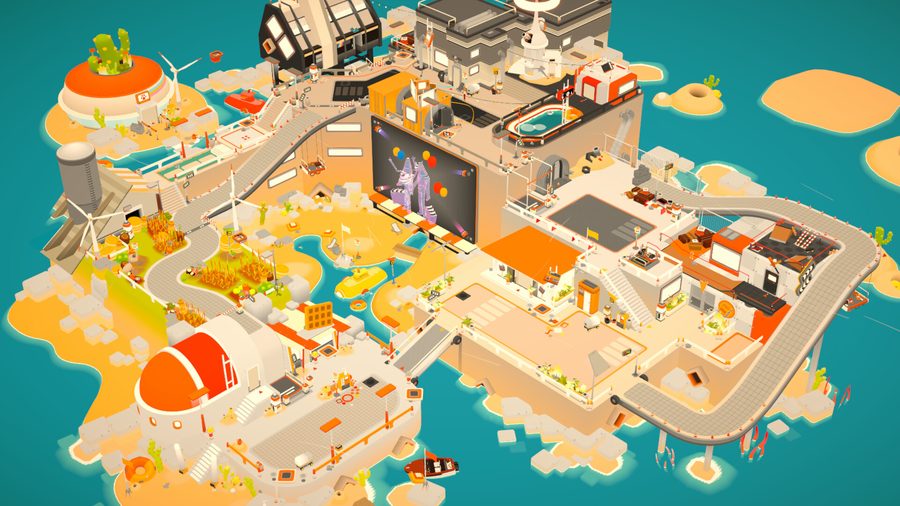
Screenshot from the Noun Town Steam store page, showing the open 3D world children explore to learn new words
None of these six titles needs to be the only thing a child plays. Rotating between a maths game, a vocabulary or language game, and a pure logic or building puzzle covers more educational ground than any single title could alone, and keeps a child from burning out on one style of play. A reasonable weekly mix might look like Prodigy for maths practice, Scribblenauts or Noun Town for vocabulary, and Poly Bridge or LEGO Builder's Journey for something quieter and more spatial.
It is also worth letting a child gravitate toward whichever of these actually holds their attention rather than forcing equal time across all six. A child who loves Scribblenauts and resists Poly Bridge is still learning plenty from the one they enjoy, and enthusiasm at this age tends to matter more for long-term learning outcomes than strict balance across subjects.
The American Academy of Pediatrics recommends consistent, parent-set limits on entertainment screen time for school age children, generally keeping high quality content to one to two hours a day, with sleep, physical activity, and offline play protected first rather than squeezed around screen time. The World Health Organization gives broadly similar guidance, emphasising that screen quality and content matter as much as the raw number of minutes.
An educational label does not exempt a game from these guidelines, since it is still screen time either way. Research summarised by organisations like researchers studying play-based learning generally treats well designed games as one useful tool among many, not a replacement for reading aloud, outdoor play, or unstructured free time, all of which remain just as important at six to eight as they were at five.
| Game | Price | Best for |
|---|---|---|
| Prodigy Math Game | Free | Curriculum-aligned maths practice |
| Scribblenauts Unlimited | $19.99 | Spelling, vocabulary, creative problem solving |
| Poly Bridge | $9.99 | Early engineering and physics intuition |
| LEGO Builder's Journey | $19.99 | Spatial reasoning, patient puzzle solving |
| Human Resource Machine | $14.99 | Early programming and computational logic |
| Noun Town | $19.99 | Second language vocabulary through play |
Curious whether Noun Town fits your family? Try the free demo first.
Try Noun Town on SteamProdigy Math Game (free), Scribblenauts Unlimited ($19.99), Poly Bridge ($9.99), LEGO Builder's Journey ($19.99), Human Resource Machine ($14.99), and Noun Town ($19.99) all suit this age band well, since children at 6 to 8 can typically read simple on-screen instructions and use a mouse with growing independence.
Most children this age can read simple text, follow multi-step instructions, and control a mouse and keyboard without constant help, which is exactly the skill set most PC games marketed as educational assume. That single shift opens up a much wider catalogue than exists for children under six.
Yes, in a genuine way. Scribblenauts Unlimited asks players to type any noun they can think of to solve puzzles, which turns spelling and vocabulary into the actual mechanic of the game rather than a side activity, and rewards creative thinking over memorised answers.
Yes. Games like Poly Bridge introduce basic engineering concepts, weight, tension, and structural failure, through trial and error rather than lecture, which research on STEM education generally treats as an effective way to build early intuition for physical science.
The American Academy of Pediatrics recommends consistent limits on entertainment screen time for school age children, generally no more than one to two hours of high quality content per day, with sleep, physical activity, and offline time protected first.
Yes, this is close to the age Noun Town is actually designed for. The game is built from age 7 upward, and its vocabulary-first approach, matching spoken words to objects in a 3D world rather than reading grammar explanations, suits a child who is a confident but still-developing reader.
Prodigy Math Game is free with no expiring trial and covers maths content aligned to school curricula from roughly first through eighth grade, making it one of the strongest free options for the younger end of this age band.
Clear, simple menus that do not require advanced reading, short activities that can be finished in one sitting, no ads or in-app purchases aimed at children, and mechanics that reward experimentation rather than punishing mistakes, since children this age are still building confidence with failure and retrying.
It can be, since the puzzles introduce real programming logic that some six year olds find frustrating without help. It tends to suit the older end of this band best, around 7 to 8, or a 6 year old playing alongside a parent who can talk through the early puzzles.
Research on play-based and game-based learning generally supports it for school age children when the content is well designed, particularly for vocabulary, early logic, and spatial reasoning, though outcomes depend heavily on engagement and are strongest when games supplement rather than replace other learning.