
Photo: Shixart1985 / Wikimedia Commons (CC BY 2.0)
Screen time guidance for kids changed significantly in January 2026, when the American Academy of Pediatrics retired its long standing two hour a day rule for children 6 and older. For children 2 to 5, the AAP still points to roughly 1 hour a day of high quality content. The World Health Organization is stricter still for the youngest children, recommending no screen time under age 1 and a similar 1 hour daily cap from age 2. For educational games specifically, both bodies now weigh what a child is doing on the screen more heavily than the number on the clock.
Short answer: Under 18 months, avoid screens except video calls. Ages 2 to 5, around 1 hour a day of high quality content, including educational games. Ages 6 and up, the AAP no longer sets a fixed number and instead asks families to set consistent limits using its 5 Cs framework: Child, Content, Calm, Crowding Out and Communication. Active, educational screen time is generally viewed more favorably than passive viewing, but it still needs boundaries.
It helps to separate the two main sources parents usually encounter, since they do not say quite the same thing and were published years apart.
| Age | WHO (2019) | AAP (2026 update) |
|---|---|---|
| Under 1 year | No screen time | Avoid, except video chatting with family |
| 1 year | No screen time | Only high quality content with a caregiver present |
| 2 to 4 years | 1 hour or less, less is better | Around 1 hour a day of high quality content |
| 6 years and up | Not specifically addressed | No fixed number, family sets consistent limits via the 5 Cs |
The WHO's numbers come from its Guidelines on Physical Activity, Sedentary Behaviour and Sleep for Children Under 5, published in 2019, which treats screen time as one part of a wider picture that also covers physical activity and sleep. The AAP's newer guidance, covered in more detail on HealthyChildren.org, takes a different approach once kids reach school age, moving away from counting hours altogether.
The old rule, a flat two hours a day of recreational screen time for children over 2, had been AAP guidance in various forms for years. In January 2026 the organization's Center of Excellence on Social Media and Youth Mental Health replaced it with something more flexible, largely because a single number never captured the difference between an hour of an active, engaging educational game and an hour of autoplaying video.
The shift reflects a broader change in how researchers think about media effects on kids. Two children with identical screen time totals can have very different outcomes depending on what they watched, whether a parent was involved, and whether that time replaced sleep or outdoor play. A flat number could not account for any of that, so the AAP built a framework that asks better questions instead of a single stricter or looser number.
This does not mean unlimited screen time is fine. It means the AAP is asking families to look at content and context rather than reach for a stopwatch, which in practice can be a harder standard to meet honestly than just watching a clock.
Not in the sense that it is exempt from any limit, but the AAP's own framework treats the two differently in practice. An hour spent actively working through problems in a well designed educational game involves attention, decision making and feedback loops that passive video watching simply does not require.
That distinction matters more for younger children, where the 1 hour a day figure is explicitly tied to "high quality" content rather than screen time in general. A toddler watching an hour of unrelated cartoons and a toddler spending an hour in an interactive, age appropriate educational game are both using a screen for the same length of time, but the guidance was written with exactly that difference in mind.
For older kids and teens, where the AAP no longer sets an hours figure, the same logic applies through the 5 Cs framework below. Active, purposeful screen time is not automatically fine in unlimited quantities, but it is treated as meaningfully different from passive scrolling or autoplay.
Instead of a single number, the AAP's current guidance for children 6 and older, laid out on its Center of Excellence on Social Media and Youth Mental Health, asks families to work through five questions, known as the 5 Cs.
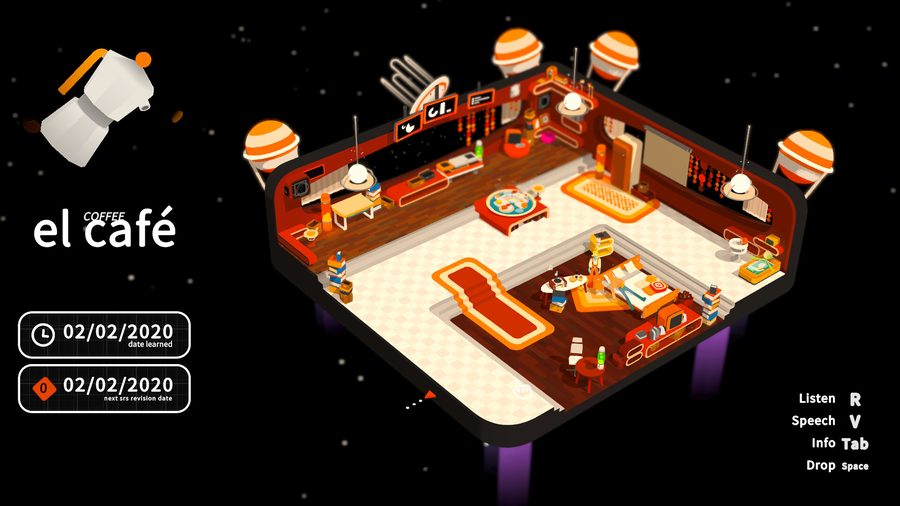
Screenshot from the Noun Town Steam store page, showing built-in review scheduling
The AAP's practical tool for putting the 5 Cs into practice is a Family Media Plan, a free household agreement you build together rather than a rule handed down from a pediatrician's office. Applying it specifically to educational games looks something like this.
Even genuinely educational screen time can tip into crowding out other parts of a child's day, and it is worth knowing the signs rather than waiting for a bigger conflict.
None of these signs mean a game itself is the problem. They usually mean the boundaries around it need adjusting, which is exactly what the Communication and Crowding Out parts of the 5 Cs framework are designed to catch early.
We built Noun Town with sessions that are designed to end naturally rather than stretch on indefinitely. A spaced repetition review set has a defined number of words to get through, then it is done, there is no infinite feed and nothing autoplays into the next thing to keep a session going past the point it was useful.
There are also no ads interrupting a session, which matters for the Calm and Crowding Out parts of the 5 Cs specifically, since ad breaks are a common way a short session turns into a much longer one without a child (or a parent) quite noticing. Nothing is paywalled once you own the game either, so there is no pressure loop nudging longer play to unlock the next tier.
None of that replaces an actual family conversation about limits. But a game that has a natural stopping point built in makes the Family Media Plan easier to stick to than one that is designed to keep a player going for as long as possible.
Curious what a session with a natural stopping point actually looks like? There is a free demo on Steam.
Try Noun Town on SteamFor children 2 to 5, the American Academy of Pediatrics recommends around 1 hour a day of high quality content, which includes educational games. For children 6 and older, the AAP no longer sets a fixed number of hours and instead asks families to set consistent limits that protect sleep, physical activity and offline time.
The World Health Organization recommends no screen time at all under age 1, and none for 1 year olds either. From age 2, both the WHO and AAP allow limited use of high quality, educational content, generally capped around an hour a day for children under 5.
Not for children 6 and older. In January 2026 the AAP retired its long standing two hour a day guidance for that age group in favor of the Family Media Plan and the 5 Cs framework, which focus on content quality and context rather than a single number of hours.
The 5 Cs are Child, Content, Calm, Crowding Out and Communication. They ask parents to consider their specific child's needs, what the content actually contains, whether screens disrupt calm and sleep, whether media is crowding out other activities, and whether the family talks openly about what is being watched or played.
They broadly agree on early childhood. Both recommend no screen time under 1, and around 1 hour a day maximum for ages 2 to 4 or 5. The WHO's 2019 guidance is stricter and simpler for the youngest ages, while the AAP's 2026 update shifts toward flexible, content based guidance once children reach school age.
Both count toward total screen time, but quality is treated as more important than a strict swap. An hour spent actively solving problems in an educational game is generally viewed more favorably than an hour of passive video watching, which is exactly why the AAP moved toward a content focused framework instead of a flat time limit.
A Family Media Plan is a personalized household agreement, built using a free tool at HealthyChildren.org, covering screen free times, screen free zones in the home, content standards and device rules. The AAP designed it as the practical replacement for its old flat two hour rule.
Watch for crowding out, meaning screen time displacing sleep, physical activity, reading or family time, and for difficulty calming down or falling asleep after playing. If a child resists stopping, hides how long they have played, or media use is the only thing they want to talk about, those are signs worth addressing directly.
Noun Town is built around active, content driven learning rather than passive or endless play, with sessions that naturally wrap up once a review set is complete, no infinite scroll, no autoplay and no ads pulling a session longer than intended, which fits comfortably within a content focused approach like the AAP's.
Current guidance does not set separate weekday and weekend numbers. What matters more is whether the same 5 Cs still hold on a day off: is content still high quality, is sleep still protected, and is screen time still leaving room for physical activity and family time, rather than expanding simply because the calendar is clearer.