A preschooler, roughly ages 3 to 5, cannot read a menu, cannot skip past a tutorial they do not understand, and has no patience for a game that assumes either of those things. That single fact rules out most of what gets labelled "educational" for older kids and narrows the field to games built entirely around sound, colour, and simple cause and effect. Five titles manage that well: Slime Rancher, A Little to the Left, Untitled Goose Game, Arthur's Preschool, and Funny Farm Learning Games for Toddlers and Kids, none of which need a child to read a single word to enjoy them.
Short answer: Slime Rancher ($19.99), A Little to the Left ($14.99), Untitled Goose Game ($19.99), Arthur's Preschool ($9.99), and Funny Farm Learning Games for Toddlers and Kids ($7.99) are the strongest picks, chosen because none of them require reading and none rely on ads or in-app purchases to work.
Everything about choosing a game shifts once the player cannot yet read. Text based instructions, written objectives, and menus full of small labelled buttons all become obstacles rather than helpful information. What replaces them has to be audio, colour, and repetition: a friendly voice explaining a goal, a big obvious button to click, an animation that shows exactly what happens next before it happens.
The CDC's developmental milestones for age 3 describe children at this stage as able to identify shapes, compare two items, and count to three, well before formal reading begins. That gap between what a preschooler can already do and what most software assumes a player can do is exactly where a lot of so-called educational games for this age quietly fail. A game built around genuine preschool ability, sorting, matching, simple cause and effect, tends to land far better than one that was designed for a slightly older child and just repackaged with brighter colours.
Attention span is the other big constraint. Preschoolers generally focus well in short bursts rather than long, uninterrupted sessions, which is part of why every game on this list is built around small, self-contained activities rather than a single long objective that has to be finished in one sitting.
Slime Rancher ($19.99, Windows, Mac, and Linux) puts a child in charge of a colourful ranch full of bouncy, harmless creatures, with almost nothing in the way of written text getting in the way. It is closer to a gentle sandbox than a game with a fixed goal, so a child can wander, collect, and experiment at their own pace. It suits the older end of preschool best, since catching slimes with the mouse takes a bit more precision than a 3 year old may have yet.
A Little to the Left ($14.99, Windows and Mac) is a quiet tidying and sorting puzzle game, dragging objects into place until a pattern feels right. There is no reading required and no way to truly fail a puzzle, only a satisfying click when something slots into position. It is a good fit for a preschooler who likes order and repetition, and calm enough that it rarely causes frustration.
Untitled Goose Game ($19.99, Windows and Mac) hands a child control of a mischievous goose with a short list of simple goals shown visually rather than in text, honk at someone, steal an item, waddle somewhere new. The physical comedy and total absence of any real penalty for getting things wrong makes it an easy game to hand to a young child and let them explore.
Arthur's Preschool ($9.99, Windows only) is built specifically for this age band, covering letters, numbers, shapes, and matching through the familiar Arthur characters, with full voice narration guiding every activity. It is one of the few games on this list actually marketed as preschool software rather than a general audience game that happens to suit young kids, though it currently only runs on Windows.
Funny Farm Learning Games for Toddlers and Kids ($7.99, Windows only) is a straightforward set of matching, sorting, and counting mini games wrapped in a farmyard theme, again fully narrated so a child never needs to read a prompt. Like Arthur's Preschool, it is Windows only, so Mac households will need to lean on the other titles here instead.
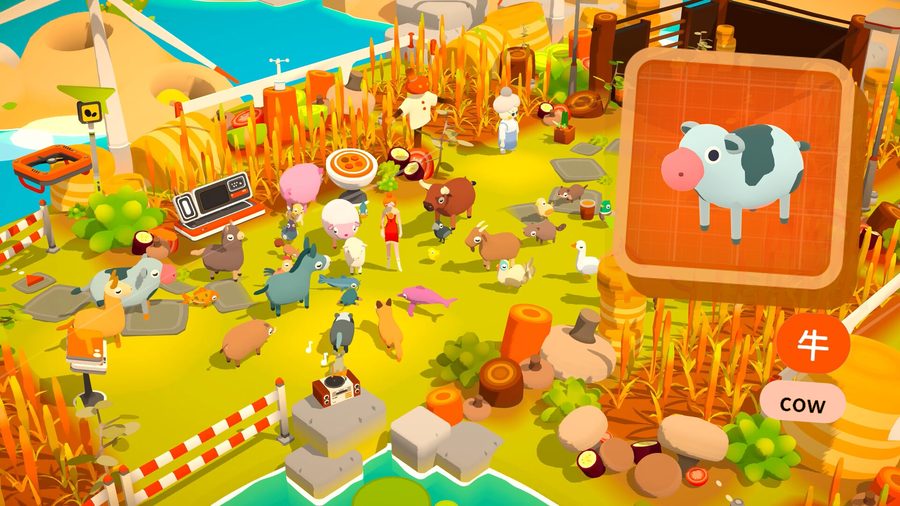
Screenshot from the Noun Town Steam store page, showing the kind of picture-first, audio-led vocabulary scene that suits young children once they are ready for it
Plenty of mobile apps marketed at young children are free to download and make their money through ads or in-app purchases instead, and preschoolers are the age group least equipped to handle that. The American Psychological Association's Task Force on Advertising and Children found that most children under 7 to 8 years old cannot reliably tell the difference between an advertisement and the actual content around it, which makes an ad-supported app a genuinely poor fit for this specific age group rather than just an annoyance.
All five games above are paid, one-time purchases with nothing to unlock later and nothing trying to sell a child anything mid-session. That is not a small detail at this age. A preschooler who gets interrupted by an ad or a purchase prompt has no real way to understand what just happened or why, which can turn a calm activity into a confusing one fast.
The American Academy of Pediatrics generally suggests around one hour of high quality content a day for children aged 2 to 5, ideally with a caregiver nearby to talk through what is happening on screen rather than leaving a child to it entirely. None of the games above are designed to be played for hours unsupervised, and all work well in short, shared sessions.
On the learning side, a study looking at an active video game intervention for preschool age children found real, measurable benefit for physical and cognitive engagement when the game was well matched to the child's age and abilities. That matters more than any label on the box. A game built around genuine preschool level tasks, sorting, matching, simple cause and effect, tends to do more good than one that is simply quieter or more colourful than the games older siblings play.
Once a child moves past preschool and starts reading with more confidence, usually somewhere around age 6 or 7, a wider category of educational games opens up, including language learning titles like Noun Town, which pairs spoken vocabulary with a 3D world a child can explore. It is not built for preschoolers, since it assumes a reader who can follow along independently, but it is worth keeping on the radar for a year or two down the line.
| Game | Price | Platform | Best for |
|---|---|---|---|
| Slime Rancher | $19.99 | Windows, Mac, Linux | Gentle sandbox exploration, ages 4 to 5 |
| A Little to the Left | $14.99 | Windows, Mac | Sorting, matching, calm repetition |
| Untitled Goose Game | $19.99 | Windows, Mac | Visual goals, simple cause and effect |
| Arthur's Preschool | $9.99 | Windows only | Letters, numbers, shapes with full narration |
| Funny Farm Learning Games | $7.99 | Windows only | Matching and counting mini games |
Got an early reader at home? See if Noun Town is a fit with the free Steam demo.
Try Noun Town on SteamSlime Rancher ($19.99), A Little to the Left ($14.99), Untitled Goose Game ($19.99), Arthur's Preschool ($9.99), and Funny Farm Learning Games for Toddlers and Kids ($7.99) all work well for preschool age children, since none of them require the player to read to make progress.
No, and that is the whole point of this list. Every game here communicates through sound, colour, and simple icons rather than written instructions, since most children have not started reading independently until several years later.
It suits the older end of preschool better, roughly 4 to 5, since it asks for reasonably precise mouse or controller movement to catch slimes and move around the ranch. A 3 year old will likely need a parent nearby to help with the controls, even though the content itself is gentle.
The American Academy of Pediatrics generally recommends around one hour of high quality content a day for children aged 2 to 5, watched or played alongside a caregiver where possible, rather than a strict cutoff enforced without any context.
Research summarised by the American Psychological Association Task Force on Advertising and Children has found that most children under 7 to 8 years old cannot reliably tell the difference between advertising and the actual content they are engaging with, which makes ad supported apps a particularly poor fit for preschoolers specifically.
Not yet. Noun Town is designed for players from age 7 upward, since it assumes a level of reading and sustained attention that most preschoolers have not reached. It is worth keeping in mind for a couple of years later, once a child moves from preschool into confident early reading.
Yes, both are Windows only on Steam, so Mac households will need to look to the other titles on this list, such as Slime Rancher, A Little to the Left, or Untitled Goose Game, all of which run natively on Mac.
Research on active, well designed games for preschool age children has found real benefit for attention, coordination, and basic cognitive skills, though outcomes depend heavily on the specific game and on a caregiver staying involved rather than using the game as a babysitter.
A computer game generally requires a mouse, keyboard, or controller, which asks more of a young child's motor skills than tapping a touchscreen, but it also tends to avoid the constant ad interruptions and impulse purchase prompts that are common on mobile app stores aimed at kids.
Audio driven instructions rather than text, large forgiving controls, no ads or in app purchases, short sessions that match a preschooler's attention span, and no punishing fail states that could discourage a child who is still building basic confidence with a mouse or controller.