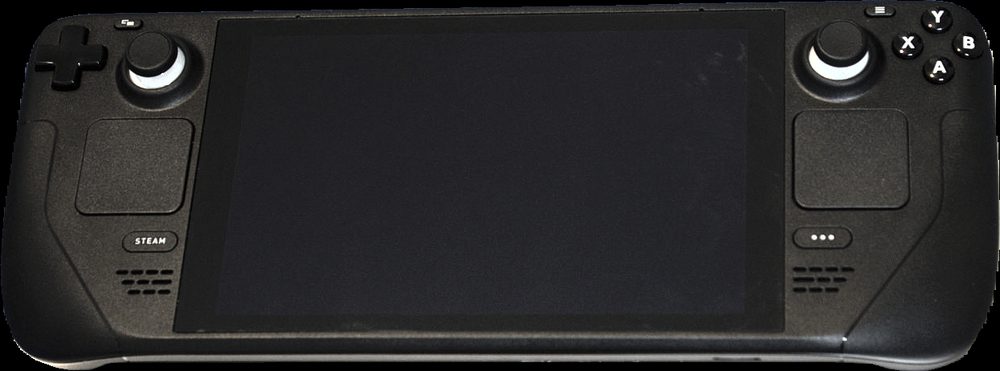
Photo: Liam Dawe / GamingOnLinux, PNG version by VulcanSphere / Wikimedia Commons (CC BY-SA 4.0)
Short answer: The best educational Steam Deck games for kids combine genuine learning with gameplay kids actually want to keep playing. Strong picks include Noun Town for language learning across 12 languages, Human Resource Machine and 7 Billion Humans for coding logic, and Kerbal Space Program for physics and problem solving. Prices range from free demos to around $20, and most run fully offline once downloaded.
The Steam Deck is not marketed as a kids device. It is a full PC in handheld form, which means there is no curated "kids section" waiting for you when you turn it on. That is both the appeal and the catch: parents get access to the entire Steam library, but they also have to do the picking themselves.
We build a language learning game ourselves, so we are not a neutral party on one entry in this list. But the goal here is a genuinely useful roundup, not a excuse to talk about our own game for ten paragraphs, so most of this article covers other titles worth knowing about.
Before picking games, it is worth spending ten minutes on setup. Steam's Family View feature lets you restrict a profile to an approved list of games, block store browsing and community features, and set daily or weekly playtime limits. This matters more on Steam Deck than on a locked-down tablet, because the store is one tap away and nothing stops a child from browsing or buying without it.
A 3D open world game covering 12 languages including Spanish, French, Japanese and Korean, where kids learn vocabulary in context rather than through flashcard drills. Words are attached to objects and characters in the world, spoken aloud by native speakers, and reviewed later using a spaced repetition system so nothing gets forgotten. $19.99 one time, free demo available, no ads, nothing paywalled once bought.
What makes a language game work on a handheld specifically is session length. Kids do not always want a rigid ten minute lesson, they want to explore for however long feels right, and Noun Town's open world format lets that exploration double as vocabulary practice without feeling like homework. This is broadly in line with what education researchers call digital game-based learning, where content absorbed during genuine play tends to be retained better than content drilled in isolation. Runs offline once installed, which is useful on a long car trip.
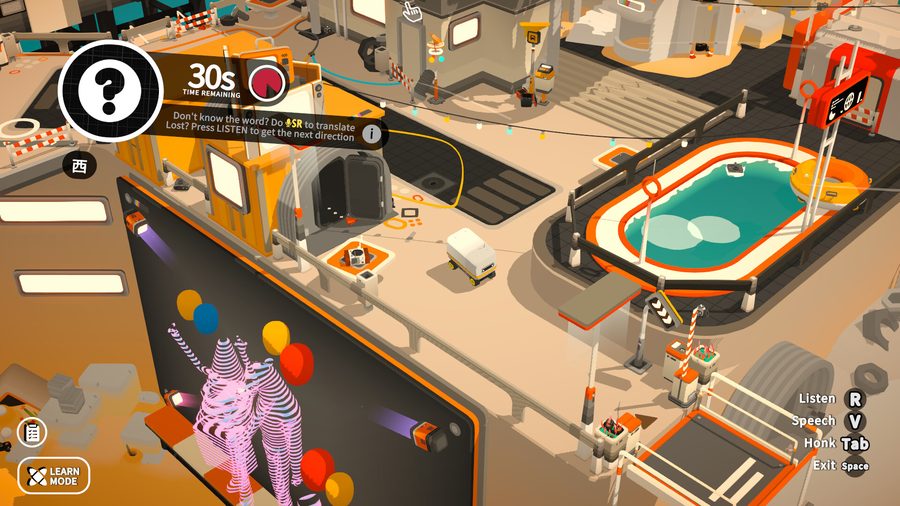
Screenshot from the Noun Town Steam store page
A puzzle game where you program a little office worker using drag and drop instructions to move numbers and letters around. It teaches core computational thinking concepts like loops and conditionals without ever showing a line of formal syntax, which makes it a genuinely good entry point for kids around age nine and up.
The sequel to Human Resource Machine, adding parallel programming concepts as multiple workers need to be coordinated at once. Slightly harder than the original, so it works well as a follow-up once a child has finished the first game.
Kids design and launch rockets, learning real orbital mechanics concepts through trial, error and a lot of spectacular crashes. It has a steeper learning curve than the other games here, so it suits kids around eleven and up, or younger with a parent playing alongside them.
A puzzle game about building chemical reactors that quietly teaches sequencing, resource management and spatial logic. It is genuinely difficult in its later levels, so it suits older kids and teenagers more than younger children, but the early levels are approachable for a determined ten year old.
If none of these fit what your child is into, a few criteria help when browsing the Steam store on your own. Look for a clear PEGI age rating, read a handful of user reviews specifically mentioning children, and check whether the game has in-game purchases or online chat, both of which are worth disabling for younger players regardless of the game itself. The American Academy of Pediatrics also publishes general guidance on balancing screen time with other activities, which is worth a look if screen time is a wider concern in your household rather than a question about any one game.
Curious whether Noun Town is a good fit for your household? There is a free demo on Steam.
Try Noun Town on SteamYes, with a few caveats. The Steam Deck runs full PC games rather than a locked-down kids catalogue, so a parent needs to pick titles deliberately and set up Family View or a separate account with spending limits. Once that is in place, it is a genuinely good handheld for children eight and up, and younger with supervision.
Valve does not publish an official minimum age, but most reviewers and parents treat it as suitable from around age eight, depending on the child and the games installed. The controls are more complex than a typical kids tablet, so younger children usually need help getting started.
Yes. Steam Family View lets a parent restrict which games, store pages and community features a child's profile can access, and set daily playtime limits. Combined with a curated library of educational and age-appropriate titles, this turns the Deck into a much safer device for younger players.
Yes. Noun Town is a language learning game built for PC and Mac that runs on Steam Deck, teaching vocabulary across 12 languages through a 3D open world with native speaker audio and spaced repetition reviews, rather than through a flashcard-style app interface.
Not generally. Prices for the games in this list range from free to around $20, similar to non-educational indie titles. Educational games rarely carry a premium simply for having a learning angle.
Most single-player educational games, including Noun Town, can be played fully offline once downloaded, which makes the Deck useful on long car journeys or flights. A connection is only needed for the initial install and any updates.
Human Resource Machine and its sequel 7 Billion Humans are widely recommended starting points, teaching programming logic through puzzle solving rather than a formal syntax-heavy language, which suits kids new to coding concepts.
Yes, there is a free demo available on Steam. The full game is a one-time purchase of $19.99 with no ads and no additional paywalled content once bought.
Not entirely, but choosing games with genuine educational content changes what that screen time is doing. A child spending an hour on a well-designed language or logic game is engaging differently than passive scrolling, even though moderation and balance still matter.
Most of the games on this list are modest in size, typically under 5GB, which is small next to many AAA titles and easy to fit on the base 256GB or 512GB Steam Deck models without needing an SD card upgrade.