

Photo: Bill Branson, National Cancer Institute / Wikimedia Commons (Public domain)
An offline educational game is one that can be fully played without an internet connection once it has been installed, which matters more than it sounds. A five-hour car journey, a hotel with patchy wifi, or a household router that gets switched off after dinner as a screen-time rule will all stop an online game dead. It will not touch an offline one. Below are five real, currently available games that install once through Steam, then run without ever needing to reconnect, covering logic, physics, vocabulary and spatial puzzles for ages roughly 7 and up.
Short answer: The best offline educational games for kids are Baba Is You ($14.99, logic puzzles, age 8+), Poly Bridge ($9.99, physics and engineering, age 8+), Scribblenauts Unlimited ($19.99, vocabulary and creativity, age 7+), A Little to the Left ($14.99, spatial puzzles, all ages) and Noun Town ($19.99, language learning, age 8+). All five install once from Steam and run completely without wifi afterward.
Buying and downloading a game always requires an internet connection at least once. What varies is what happens after that. Some titles, particularly ones with online leaderboards or cloud-saved progress, quietly expect to phone home every so often, and can behave oddly or refuse to launch without a connection. Others are built as pure single-player experiences that never need to talk to a server again once the files are on the hard drive.
Steam itself has a manual offline mode, found in the client settings, which needs to be switched on before losing a connection rather than after. Once enabled, any game that does not depend on an always-online server, which includes all five below, will launch and run normally.
It is worth checking this for any game before relying on it for a flight or a remote cabin, since not every "single-player" label guarantees offline play. The five games in this list have been checked and confirmed to run fully offline after installation.
Home broadband is more reliable than it used to be, but it is still not universal, and it is not always in the household's control. Rural areas, older buildings and travel all create real gaps. A game that depends on a constant connection simply is not an option in those situations, no matter how good it is.
Screen-time management is the other reason this keeps coming up. Plenty of parents deliberately turn off the home wifi in the evening or during homework hours as a blunt but effective control. An offline game keeps working through that, which some families see as an advantage rather than a workaround, since it separates "time on a device" from "time able to access the wider internet."
Reliability plays a part too. An offline game does not stall on a loading screen because a server is under maintenance, and it does not vanish if a publisher eventually shuts down the servers for an online-only title years later. What is installed on the drive keeps working.
| Game | Price | Age | Teaches |
|---|---|---|---|
| Baba Is You | $14.99 | 8+ | Logic and rule-based reasoning |
| Poly Bridge | $9.99 | 8+ | Physics and structural engineering |
| Scribblenauts Unlimited | $19.99 | 7+ | Vocabulary and creative problem solving |
| A Little to the Left | $14.99 | All ages | Spatial reasoning and sorting |
| Noun Town | $19.99 | 8+ | Vocabulary in 12 languages |
Baba Is You hands the player rule blocks that can be physically pushed around the level, which means the rules of the puzzle can be rewritten mid-game. It looks simple and plays like a genuine logic course in disguise. Poly Bridge asks players to build a bridge strong enough to survive traffic, then shows exactly where and why it collapses when the maths does not add up, which turns structural engineering into trial and error rather than theory.
Scribblenauts Unlimited is almost entirely about words: typing an object's name summons it into the world, and the game rewards creative vocabulary, obscure nouns and unusual combinations. A Little to the Left is a quieter, tidier kind of puzzle game built around sorting and organising objects into their correct place, suitable for a much wider age range since there is no reading requirement to get started.
Noun Town rounds out the list as the only one focused on language rather than logic or physics. New words appear attached to objects inside a 3D world, spoken aloud by native speakers, with a spaced repetition system quietly scheduling review sessions in the background. Once installed, none of this needs a live connection to work.
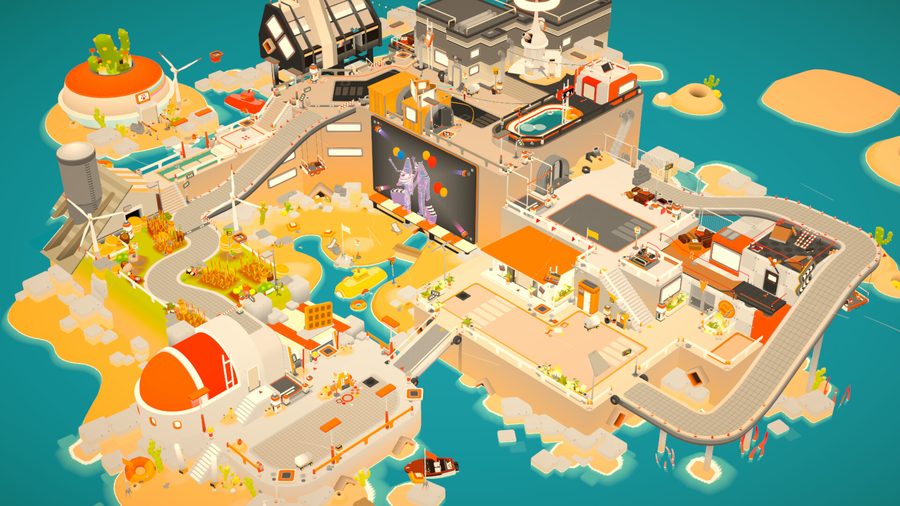
Screenshot from the Noun Town Steam store page, showing the open 3D game world
Noun Town downloads its full library of vocabulary, native speaker audio and 3D world assets during installation, so nothing streams in during play. A child working through Spanish or Japanese vocabulary on a long car journey is not relying on a mobile signal at any point once the game is open.
The game also has no ads and nothing locked behind a paywall after purchase, a deliberate decision by the team behind it after using the major mobile language apps themselves and finding the ad breaks and paywalled lesson tiers frustrating, a complaint they then heard echoed by thousands of other learners. That matters slightly more offline than online, since an ad-supported app that cannot fetch new ads offline sometimes behaves unpredictably or blocks progress entirely.
A free demo is available on Steam and can be downloaded in advance the same way as the full game, which is worth doing before a trip if a family wants to try it out without committing to the full purchase first.
Guidance on children's screen time varies by age far more than most headlines suggest. The World Health Organization's guidelines on screen time for children under five recommend none at all under two, and no more than an hour a day between two and four, with less being better. For children five and older, the emphasis shifts from a hard cap toward consistent limits and the quality of what is being played.
Common Sense Media's screen time research makes a similar point, arguing there is no single number that suits every child, and that how a child engages with content, actively solving a puzzle versus passively scrolling, matters as much as the clock. A single-player puzzle or vocabulary game sits closer to the "active" end of that spectrum than passive video.
None of the five games above are a substitute for outdoor play, reading or sleep, and none of the research cited here suggests otherwise. What it does support is a fairly simple idea: if a child is going to have screen time anyway, a game that asks them to solve something is a reasonable way to spend some of it, and an offline one removes several of the practical headaches that come with managing when and where that happens.
Want to try the vocabulary game that works with or without wifi?
Try Noun Town on SteamIt means the game can be launched and played fully without an active internet connection, once it has been downloaded and installed. Some games marketed as single-player still require a one-time online check or occasional login, so it is worth confirming a specific title supports Steam's offline mode before relying on it for travel.
Yes. Baba Is You, Poly Bridge, Scribblenauts Unlimited, A Little to the Left and Noun Town all install once through Steam and then run completely offline, covering logic, physics, vocabulary and spatial reasoning between them.
Yes. Once installed through Steam, Noun Town runs fully offline, including the vocabulary lessons, spaced repetition reviews and native speaker audio. An internet connection is only needed for the initial download and any future updates.
Scribblenauts Unlimited is generally suitable from around age 7 upward, since it involves reading and typing out words to summon objects. Younger children who cannot yet read comfortably will need an adult nearby to help with spelling.
Yes. A Steam account and an internet connection are needed to purchase and download any of these games, and Steam's offline mode needs to be switched on manually before going without wifi. After that initial setup, the games themselves do not need to reconnect to be played.
Yes, as long as the game has been downloaded in advance and Steam has been switched to offline mode before losing signal. All five games in this list are designed for single-player sessions with no ongoing connection required during play.
Offline single-player games remove the risk of chat with strangers, in-game friend requests and the pressure of online leaderboards, which are common concerns parents raise about multiplayer titles. They do not automatically make a game more age-appropriate, so checking the content rating still matters.
No. All five games, Baba Is You, Poly Bridge, Scribblenauts Unlimited, A Little to the Left and Noun Town, are single, one-time purchases with everything included. None of them add extra paid content or loot boxes after purchase.
The World Health Organization recommends no sedentary screen time for children under two, and no more than one hour a day for children aged two to four, with less being better. Guidance for children five and older shifts toward consistent limits and content quality rather than a fixed hourly cap.
Baba Is You has simple visuals but genuinely tricky logic puzzles, so it tends to suit children from around age 8 upward, or younger children playing alongside a patient adult. Very young children often find the early puzzles frustrating rather than fun.