An educational game for a teenager only works if it does not feel like a worksheet with a game skin stretched over it. That is where most "educational" software aimed at teens goes wrong: it teaches by testing, not by playing. The six games below avoid that trap. Each one is a complete, commercially successful game that happens to teach a real subject through its actual mechanics, not through bolted-on trivia questions. Prices run from $6.99 to $39.99, all six run on PC and Mac, and the subjects span orbital mechanics, city economics, astrophysics, political systems, programming logic and language.
Short answer: The best educational games for teens in 2026 are Kerbal Space Program ($39.99, orbital mechanics and physics), Cities: Skylines ($29.99, urban planning and economics), Universe Sandbox ($29.99, astrophysics), Democracy 4 ($29.99, political systems), TIS-100 ($6.99, programming logic) and Noun Town ($19.99, language learning across 12 languages). All six run on PC and Mac, and none use ads or loot boxes.
There is a real difference between a game aimed at a six year old and one that will hold a fifteen year old's attention. Younger kids respond well to bright colours, simple counting and instant praise. Teenagers can spot that formula from across the room, and they close it. What works instead is depth: systems with real consequences, failure states that make sense, and enough complexity that mastery actually takes effort.
This broader category is sometimes called a serious game, meaning any game built with a primary purpose beyond pure entertainment, whether that is training, awareness or education. Educational games for teens sit inside that category, but the good ones rarely advertise themselves that way. They are simply good games that happen to be built on real subject matter.
The simplest test we use when judging whether something belongs on a list like this: would a teenager choose to play it even if a parent had never mentioned the word "educational"? Every game below passes that test on its own merits, in its own right, on Steam's regular bestseller and top-rated lists.
Quiz-style apps reward a teenager for recalling a fact fast. Simulation and puzzle games reward them for understanding how a system behaves, which is a slower, deeper kind of learning that tends to stick around after the app is closed. A teenager playing Cities: Skylines is not memorising the definition of "zoning," they are watching what happens to traffic when they zone badly, then fixing it themselves.
Teenagers are also unusually motivated by mastery and challenge for its own sake, more so than by external rewards like stickers or streak counters. Games like TIS-100 and Universe Sandbox lean directly into that instinct instead of working against it. There is no score being reported to a parent, no daily streak to protect, just a puzzle that either works or does not.
None of this makes quiz apps useless. They are efficient for memorising vocabulary, dates or formulas in short bursts. But for building the kind of systems thinking that shows up in subjects like economics, physics and civics, a well-designed simulation tends to go further, precisely because the teenager is doing the thinking rather than selecting an answer from a list.
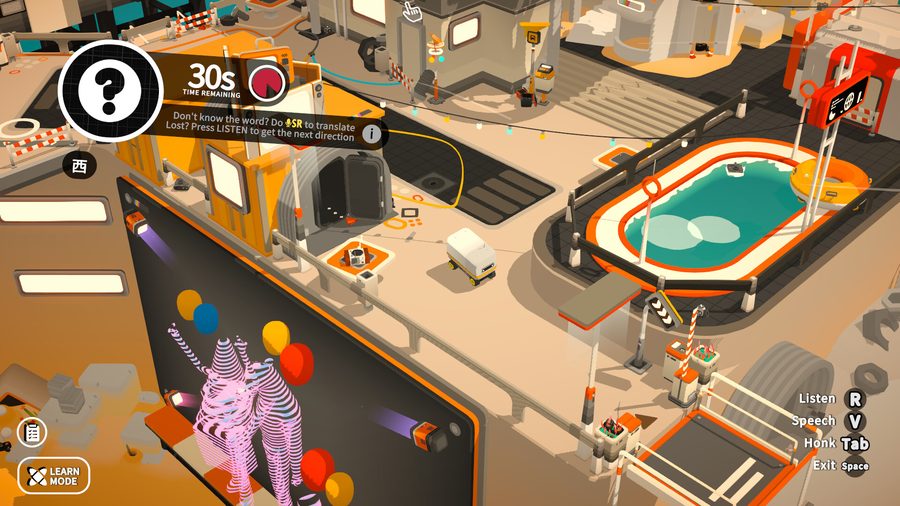
Screenshot from the Noun Town Steam store page, showing a timed recall challenge
Language apps built around flashcards tend to lose teenagers faster than almost any other age group, mostly because the format reads as homework the moment the novelty wears off. Noun Town takes a different approach: vocabulary is attached to a 3D world rather than a deck of cards, native speaker audio plays automatically, and a spaced repetition system schedules reviews without the player needing to think about it.
The game was never designed exclusively for young children, and teenagers make up a meaningful share of its player base. It also has no ads and nothing locked behind an extra paywall once purchased, a decision the team made after using the major mobile language apps themselves and running into the same ad breaks and paywalled lesson tiers that frustrate so many learners.
A free demo is available on Steam for anyone who wants to try a session or two of the actual gameplay, in one of the 12 supported languages, before deciding whether it suits a teenager's taste in games.
There is no single number of hours that turns gaming from a hobby into "educational time." What matters more is the mix of content and how it sits alongside sleep, schoolwork and other activities. The American Academy of Pediatrics, through its parent resource HealthyChildren.org, recommends consistent, agreed limits for children six and older rather than a strict clock, alongside making sure screen use never crowds out sleep or physical activity.
Common Sense Media's own research on screen time found that teenagers already average more than six hours of daily screen use across all devices, well above younger age groups. Their guidance leans on quality of content and how a teenager engages with it, rather than treating every hour of screen time the same.
Systems-thinking skills, the kind exercised by games like Cities: Skylines and Democracy 4, overlap with the problem-solving competencies the OECD assesses internationally through its PISA testing programme, even though none of the games in this list were built with any test in mind. That overlap is a reasonable argument for choosing this kind of game over a passive one, not an argument for unlimited hours.
Curious whether a language game holds up to teenage attention spans? Try the free demo yourself.
Try Noun Town on SteamThere is no single best one, since it depends on the subject. Kerbal Space Program is the strongest pick for physics and orbital mechanics, Cities: Skylines for economics and systems thinking, Universe Sandbox for astronomy, Democracy 4 for politics, TIS-100 for programming logic, and Noun Town for language learning across 12 languages.
Games built around real simulation and logic, rather than quiz mechanics, exercise systems thinking, planning and problem solving. These are the same broad skills that assessments like the OECD's PISA test measure across school systems, though none of the games below were designed as test prep.
Teenagers generally get more out of games that were designed as genuine simulations or puzzles first, with learning built into the core mechanic, rather than games with an educational label stuck on top. All six games in this list are commercially successful titles in their own right, not classroom software repackaged for retail.
Yes. Noun Town was not designed only for young children, and teenagers are one of its larger player groups. New vocabulary appears attached to objects and native speaker audio in a 3D world, with spaced repetition scheduling reviews automatically, which suits teenagers who have outgrown flashcard apps but still want structure.
The term serious game refers to any game designed with a primary purpose beyond pure entertainment, which includes training simulators, awareness campaigns and educational titles. Educational games are a subset of serious games specifically aimed at teaching academic or practical skills.
Yes, all six games listed here, including Noun Town, run natively on both PC and Mac through Steam.
There is no fixed number of hours that makes gaming educational, since it depends far more on what is being played and how it fits around sleep, schoolwork and other activities. The American Academy of Pediatrics recommends consistent limits and prioritising quality of content over a strict clock, rather than a single hour count that applies to every teenager.
It has a real learning curve, but the tutorial missions ease new players into orbital mechanics gradually, and failure is immediate and visual rather than punishing in a way that discourages retrying. Most teenagers who enjoy building or engineering games pick it up within a few sessions.
Free options exist but tend to be smaller in scope than the paid titles above. Noun Town offers a free demo on Steam covering a portion of the full game, which is a reasonable way to try before buying any of the games on this list.
No. Noun Town is a one-time $19.99 purchase with no ads and nothing locked behind an additional paywall. The team built it this way after using ad-supported and freemium mobile language apps themselves and hearing the same frustration from thousands of other learners.