Five is a genuinely awkward age for PC gaming. Most titles marketed as educational assume a child who can read on-screen instructions and use a mouse independently, which in practice usually means age 7 and up. At five, the realistic options on PC are a small, specific list: a free browser-based maths tool, a handful of dedicated early years titles on Steam, and a few bigger games used in a limited way with a parent nearby. This list covers what actually works, not what a marketing page claims works.
Short answer: Prodigy Math Game (free, browser based), Arthur's Preschool ($9.99), Funny Farm Learning Games for Toddlers and Kids ($7.99), and Coloring Book for Kids (free) are the PC options genuinely built for this age. Bigger titles like Minecraft, in creative mode, can work too with a parent alongside.
Search for "educational PC games for kids" and most results are lists built for ages 7 to 12, the age band where children can read fluently, follow multi-step instructions, and handle a keyboard and mouse with some independence. A five year old is often still learning to read, has a shorter attention span for any single activity, and needs an adult within earshot for most screen time anyway.
That narrows the field considerably. Steam's catalogue, in particular, skews toward older children and adults, and most publishers building specifically for children under six focus on tablets and phones, where touch input suits small hands far better than a mouse. PC ends up being a genuinely underserved platform for true early years content, which is worth knowing before you go looking for a long list of options, because a long list mostly does not exist yet.
These are dedicated early years or early primary titles, not games with a five year old bolted on as an afterthought. None of them has a huge back catalogue of reviews yet, since this is a small niche on Steam, so treat these as a genuine starting list rather than a ranked top ten.
Prodigy is built for grades 1 through 8, so a five year old is at the very bottom of its intended range and will need an adult reading questions aloud. Even so, it is one of the more workable options at this age. The core maths content is entirely free with no expiring trial, questions are tied to real curriculum standards, and the fantasy RPG framing tends to hold a young child's attention better than a plain worksheet-style app. A free parent account shows which topics your child has covered and where they are getting stuck.
A dedicated preschool title with nine structured learning activities covering early literacy and numeracy, plus over twenty creative activities layered on top. It is built specifically for the preschool to kindergarten age band, which makes it one of the few Steam titles that does not need an age caveat attached. It is a small, recently released title, so go in expecting a simple, focused experience rather than a large production.
A farm-themed collection of activities teaching colours, shapes and sizes through animated puzzles. The farm animal theming is a genuine point in its favour at this age, since young children respond well to concrete, familiar subjects over abstract ones, and the activities are short enough to suit a five year old's attention span.
A straightforward digital colouring book with a set of sheets designed for young children. It will not teach numeracy or literacy directly, but open-ended creative play has real developmental value at this age, it needs zero reading ability to use, and it costs nothing to try, which makes it a reasonable addition to a rotation rather than a full solution on its own.
Officially, Noun Town is designed from age 7 upward. The vocabulary-first approach means a child does not need to understand grammar rules to make progress, since they are exploring a 3D world, hearing native speaker audio, and matching words to objects rather than reading paragraphs of instructions. Some five and six year olds manage this with an adult sitting alongside them, especially children who are already curious about a second language, but it is genuinely built with a slightly older, more independent player in mind.
If your five year old is an early reader or has a longer attention span than average, the free demo on Steam is worth trying before deciding either way. If they are a more typical five year old who needs constant redirection, the dedicated early years titles above are a better first stop, and Noun Town is worth revisiting in a year or two.
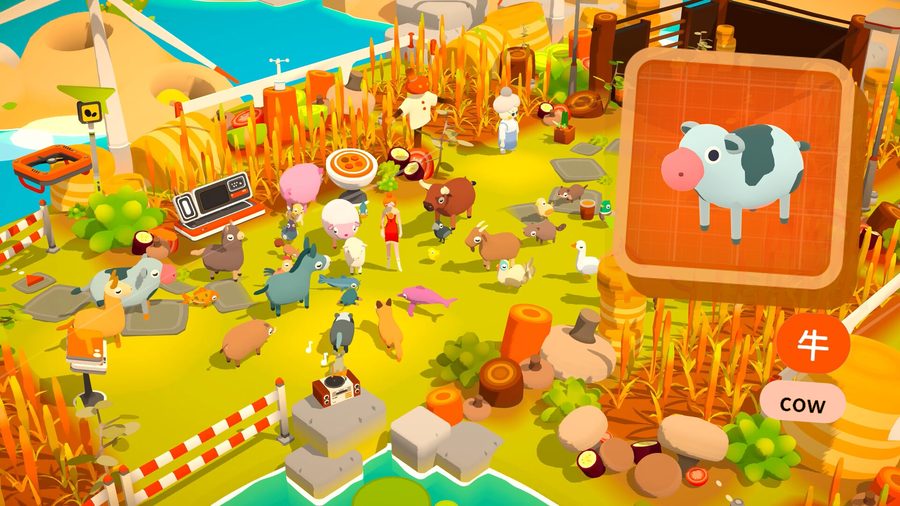
Screenshot from the Noun Town Steam store page, showing a farmyard vocabulary scene
A few games not designed for this age can still work in a restricted form, with an adult actively involved rather than the child playing alone.
Games not on this list, including most titles built for ages seven and up, are usually better saved for a year or two later. A five year old struggling to navigate a menu independently is more likely to get frustrated than to learn from the experience.
Before picking a game, it is worth being clear on how much time is reasonable at this age in the first place. The American Academy of Pediatrics recommends no more than one hour of high quality screen time per day for children aged two to five, ideally with a parent co-viewing or co-playing rather than a child using a screen alone. The World Health Organization gives broadly similar guidance for children under five, alongside recommendations for physical activity and sleep that matter just as much at this age.
Educational content does not exempt a game from these guidelines. A well designed learning game is still screen time, and the research on play-based learning in early childhood generally treats screens as one tool among many rather than a replacement for physical play, reading aloud, and unstructured time.
| Game | Price | Best for |
|---|---|---|
| Prodigy Math Game | Free | Early maths, with an adult reading questions |
| Arthur's Preschool | $9.99 | Structured literacy and numeracy activities |
| Funny Farm Learning Games | $7.99 | Colours, shapes and sizes, farm theme |
| Coloring Book for Kids | Free | Open-ended creative play, no reading needed |
| Minecraft (creative mode) | Varies | Spatial and planning skills, adult alongside |
| Noun Town | $19.99 | Early exposure to a second language, older end of 5 to 6 |
Curious whether Noun Town is a fit for your family? Try the free demo first.
Try Noun Town on SteamProdigy Math Game (free, browser based, ages 6 to 14 curriculum but usable with a parent reading), Arthur's Preschool, Funny Farm Learning Games for Toddlers and Kids, and Coloring Book for Kids are among the few titles genuinely built for this age band on PC. Most games marketed as educational assume a child who can read and use a mouse independently, which usually means age 7 and up.
Not necessarily, but the field genuinely narrows at this age. A five year old can manage simple point-and-click games and browser tools with an adult nearby, but most PC titles marketed as educational are designed for readers who can navigate menus independently, which usually means seven and up.
It can work with support. Prodigy covers grades 1 through 8, so a five year old will need an adult reading questions aloud, but the free, curriculum-aligned maths content and RPG framing make it one of the more workable options at this age, and it needs no download since it runs in a browser.
The American Academy of Pediatrics recommends no more than one hour of high quality screen time per day for children aged 2 to 5, ideally with a parent co-viewing or co-playing. The World Health Organization gives similar guidance for children under 5.
Yes. Prodigy Math Game is free with no expiring trial, and Coloring Book for Kids is free to play on Steam. Both work reasonably well for this age with a bit of adult involvement.
Simple navigation that does not require reading, short activities rather than long levels, no in-app purchases or ads aimed at children, and content that holds up to repetition, since young children often want to replay the same activity many times.
Yes, in creative mode with a parent nearby. Regular Minecraft played in creative mode, without survival mechanics or online multiplayer, is a reasonable way to build early spatial and planning skills, though it is not purpose built for this age the way a true early years title is.
Officially Noun Town is designed from age 7 upward, but some five and six year olds manage the exploration and word-to-object matching with light adult support in the room, since it does not require reading English text to progress. It is worth trying the free Steam demo first to see how your child responds.
Steam's audience skews toward older children and adults, and most publishers building for very young children focus on tablets and phones instead, where touch input is easier for small hands than a mouse and keyboard. This leaves PC as a genuinely underserved platform for this specific age group.
Research on play-based learning generally supports it for early childhood, particularly for early numeracy and vocabulary, though outcomes depend heavily on content quality and adult involvement rather than the format alone. A game is a supplement to, not a replacement for, reading and play with a caregiver.