Ten to twelve is the age where "educational" games either click or get abandoned within a week. By this age, most kids read fluently, handle a mouse and keyboard on their own, and can sit with a difficult problem for more than a few minutes, which means the simplified games that worked at six or seven now feel slow and a little obvious. What actually holds a preteen's attention is real complexity: physics that behaves like real physics, logic puzzles with genuine wrong answers, systems with enough depth to reward experimentation. Seven PC games clear that bar well, and none of them talk down to the player.
Short answer: Kerbal Space Program ($39.99), Human Resource Machine ($14.99), Poly Bridge 2 ($14.99), Cities: Skylines ($29.99), while True: learn() ($12.99), Universe Sandbox ($29.99), and Noun Town ($19.99) are the strongest educational PC picks for 10 to 12 year olds, all built around real systems rather than a simplified version of a subject.
A 6 to 8 year old still benefits from short activities, simple menus, and text that does not demand much independent reading. By 10 to 12, that constraint has mostly disappeared. Most kids this age can read a wall of instructions without help, remember rules across a long play session, and come back to a half finished puzzle the next day without losing their place. The thing standing between a preteen and an educational game is no longer literacy. It is whether the game is actually interesting.
That shift changes what "good" looks like. A game that constantly praises small actions, uses a cartoon mascot to explain every step, or resets difficulty the moment a player struggles tends to get rolled eyes rather than engagement at this age. Kids old enough to notice when a game is being gentle with them usually do not want it to be.
Cognitive development backs this up. Piaget's classic account of the concrete operational stage, which runs roughly from age 7 to 11, describes children gaining the ability to reason logically about real systems, hold several variables in mind at once, and reverse a line of thinking to check it. A ten to twelve year old sits right at the edge of that stage, which is exactly why games built around genuine cause and effect, a rocket that explodes for a specific reason, a bridge that fails under a specific load, land so much better than a simplified stand in.
Kerbal Space Program drops players into a genuine orbital mechanics sandbox, where building and flying a rocket means grappling with thrust, staging, and gravity instead of following a script. Failure is loud and constant at first: rockets tip over, engines run dry mid launch, landings go sideways. That is exactly what makes it land with this age. A kid who sticks with it is learning real physics concepts through repeated experiment, not being told about them in a diagram.
Human Resource Machine teaches the actual building blocks of programming, sequencing, loops, and conditionals, by having players drag simple commands together to solve office themed puzzles. Where a younger child might need help working out what a loop even does, most ten to twelve year olds can figure it out from the puzzle itself and carry that understanding into the next, harder one. It rewards logical thinking without ever using the word "algorithm."
The sequel keeps what made the original work for younger kids and raises the ceiling considerably: heavier vehicles, trickier terrain, and a hydraulics system that adds a genuine engineering variable to solve for. A bridge that looks solid on paper can still collapse the moment a truck rolls across it, and working out why is the entire point. This suits an age group that wants a real puzzle, not a foregone conclusion dressed up as one.
Cities: Skylines hands a player an entire city budget, road network, and set of public services to manage, then lets the consequences of bad decisions show up honestly: traffic jams, unhappy residents, a budget that will not balance. It is closer to a systems thinking exercise than a typical game, and preteens who enjoy planning and problem solving tend to lose hours in it without it ever feeling like homework.
This one turns basic machine learning ideas, sorting data, spotting patterns, chaining together simple decision blocks, into visual puzzle logic rather than lines of code. It plays more like a puzzle game than a coding course, which keeps it approachable, but the underlying concepts are the same ones used in real data science. It suits a kid who has already worked through simpler logic games and wants the next step up.
Universe Sandbox is a physics simulator built around gravity, orbits, and planetary collisions, letting players drop moons into orbit, smash planets together, or just watch a solar system evolve over millions of simulated years. There is no fail state and no fixed objective, which makes it a good match for a preteen who wants to explore a system on their own terms rather than follow a set of levels.
Noun Town is built for players from age 7 upward, and by 10 to 12 most kids are confident enough readers to get real value from its 3D open world, native speaker audio, and spaced repetition review system across 12 languages. Unlike a phone app, there are no ads and nothing locked behind a subscription once it is bought, and a free demo on Steam makes it easy to try before deciding whether it fits.
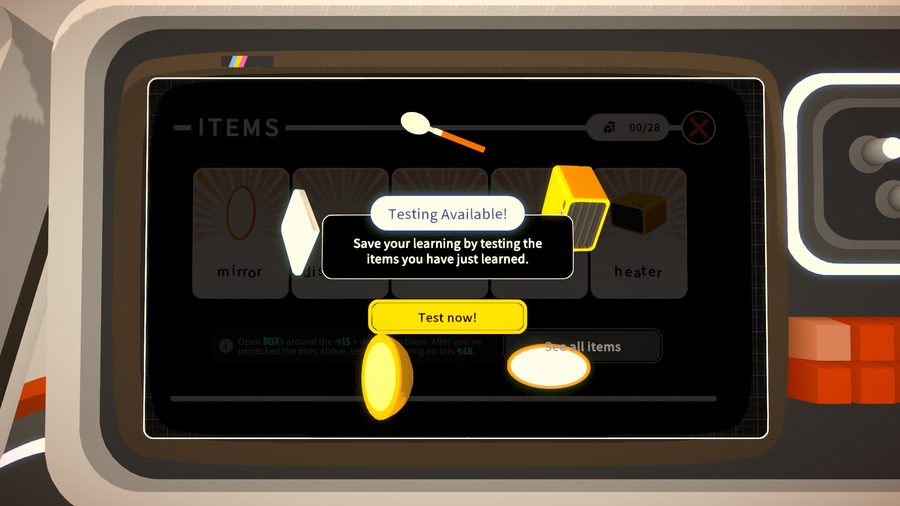
Screenshot from the Noun Town Steam store page, showing the prompt that invites a player to test what they just learned
None of these seven games soften their own rules to make a child feel better. A rocket in Kerbal Space Program explodes for a reason a player can trace and fix. A bridge in Poly Bridge 2 fails under a load a player miscalculated. Cities: Skylines will let a budget run into the red with no warning popup stepping in to stop it. That honesty is the whole appeal at this age, and it is a large part of why simplified, heavily gamified apps aimed at younger children tend to lose a preteen's interest fast.
The American Academy of Pediatrics' current guidance leans in a similar direction, focusing less on a strict hourly cap for this age and more on the quality of what a child is engaging with and whether a parent stays involved in the conversation about it. A genuinely challenging game that a kid wants to talk through afterward fits that guidance a lot better than a shallow one that gets abandoned in a week.
There is also a real cognitive angle here, not just a marketing one. A study using a 3D video game to assess executive function in children and adolescents found that game based tasks can meaningfully engage planning, working memory, and inhibitory control, the same mental skills a real puzzle or simulation asks a player to use over and over. A game that is too easy simply does not exercise those skills as hard.
It is easy to underestimate a ten to twelve year old's capacity for genuine complexity, especially if the comparison point is a six year old rather than an adult. According to a clinical overview of childhood cognitive development, by this age most children can hold multiple variables in mind simultaneously, reason about cause and effect across several steps, and revise a plan after it fails, all skills that a simplified educational app rarely asks them to use.
That is a large part of why a game like Human Resource Machine or while True: learn() can teach real programming logic to an eleven year old without a single line of code ever appearing on screen. The underlying reasoning, break a big problem into smaller steps, test one change at a time, notice a pattern, is squarely within reach. What changes at this age is not the ceiling on what a child can understand. It is how much patience they have for a game that treats them like they cannot.
This is also where a lot of parents overcorrect in the other direction, assuming a preteen wants something that looks like a school subject rather than a game. In practice, the titles that succeed here rarely brand themselves as educational at all. Kerbal Space Program and Cities: Skylines are sold as simulation games first. The learning is real, but it is a side effect of the mechanics rather than the pitch.
Building a rotation across a few of these, rather than picking just one, tends to work best. A physics sandbox, a logic puzzle, and something with a language or vocabulary angle like Noun Town cover meaningfully different ground, and preteens are just as likely to burn out on a single genre as younger kids are.
See whether Noun Town fits your family with the free Steam demo.
Try Noun Town on SteamKerbal Space Program ($39.99), Human Resource Machine ($14.99), Poly Bridge 2 ($14.99), Cities: Skylines ($29.99), while True: learn() ($12.99), Universe Sandbox ($29.99), and Noun Town ($19.99) all give kids this age genuine complexity to work through instead of a simplified, watered down version of a subject.
Most educational games are designed around early readers and short attention spans, so they lean on bright colours, constant praise, and very short tasks. Kids this age have moved past that. They can handle multi step problems, real failure, and a game that does not pause to congratulate them every thirty seconds.
It has a real learning curve, and a first launch usually ends in an explosion, but that is part of the appeal for this age group. Kids who stick with it are learning actual orbital mechanics through trial and error, not a simplified cartoon version of how rockets work.
In practice, it means real rules that do not bend to make a child feel better, systems complex enough to reward experimentation, and no forced tutorial that assumes the player cannot figure anything out alone. Games like Human Resource Machine and Poly Bridge 2 let a wrong answer just be wrong, then let the player try again.
The American Academy of Pediatrics recommends consistent, agreed limits on entertainment screen time rather than a fixed number of hours at this age, with sleep, schoolwork, physical activity, and in person time protected first. Quality of content matters as much as the total time spent.
Yes. Noun Town is built for players from age 7 upward, and by 10 to 12 most children are reading confidently enough to get the most out of its vocabulary rich 3D world, spaced repetition reviews, and speech recognition practice, without needing an adult nearby.
None of the seven are free outright, though Noun Town offers a free demo on Steam so a family can try it before buying. Genuinely well made educational games at this age tend to be paid titles rather than free to play, since free models usually rely on ads or purchases that undercut the learning experience.
Research on game based learning generally finds real benefit for children this age, particularly for logical reasoning, spatial thinking, and working memory, though results depend heavily on how well a game is designed and how engaged a child actually is with it.
Reading is no longer a limiting factor, so games can introduce real systems such as orbital physics, programming logic, or city budgets that would overwhelm a younger child. The main risk shifts from choosing something too advanced to choosing something that feels babyish and gets ignored.
Most kids this age genuinely prefer figuring a game out themselves, and that independence is part of what makes titles like these valuable. It is still worth checking in occasionally, both to see what they are learning and because some of these games, Cities: Skylines especially, are more fun to talk through together.