
Photo: Beyond My Ken / Wikimedia Commons (CC BY-SA 4.0)
French is one of the fastest languages for English speakers to pick up, largely because the two languages share a huge amount of vocabulary through Norman French and Latin roots. The US Foreign Service Institute classifies French as a Category I language, estimating 600 to 750 class hours, roughly 24 to 30 weeks of full-time study, to reach professional working proficiency. Casual learners studying an hour a day get there more slowly, usually within a year and a half to two years for solid conversational ability. How fast you actually progress depends heavily on your study method and how consistently you practise.
Short answer: French is an FSI Category I language, the easiest group for English speakers. Reaching conversational fluency (CEFR B1) takes about 350 to 400 study hours; professional proficiency (B2/C1) takes 600 to 750 hours, roughly 24 to 30 weeks of full-time classroom study. At thirty minutes a day, expect around a year and a half to two years to reach a comfortable conversational level.
The Common European Framework of Reference for Languages (CEFR) is the standard scale used across Europe to describe language ability, from A1 at the beginner end to C2 at native-like mastery. Cambridge English publishes general guided learning hour benchmarks for each level, based on classroom study with a teacher:
| CEFR level | Hours needed (from zero) | What you can do |
|---|---|---|
| A1 | 60 to 80 hours | Handle basic greetings, order food, introduce yourself |
| A2 | 180 to 200 hours | Simple everyday conversations, basic past and future tense |
| B1 | 350 to 400 hours | Comfortable conversational fluency, most travel and social situations |
| B2 | 500 to 600 hours | Follow native-speed conversation, discuss opinions and abstract topics |
| C1 | 700 to 800 hours | Near-fluent, matches FSI's professional working proficiency |
| C2 | 1,000 to 1,200 hours | Native-like mastery |
Those hour ranges are general CEFR benchmarks that apply across languages, not specific to French. What makes French notable is where the FSI's French-specific figure lands within them: 600 to 750 hours to reach S3/R3 proficiency, the FSI's own scale, sits right around the upper end of B2 and into C1. That's a strong confirmation of French's Category I status, since several other languages need two, three or even four times as many hours to reach the same point.
It's worth being clear about what "hours" means here. These are guided, focused study hours, not passive exposure like having French radio on in the background. Self-study or full immersion changes the multiplier considerably, usually for the better, which is what the next section covers.
The same total hours can be spread across very different calendar timelines depending on how you study. Here's roughly how four common approaches compare for reaching B1, a comfortable conversational level:
| Study method | Typical pace | Time to reach B1 |
|---|---|---|
| Full immersion (living in France) | 35+ hours a week | 10 to 14 weeks |
| Intensive classroom (FSI-style) | 25 hours a week | 14 to 16 weeks |
| Weekly evening class | 2 to 3 hours a week | 2 to 3 years |
| Self-paced app or game | 30 to 60 minutes a day | 1.5 to 2 years |
Immersion wins on raw speed, but it isn't a realistic option for most people with a job, school or family to work around. Official bodies like the Alliance Française run structured in-person courses worldwide for learners who want classroom immersion without relocating to France. Intensive classroom study gets close to immersion speed but requires the kind of schedule freedom that mainly applies to diplomats and full-time students, which is exactly who the FSI trains.
For everyone else, the honest comparison is between a weekly class and self-paced daily study, and self-paced daily practice usually wins on total time even though each individual session is shorter. Consistency beats intensity for almost everyone outside of a full-time program, mostly because spaced repetition and frequent small reviews build stronger long-term memory than cramming does.
English and French share an unusually deep well of vocabulary, a legacy of the Norman conquest of England in 1066, after which French was the language of the English court and legal system for roughly three centuries. Linguists estimate that close to a third of English vocabulary traces back to French or the Latin it shares with French, which means English speakers arrive at French with a head start most other learners don't get.
Words like "hotel," "restaurant," "menu," "important" and "possible" barely change between the two languages, and hundreds more follow recognisable patterns once you notice them. That's a genuine shortcut, not a coincidence, and it's a large part of why French sits in the same easiest category as Spanish and Italian rather than alongside languages with no shared vocabulary at all.
French also uses the same Latin alphabet and, for the most part, the same subject-verb-object sentence order as English. Learners aren't decoding an unfamiliar writing system or rebuilding their sense of how a sentence is structured from scratch, which is a real barrier for learners tackling, say, Japanese or Arabic.
French's advantages don't mean it's without genuine difficulty. A handful of specific features consistently trip learners up, and they're worth naming directly rather than glossing over, since knowing what's coming makes them easier to work through. We've covered the specific hard parts of French in more depth in our companion piece on whether French is hard to learn, but the short version is below.
Listening comprehension tends to be the single biggest complaint from intermediate learners, more than grammar or vocabulary. Spoken French genuinely sounds different from what the spelling suggests, and that gap between page and speech is exactly what makes native-speaker audio so important early on, rather than saving listening practice for later.
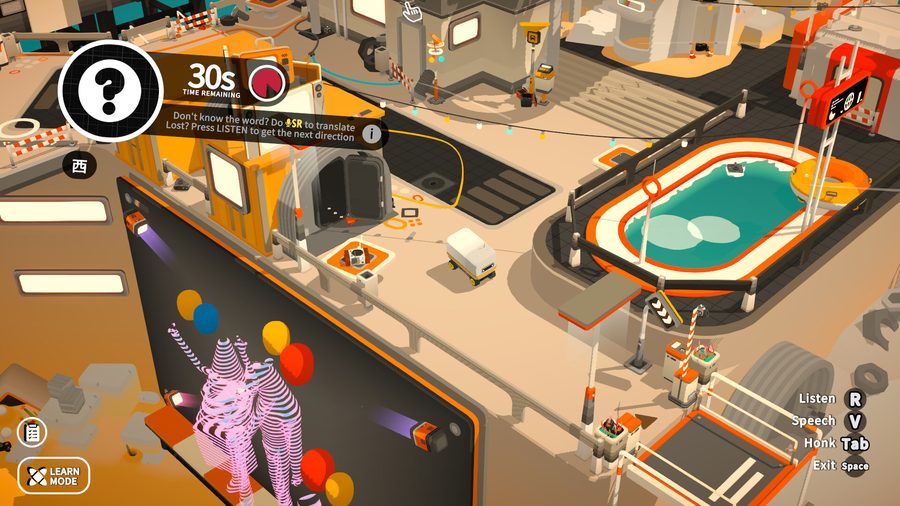
Screenshot from the Noun Town Steam store page, showing a timed recall challenge
Most people don't fail to learn French because the language is too hard. They fail because their study plan doesn't survive contact with a busy week. A realistic plan matters more than an ambitious one:
Games built specifically around high-frequency, context-based vocabulary follow this same logic. Our language learning game pairs French nouns with native speaker audio inside a 3D world you actually explore, then brings words back for review on a spaced schedule rather than leaving retention to chance.
People use "fluent" loosely, and it's worth being precise, because the target changes the timeline a lot. Conversational fluency, being able to hold a natural conversation about everyday topics without constantly reaching for a dictionary, is a B1 to B2 goal and realistically achievable within a year or two of consistent study.
Professional fluency, the kind needed to work or study in French, sits closer to C1, which is where the FSI's 600 to 750 hour figure points. Native-like mastery, C2, is a genuinely different and much longer project, and honestly isn't a goal most learners actually need to hit.
Setting your target level before you start studying makes a real difference to motivation, since "fluent" without a definition is a moving goalpost that's easy to feel like you're failing to reach. A defined, achievable target, reviewed against real hour benchmarks, tends to keep people studying long enough to actually get there.
Ready to start building your French vocabulary the vocabulary-first way?
Try Noun Town on SteamIt depends on your goal. Reaching a comfortable conversational level (CEFR B1) takes roughly 350 to 400 guided study hours. A basic beginner level (A2), enough for simple everyday exchanges, takes around 180 to 200 hours.
Both are rated Category I by the US Foreign Service Institute, meaning both take roughly 600 to 750 class hours for an English speaker to reach professional proficiency. Spanish spelling maps more predictably onto pronunciation, while French pronunciation, with its nasal vowels and silent letters, tends to take longer to get comfortable with.
You can reach a basic A2 level in around three months with intensive study, roughly 25 to 35 hours a week, similar to a full-time immersion course. Genuine conversational fluency in three months is unrealistic for most learners studying part time.
Thirty to sixty minutes of consistent daily study tends to produce better long-term results than occasional long sessions, since spaced repetition and regular exposure matter more for retention than total hours in any single week.
French is one of the easier languages for English speakers overall, thanks to a huge amount of shared vocabulary. The genuinely hard parts are grammatical gender, verb conjugation across many tenses, and listening comprehension, since spoken French sounds quite different from its spelling.
No. Many learners build useful conversational ability by absorbing vocabulary and common phrases in context first, then layering formal grammar on top once they already have an intuitive feel for how sentences are put together.
Starting with high-frequency nouns and everyday objects, paired with native speaker audio and reviewed on a spaced repetition schedule, tends to produce faster, more durable results than memorising alphabetical word lists.
Using Cambridge English's general CEFR benchmarks, C1 (advanced) typically requires around 700 to 800 guided learning hours from zero, which lines up closely with the FSI's French-specific estimate of 600 to 750 hours for professional working proficiency.
Full immersion, living somewhere French is spoken daily, is the fastest route by total calendar time, often reaching B1 in ten to fourteen weeks. It isn't realistic for most people, though, which is why consistent daily practice with a structured tool is the more achievable middle ground for most learners.