Photo: Fred Romero / Wikimedia Commons (CC BY 2.0)
French sits in FSI Category I, the easiest tier for native English speakers, alongside Spanish, Italian and Portuguese. The US Foreign Service Institute lists French specifically at 30 weeks, around 690 class hours, to reach professional working proficiency. Part of that head start comes free: English borrowed an enormous share of its vocabulary from French after the Norman Conquest, so thousands of French words are already sitting in an English speaker's head without them realising it. What actually slows learners down is not vocabulary. It is the gap between how French is spelled and how it is spoken out loud.
Short answer: French is not hard for English speakers by international standards. FSI puts it at Category I, 30 weeks or about 690 class hours to professional fluency, similar to Spanish and only slightly behind Italian's 24 weeks. English shares thousands of cognates with French from the Norman Conquest, but French pronunciation, silent letters, liaison and nasal vowels are unlike anything in English and take real, dedicated listening practice.
The Foreign Service Institute trains US diplomats and has tracked, for over seven decades, how long it genuinely takes an English speaking adult to reach professional working proficiency in different languages. Its category system, from Category I (easiest) through Category IV (hardest), is one of the most cited difficulty benchmarks in language learning because it comes from real classroom outcomes, not guesswork.
French shares Category I with Danish, Dutch, Italian, Norwegian, Portuguese, Romanian, Spanish and Swedish, the languages FSI describes as "close to English." Within that group there is still some spread. FSI lists French and Spanish at 30 weeks each, while Italian, Portuguese, Dutch, Danish, Norwegian, Romanian and Swedish sit at the faster end, 24 weeks. At roughly 23 hours a week in class, that works out to 690 class hours for French against 552 for the quickest Category I languages, a real but modest gap.
That extra stretch for French mostly traces back to pronunciation, not grammar or vocabulary. FSI's estimate targets speaking and listening proficiency, and French asks more of a learner's ear than most of its Category I neighbours do.
Did you know: roughly a third of everyday English vocabulary traces back to French, mostly from the three centuries after 1066 when French was the language of the English ruling class. That is a large part of why French vocabulary tends to feel more familiar to English speakers than the vocabulary of almost any other non-Germanic language.
Hour estimates vary depending on what "fluent" means to the person asking, but the ranges below give a realistic picture for a self study or part time learner working steadily toward FSI's 690 hour, professional working proficiency benchmark, using the CEFR framework published by the Council of Europe as the yardstick.
| CEFR level | What it means | Approx. hours from zero |
|---|---|---|
| A1 | Basic phrases, introductions | 70 to 140 |
| A2 | Simple everyday conversation | 140 to 230 |
| B1 | Conversational, can get by unsupported | 280 to 400 |
| B2 | Comfortable in most situations | 400 to 550 |
| C1 | Professional working proficiency | 550 to 690 |
Intensive courses running four to five hours a day can take a motivated learner from A1 to B1 in around five months. Part time learners studying five hours a week should expect that same stretch to take a year or more, since the total number of hours stays roughly the same regardless of how quickly they are spread out.
Spanish and Italian, French's closest Category I neighbours, are both a little gentler on pronunciation. Spanish spelling maps to sound with very few exceptions, and Italian is often held up as the most phonetically consistent major European language, so what you see written is close to what you say out loud in both cases. French breaks that pattern more than either of them, which is the main reason it sits at 30 weeks rather than 24 despite belonging to the same broad family and the same easiest FSI tier.
Against German, the comparison flips clearly in French's favour. German's Category II ranking reflects roughly 750 to 828 class hours, driven by three grammatical genders, four noun cases and verbs that move around the sentence in ways French simply does not ask of a learner. French's vocabulary overlap with English, built up over centuries rather than borrowed more recently the way German's is, also tends to be deeper and more immediately useful in everyday conversation.
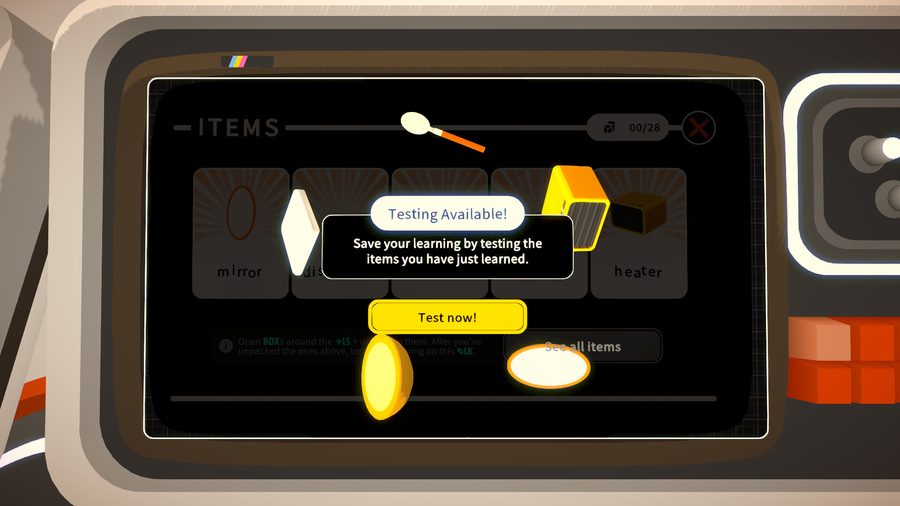
Screenshot from the Noun Town Steam store page, showing the prompt that encourages players to test recently learned words
Most of what makes French feel harder than its FSI ranking suggests comes down to one habit: trusting the spelling more than the sound. Fixing that early removes a large share of the difficulty before it has a chance to compound.
Attach native speaker audio to every new word from the very first lesson, rather than reading French silently and guessing at pronunciation later. Liaison and silent letters are far easier to absorb by ear, through repetition, than they are to memorise as a list of spelling rules. This is the exact approach the Noun Town language learning game takes with French vocabulary: every noun is introduced inside a 3D scene with native audio and spaced repetition, so the sound of a word gets learned at the same time as its meaning, not weeks afterward.
Do not avoid the subjunctive out of nerves. Learning a handful of the common trigger phrases early, il faut que, je veux que, and building from there, prevents the mood from turning into a wall later on, when far more of the language depends on getting it right.
Finally, treat tu and vous as a habit to build rather than a rule to memorise. Listening to how native speakers actually switch between them in different situations teaches the instinct faster than any grammar explanation can.
Start building French vocabulary the way it actually sounds.
Try Noun Town on SteamBy FSI's own numbers, French takes slightly longer, 30 weeks against Spanish's 30 weeks too, though older FSI editions have listed Spanish nearer 24 weeks. Both sit in Category I and both are genuinely manageable for an English speaker. French pronunciation tends to feel harder early on, since Spanish spelling matches its sound far more consistently.
No. French is FSI Category I at 690 hours, while German is Category II at around 750 to 828 hours. French also skips the grammatical cases and the verb-splitting word order that make German genuinely harder for English speakers to produce correctly.
Because written French and spoken French often look nothing alike. Silent final letters, liaison between words, and nasal vowels with no equivalent in English all mean the spelling gives far fewer clues to pronunciation than most learners expect from a European language.
Conversational ability, roughly CEFR B1, typically takes 280 to 400 hours of study for an English speaker, which is around five to seven months of consistent daily practice, faster with regular listening and speaking immersion.
Not on day one, but don't put it off too long either. The subjunctive shows up constantly in ordinary French conversation after expressions like il faut que and je veux que, so beginners who avoid it entirely tend to hit a wall around the intermediate stage.
Yes, more than almost any other non-Germanic language. After the Norman Conquest of 1066, French was the language of the English court and legal system for roughly three centuries, and English absorbed thousands of French words during that time, from government and justice to beef and cuisine.
Train your ear before you trust your eyes. Because French spelling hides so much of the pronunciation, listening to native audio from the very first vocabulary word, rather than relying on reading alone, prevents habits that are hard to unlearn later.
Yes, particularly because pronunciation needs repetition that reading a textbook cannot give you. Noun Town pairs every French noun with native speaker audio and speech recognition practice inside a 3D scene, so the sound of a word gets learned alongside its spelling rather than after it.
Noun Town focuses on vocabulary, listening and speaking practice through spaced repetition inside a 3D world, rather than replacing a grammar course. Most learners pair it with a structured grammar resource, since a solid vocabulary base makes rules like the subjunctive much easier to absorb later.
For most goals, yes. French is an official language in 29 countries, a working language of the United Nations, the European Union and the International Olympic Committee, and it opens direct access to francophone Africa, Canada and large parts of the diplomatic and NGO world that Spanish does not cover in the same way.