
Photo: Chabe01 / Wikimedia Commons (CC BY 2.0)
Short answer: Beginners build usable French vocabulary fastest by combining a small core of high-frequency words, roughly 500 to 1,000 of them, with spaced repetition and real context rather than isolated word lists. Learn gendered nouns as single chunks (le chat, la table), lean on cognates carefully, and review words right before you'd naturally forget them. Most learners reach a functional beginner vocabulary in two to three months of consistent short sessions.
French has a reputation for being one of the more approachable languages for English speakers to start, and vocabulary is usually where that reputation comes from. Between the shared Latin roots and centuries of borrowed words, a beginner can recognise a surprising number of French words before ever opening a textbook. The catch is that recognising a word and actually remembering it under pressure, mid-conversation, are two very different skills.
This post is about closing that gap. Not grammar, not pronunciation drills, just the specific habits that make French vocabulary stick for people starting from zero.
One of the most common beginner mistakes is working through a dictionary or a random vocabulary app list in whatever order it happens to present words. That approach wastes early effort on words you might use once a year, like "hedgehog" or "windowsill," instead of words you'll use daily.
Frequency-based vocabulary research consistently points to the same pattern: a relatively small set of words, somewhere around the 500 to 1,000 most common, covers the overwhelming majority of everyday conversation. Words like être, avoir, faire, aller, and a core set of nouns for people, places, food and time, do most of the heavy lifting. Get those solid first.
| Category | Examples | Why it matters early |
|---|---|---|
| Core verbs | être, avoir, faire, aller, vouloir | Used in almost every sentence structure |
| People and family | ami, famille, enfant, homme, femme | Comes up in nearly every conversation |
| Everyday objects | maison, voiture, téléphone, livre | Concrete nouns are easiest to learn through images |
| Time and numbers | aujourd'hui, demain, heure, jours | Needed for planning and basic exchanges |
Every French noun has a grammatical gender, masculine or feminine, and this trips up more beginners than almost anything else in early vocabulary building. The mistake is learning the word first and the article second, as if gender is an optional grammar rule bolted on afterward.
It works far better the other way around. Learn "le chat" as one unit, not "chat" plus a rule you apply later. The same goes for "la table," "le pain," "la voiture." Your brain files these more like single vocabulary items than word-plus-tag pairs, and that small shift noticeably reduces gender mistakes down the line. There are some patterns that help too, since words ending in -tion, -sion and -té are almost always feminine, and words ending in -eau or -isme are usually masculine, but treating the article as glued to the noun from day one beats memorising exceptions later.
English absorbed an enormous amount of vocabulary from French, largely following the Norman Conquest of 1066, which is why words like nation, animal, hôtel, and table look and mean almost exactly what an English speaker would guess. This gives English speakers a real head start in French vocabulary that learners of, say, Japanese or Arabic simply don't get.
The catch is false friends, words that look similar but mean something different. Actuellement means "currently," not "actually." Assister means "to attend," not "to assist." A beginner who leans entirely on cognate guessing will occasionally get burned. The fix isn't avoiding cognates, it's spending a moment verifying new-looking words the first few times you encounter them, then trusting the pattern once it's confirmed.
A flashcard with "le pain = bread" on it works, but it's a thin memory. A word encountered inside a sentence, attached to an image, or heard spoken by a native speaker in a specific situation, gets stored with far more surrounding detail. That extra detail is what makes recall easier later, because your brain has more hooks to pull the word back out with.
This is part of why games and immersive tools have become a serious complement to traditional study. In Noun Town, French words are attached to objects and characters inside an explorable 3D world rather than presented as a bare list, and each word comes with native speaker audio and speech recognition so you're producing the sound, not just recognising the spelling. That contextual repetition is closer to how vocabulary gets acquired naturally than a stack of index cards.
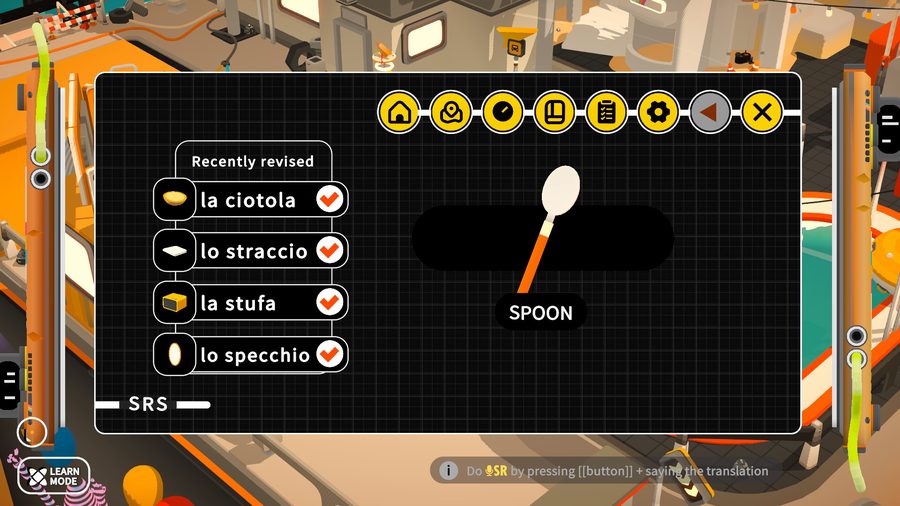
Screenshot from the Noun Town Steam store page
Vocabulary decays fast without review. The classic finding from research into the forgetting curve is that most new information is lost within days unless it's revisited, and each successful review pushes the next necessary review further out. This is the entire logic behind spaced repetition systems, which resurface a word right before you're statistically likely to forget it rather than on a fixed daily schedule.
Ten words reviewed properly across two weeks will almost always beat fifty words seen once and never revisited. If you take one habit from this whole post, make it this: review old words before adding new ones, not after.
With consistent short daily sessions, most beginners reach a functional vocabulary of 500 to 800 words within roughly two to three months. That's enough for basic conversations about everyday topics, though not enough for nuance or fast native speech. The variable that matters most isn't raw study hours, it's consistency. Fifteen minutes a day for two months outperforms three-hour weekend cram sessions almost every time, because spaced repetition needs regular touchpoints to work.
The U.S. Foreign Service Institute classes French among the easier languages for English speakers, and vocabulary is a large part of that. It's still real work, just work that rewards steady habits more than intensity.
Want to see French vocabulary taught this way in practice? There's a free demo on Steam.
Try Noun Town on SteamThe fastest reliable method combines spaced repetition with context. Learning a word alongside an image, a sentence or a spoken example, then reviewing it right before you would naturally forget it, builds retention far quicker than memorising word lists alone.
Around 500 to 1,000 of the most frequent French words cover most everyday conversation. That figure comes up repeatedly in frequency-based vocabulary research, since a small core of common nouns, verbs and connectors does most of the work in casual speech.
Yes, but not in isolation. Learning le or la attached to the noun itself, as a single chunk, is far more effective than memorising the word first and the gender as an afterthought. Treat masculin/féminin as part of the word's spelling, not a separate grammar rule.
Yes, considerably. English borrowed a huge amount of vocabulary from French after the Norman Conquest, so words like nation, table, animal and hôtel are recognisable on sight for English speakers. This head start disappears for false friends like actuellement, so cognates need light verification, not blind trust.
Both have a role, but context tends to win for retention. A word encountered in a sentence, image or interactive scene is stored with more surrounding detail than a bare flashcard, which makes it easier to recall later. Flashcards are still useful for quick review once a word is already somewhat familiar.
With consistent short sessions, most learners reach a functional beginner vocabulary of 500 to 800 words within two to three months. Progress depends heavily on daily exposure rather than total study hours crammed into fewer sessions.
Yes. Games that attach words to objects, characters and native audio inside an explorable world give vocabulary more context than a typical drill screen, and research into digital game-based learning generally shows better retention for words learned this way compared to isolated memorisation.
Trying to learn too many new words at once without reviewing older ones. Vocabulary decays quickly without repetition, so ten words reviewed properly over two weeks will usually outlast fifty words seen once and never revisited.
Yes, French is one of the twelve languages included in Noun Town, taught through a 3D open world with native speaker audio, spaced repetition and speech recognition, playable on PC and Mac via Steam.