
Photo: Dcapillae / Wikimedia Commons (CC BY-SA 4.0)
No, Spanish is not hard to learn for English speakers, at least not compared to most other languages. The US Foreign Service Institute places Spanish in Category I, its easiest ranking, alongside French, Italian, and Portuguese. Reaching professional working proficiency takes an estimated 600 to 750 classroom hours, well under half of what a Category IV language like Japanese or Arabic requires. That does not mean Spanish has no tricky parts, grammatical gender and the subjunctive mood still catch people out, but the overall climb is gentle compared to almost anything outside the Romance language family.
Short answer: Spanish is an FSI Category I language, needing roughly 600 to 750 hours for professional fluency and around 300 to 400 hours for solid conversational ability. It shares thousands of cognates with English and has consistent spelling and pronunciation, which is why it is consistently ranked among the easiest languages for English speakers to pick up.
The Foreign Service Institute trains US diplomats and has spent decades tracking how long it actually takes an English-speaking adult to reach working fluency in different languages. Their four-category system is one of the most cited benchmarks in language learning, precisely because it is based on real classroom outcomes rather than guesswork.
Spanish sits in Category I, the group of languages "closely related to English." The company it keeps tells you most of what you need to know: French, Italian, Portuguese, Dutch, Norwegian, Swedish, Danish, and Romanian. These are all languages with heavy vocabulary overlap with English, largely thanks to shared Latin and Germanic roots.
The FSI's 600 to 750 hour estimate targets what they call Speaking-3/Reading-3 on the Interagency Language Roundtable scale, roughly upper B2 to low C1 on the more familiar CEFR framework published by the Council of Europe. That is professional working proficiency, the level needed to conduct business or represent a government abroad. If your own goal is simpler, holding a conversation on holiday or chatting with in-laws, you are looking at closer to half those hours.
Three things do most of the work. First, cognates. English absorbed an enormous amount of vocabulary from Latin via French during and after the Norman Conquest, and Spanish inherited that same Latin base directly. The result is thousands of word pairs that look and mean almost the same thing: nacion and nation, informacion and information, importante and important. Recognising even a fraction of these on sight gives new learners a working vocabulary long before they have studied a single grammar rule.
Second, spelling matches sound. Spanish is what linguists call a shallow orthography, meaning that once you learn the rules, you can read almost any word aloud correctly, and spell almost any word you hear. English, by painful contrast, is full of exceptions. This single feature removes an entire category of struggle that English speakers take for granted as normal.
Third, verb conjugation is regular. Spanish verbs fall into three neat families based on their ending, -ar, -er, and -ir, and the vast majority follow the same pattern within their family. Learn the pattern once and you can conjugate hundreds of verbs correctly. English verbs, by comparison, are riddled with irregular forms that simply have to be memorised one at a time.
Cognate vocabulary, consistent spelling and pronunciation, regular verb patterns, straightforward word order in simple sentences, widely available native-speaker media and tutors.
Grammatical gender for every noun, the subjunctive mood, the ser versus estar distinction, the difference between preterite and imperfect past tenses, and regional vocabulary and accent variation.
None of this makes Spanish trivial. A handful of features consistently trip up English speakers, and it is worth knowing about them going in rather than being surprised.
Numbers help more than adjectives here. Based on the FSI's classroom data and how that scales down to self-paced, part-time study, here is roughly what to expect at each level.
| Goal | Approx. CEFR level | Estimated hours |
|---|---|---|
| Basic travel phrases | A1 | 60 to 100 hours |
| Simple everyday conversation | A2 to B1 | 250 to 350 hours |
| Comfortable conversational fluency | B1 to B2 | 350 to 500 hours |
| Professional working proficiency | B2 to C1 | 600 to 750 hours |
Translated into a study schedule, an hour a day of consistent, focused practice puts comfortable conversational fluency around the one-year mark for most learners. Professional proficiency, the FSI's own benchmark, realistically takes closer to two years at that same pace, or under a year if you can manage close to two hours a day, which is roughly what full-time diplomatic language training looks like.
These numbers assume active, spaced practice rather than passive exposure. Vocabulary that is reviewed at increasing intervals, right before you would otherwise forget it, sticks dramatically better than vocabulary crammed once and never revisited. This is the whole idea behind spaced repetition systems, and it is the core mechanic behind how Noun Town teaches Spanish vocabulary inside its 3D game world, pairing each new word with native speaker audio and bringing it back for review right as it is about to fade.
People rarely pick a language in a vacuum, so it helps to see Spanish next to the other options most English speakers weigh it against.
Spanish vs French. Both are FSI Category I languages with an identical official hour estimate. In practice, most English speakers find Spanish the friendlier starting point because its spelling maps so directly to pronunciation. French carries more silent letters, nasal vowels, and liaison rules that take longer to internalise, even though the underlying grammar is comparably regular.
Spanish vs Italian. Also Category I, also similar in difficulty on paper. Italian arguably has slightly gentler pronunciation than Spanish for absolute beginners, but Spanish wins decisively on sheer volume of learning resources, native content, and people to practise with, given its much larger global speaker base.
Spanish vs German. German sits in Category II, a step up in official difficulty, mainly due to its case system and more flexible word order. If raw learning speed is the deciding factor, Spanish is the faster route to fluency for almost every English speaker.
The FSI hour estimates assume structured, focused study, not just time spent "around" the language. A few approaches consistently speed things up:
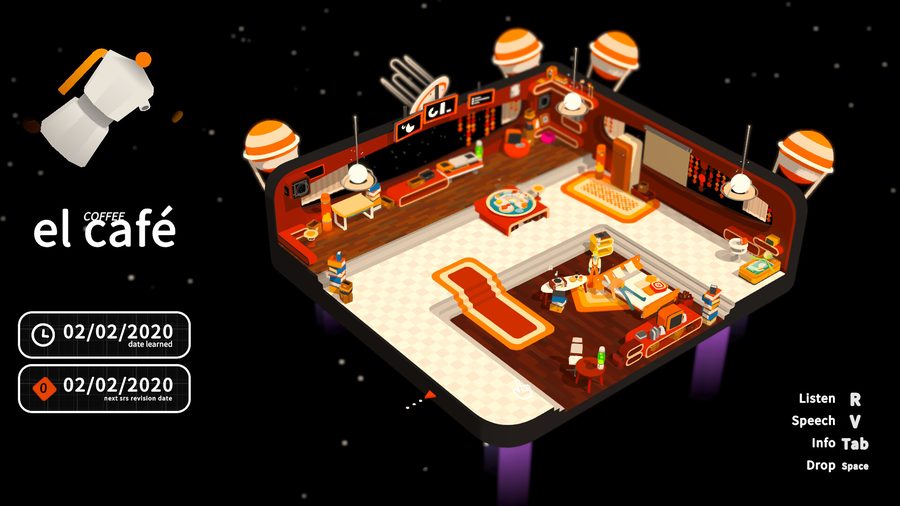
Screenshot from the Noun Town Steam store page, showing a Spanish vocabulary scene with spaced repetition review scheduling
By the numbers, yes. According to the Instituto Cervantes' 2025 report, Spanish now has around 500 million native speakers and more than 600 million speakers in total, making it the second most spoken native language on Earth after Mandarin Chinese. It is an official language in twenty countries, the majority language across almost all of Latin America, and one of the most requested second languages in schools and workplaces throughout the English-speaking world.
Combine that reach with its Category I difficulty rating and Spanish is arguably the best return on invested study time of any language available to an English speaker: broad usefulness, deep media and travel access, and a genuinely manageable learning curve.
Want to build Spanish vocabulary the way it sticks, in context, with native audio and spaced repetition built in?
Try Noun Town on SteamNo, not compared to most other languages. The US Foreign Service Institute rates Spanish as a Category I language, its easiest tier, requiring roughly 600 to 750 class hours to reach professional working proficiency.
The FSI estimate is 600 to 750 classroom hours for professional working proficiency (around B2/C1). Conversational fluency, roughly B1, typically takes about half that, somewhere between 300 and 400 hours of consistent study.
Most English speakers struggle with the subjunctive mood, the ser versus estar distinction for the verb "to be," and remembering grammatical gender for nouns. Pronunciation and basic word order tend to come easily by comparison.
Both are FSI Category I languages with the same official hour estimate. In practice, most English speakers find Spanish pronunciation more predictable than French, since Spanish is spelled almost exactly as it sounds, while French has more silent letters and nasal vowels to learn.
It is possible to reach conversational fluency in a year with regular daily practice, around an hour a day, but reaching the FSI's professional working proficiency in twelve months would require close to two hours of study every single day without breaks.
English and Spanish share thousands of cognates, words that look and mean almost the same thing, because both languages borrowed heavily from Latin. Words like nacion/nation, informacion/information, and posible/possible give English speakers a large head start on vocabulary.
Not simpler overall, but more regular. Spanish verb conjugations follow consistent patterns with far fewer irregular forms than English, once you memorise the pattern for -ar, -er, and -ir verbs, most new verbs slot straight in.
No. Spain and Latin America use the same core grammar and around 90 percent shared vocabulary. Differences are mostly accent, a handful of everyday words, and the use of vosotros in Spain versus ustedes across most of Latin America.
Start with high-frequency nouns and everyday objects rather than isolated grammar rules. Learning words in context, ideally with native audio and spaced repetition, builds a usable vocabulary faster than memorising conjugation tables first.
Spanish has around 500 million native speakers and over 600 million total speakers worldwide, making it the second most spoken native language on Earth after Mandarin. It is also the fastest route to a usable second language for most English speakers, given its FSI Category I ranking.