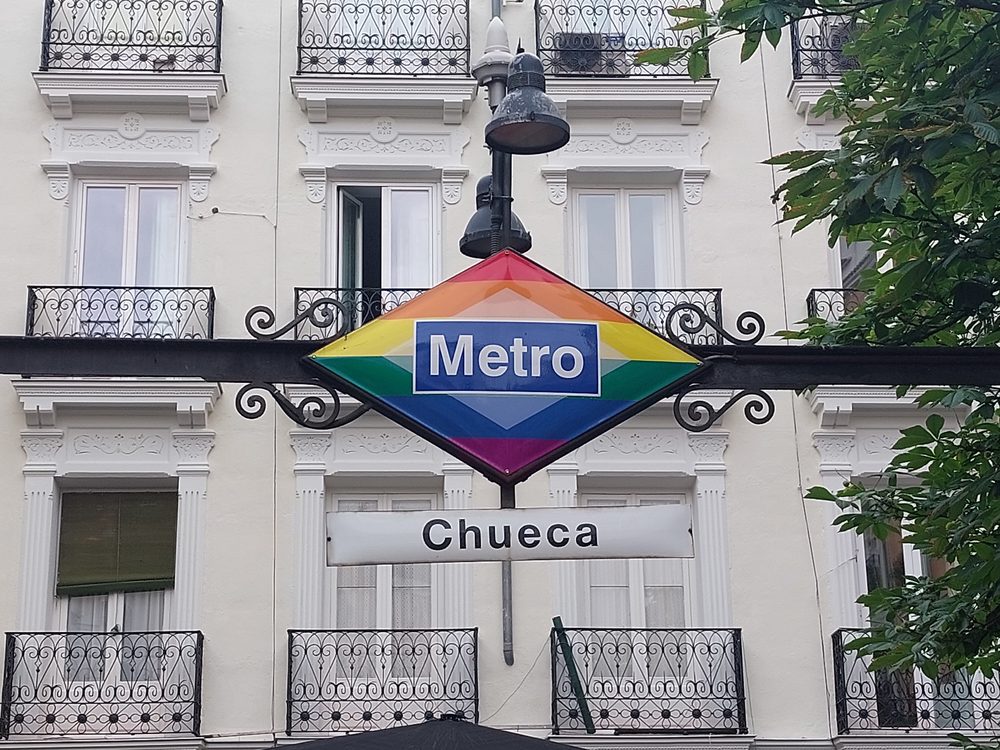
Photo: Szombat78 / Wikimedia Commons (CC0)
Learning Spanish takes around 600 to 750 hours to reach professional working proficiency, according to the US Foreign Service Institute, which trains American diplomats and has tracked outcomes across decades of classroom instruction. At one hour of study a day, that works out to roughly two years. At two hours a day, closer to one. Most people are not actually chasing professional proficiency though, and a conversational level takes considerably less time, somewhere around 300 to 400 hours. The number that matters most is not the total but how it breaks down against your own schedule, so that is where this article spends most of its time.
Short answer: 600 to 750 hours for professional proficiency (FSI estimate), or around 300 to 400 hours for solid conversational fluency. At 30 minutes a day, expect three to four years for full proficiency. At one hour a day, about two years. At two hours a day, roughly one year.
Total hours only tell part of the story, because "learning Spanish" means different things to different people. Someone heading on holiday needs far less than someone preparing to work in Spanish professionally. The table below breaks the journey into stages, using the CEFR framework published by the Council of Europe, which is the standard scale used across most language courses and certification exams worldwide.
| Level | What you can do | Hours needed |
|---|---|---|
| A1 | Greetings, basic questions, ordering food, simple directions | 60 to 100 hours |
| A2 | Everyday topics, travel situations, short exchanges with native speakers | 150 to 200 hours |
| B1 | Real conversations on familiar topics, understand most everyday written Spanish | 300 to 350 hours |
| B2 | Fluent conversation, follow films and podcasts, discuss opinions and abstract topics | 450 to 600 hours |
| C1 | Professional fluency, near-complete comprehension, nuanced writing and speech | 600 to 750 hours |
These figures assume active, engaged study rather than time spent loosely around the language. An hour spent half-watching a Spanish show while checking your phone does not count the same as an hour of focused vocabulary and conversation practice. The table above reflects someone actually working, not someone logging hours.
Framing the total in daily terms makes it far easier to plan around. Here is roughly what four common study paces produce over a year of consistent practice, assuming no long breaks.
| Daily study time | Hours per year | Roughly where you land after 12 months |
|---|---|---|
| 15 to 20 minutes | 90 to 120 | Late A2, comfortable with simple exchanges |
| 30 minutes | ~180 | Early to mid B1 |
| 1 hour | ~365 | Solid B1, edging into B2 |
| 2 hours | ~730 | Strong B2, close to C1 |
The jump between 30 minutes and one hour a day matters more than it looks on paper. Doubling the time roughly doubles the yearly hour total, but the compounding effect of more frequent exposure to vocabulary, grammar, and listening practice tends to push learners further than a simple linear scaling would suggest. Consistency inside that daily block matters just as much as the total, a point worth returning to later in this article.
Three to four hours a day, the kind of intensity used at residential language immersion schools, can produce strong conversational ability in six to nine months. That pace is not realistic for most people holding down a job or attending school, but it is worth knowing the ceiling exists if a short, intensive burst is ever an option, such as during a study abroad placement or an extended trip.
Spanish sits in FSI Category I, the easiest tier for English speakers, alongside French, Italian, and Portuguese. Three factors explain most of the speed advantage. English and Spanish share thousands of Latin-root cognates, words like nacion and nation or importante and important, that give new learners a working vocabulary before they open a textbook. Spanish spelling is also close to phonetic, meaning once you learn the sound rules, you can read almost any word correctly on sight, unlike English with its long list of exceptions. Verb conjugation, while it takes real practice, follows consistent patterns across three verb families, so learning the pattern once unlocks hundreds of verbs at a time.
None of this makes Spanish effortless. Grammatical gender, the subjunctive mood, and the split between preterite and imperfect past tenses are genuinely new concepts for most English speakers and take real repetition to internalise. But compared to a Category IV language like Japanese, Arabic, or Mandarin, which the FSI estimates at 2,200 hours or more, Spanish is a considerably shorter road.
Most learners who take far longer than the FSI estimate are not lacking aptitude, they are studying in ways that waste time without realising it. Three patterns show up again and again.
Fixing these three habits alone tends to close much of the gap between someone who reaches B1 in eight months and someone who is still there after three years of on-and-off effort.
There is broad agreement among language teachers and researchers that vocabulary, not grammar, is the real bottleneck in the early stages. Once a learner knows enough words, grammar starts making sense from context, and conversation becomes possible even with imperfect sentence structure. Frequency research suggests the 1,000 most common words in Spanish account for roughly 85% of everyday spoken usage, which is why building that core vocabulary should be the priority for the first several hundred hours, well before grammar tables and verb charts take over.
How the vocabulary is learned matters too. Words studied as isolated translation pairs on a flashcard tend to fade faster than words encountered in a real, memorable context. This is the whole premise behind the Noun Town language learning game, which teaches Spanish vocabulary inside a 3D world where each new word is tied to a visual scene and native speaker audio rather than a bare translation. That contextual, spaced-repetition approach is designed specifically to reduce the number of hours it takes for new words to stick in long-term memory.
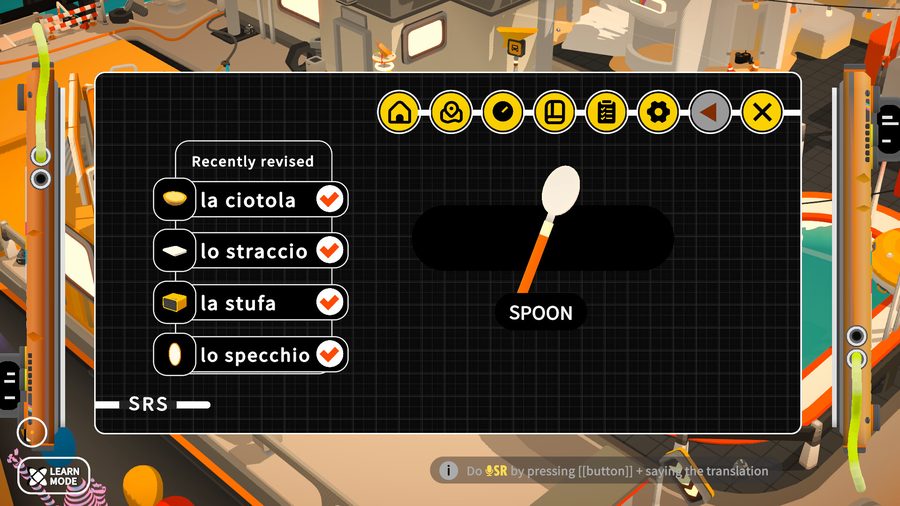
Screenshot from the Noun Town Steam store page, showing the spaced repetition review screen
The honest answer to "how long does it take to learn Spanish?" depends on three things you control directly: your daily minutes, your consistency, and whether your study methods are actually effective rather than just familiar. The FSI's 600 to 750 hour figure is a useful reference point, not a fixed rule. Some learners reach B2 in well under 500 hours because they studied efficiently from day one. Others put in 800 hours and are still at B1 because most of that time went to passive exposure or grammar drilling disconnected from real vocabulary.
A workable plan for most people: pick a daily minimum you can sustain even on a bad day, ideally 20 to 40 minutes, put vocabulary ahead of grammar for the first few months, use tools that keep engagement high rather than ones you tolerate out of duty, and track progress by what you can actually say and understand rather than by lessons completed.
Want to build Spanish vocabulary that actually sticks? There is a free demo on Steam.
Try Noun Town on SteamThe US Foreign Service Institute estimates 600 to 750 hours of study for an English speaker to reach professional working proficiency in Spanish. At 30 minutes a day that is roughly three to four years. At one hour a day it drops to around two years. At two hours a day, closer to one year.
Around 300 to 350 hours of active study gets most learners to a solid B1, the level where you can hold a real conversation on everyday topics. At one hour a day that is roughly ten to twelve months. At two hours a day, closer to five or six months.
In three months of consistent daily study, most learners reach A2, enough for simple travel conversations, greetings, and basic questions. Reaching B1 conversational fluency in three months would require close to three hours of focused study every day, which is possible but demanding alongside a normal work or school schedule.
Roughly the same. Spanish, French, and Italian are all FSI Category I languages with an identical official estimate of 600 to 750 hours. Spanish tends to feel slightly faster in practice because its spelling maps directly onto pronunciation, whereas French and Italian each carry a few more irregularities to learn.
At one hour of study a day for six months, roughly 180 hours, most learners land between A2 and early B1: comfortable with everyday topics, simple past and future tense, and a working vocabulary of one to two thousand words. At two hours a day over the same period, a confident B1 is realistic.
Yes, considerably. Spaced repetition research shows that short, regular sessions produce far better long-term retention than infrequent long ones. Thirty minutes every day beats three and a half hours once a week for the same total time invested, because your brain needs repeated, spaced exposure to move new words into long-term memory.
Around 1,500 to 2,000 high-frequency words covers most everyday conversation topics. Linguistic frequency studies suggest the top 1,000 words in Spanish account for close to 85% of everyday spoken usage, so building that core vocabulary first gives the fastest route to basic fluency.
Conversational fluency, roughly B2, is achievable in one year with about two hours of focused daily study, close to 700 hours total. Full professional proficiency in exactly one year is tighter but not impossible for someone able to dedicate two to three hours daily without long gaps.
Vocabulary is usually the biggest bottleneck in the early hours of learning any language, and games that pair words with visual context and native audio tend to produce stronger recall than flashcard drilling alone, because the brain stores the word alongside a memorable scene rather than just a translation pair.