
Photo: Wikimedia Commons contributor (CC BY-SA 4.0)
Short answer: Spanish is one of the friendlier languages for English speakers to build vocabulary in, mainly because thousands of words share Latin roots with English. Beginners get the most out of learning nouns with their article attached, using spaced repetition for verbs, and leaning on cognates early. Roughly 500 to 1,000 words covers basic conversation, and comfortable fluency sits around 2,500 to 4,000.
Spanish is usually ranked among the easier languages for English speakers to learn, and vocabulary is a big part of why. Somewhere around a third of English words trace back to Latin or French roots, which means a huge portion of Spanish vocabulary already looks familiar the moment you see it written down.
That head start is real, but it also causes a specific kind of overconfidence. Recognising "informacion" on a page is not the same as being able to produce "la informacion" correctly in a spoken sentence with the right gender and the right verb attached. Here is what actually works for building Spanish vocabulary that sticks.
A cognate is a word that looks and means roughly the same thing across two languages because they share a common root. Spanish has thousands of them with English: nacion, importante, television, animal, hospital. For a beginner, recognising cognates on sight can make reading feel dramatically easier within the first week or two of study.
The catch is that cognates are mostly a reading and recognition shortcut, not a speaking shortcut. Pronunciation differs enough that "informacion" spoken with English vowel sounds will be understood, but it will mark you clearly as a beginner. Cognates get you vocabulary recognition fast. They do not replace the need to actually hear and repeat words with correct Spanish pronunciation.
There is also a smaller set of false friends worth watching for, words that look like cognates but mean something different. "Embarazada" means pregnant, not embarrassed. "Exito" means success, not exit. These are worth learning specifically as a short list early on, since they are exactly the kind of word a cognate-trained instinct will get wrong with confidence.
Spanish nouns carry grammatical gender, masculine or feminine, and that gender affects the articles and adjectives attached to them. Most nouns ending in -o are masculine and most ending in -a are feminine, which is a useful rough pattern, but there are enough common exceptions, "la mano," "el dia," "el problema," that relying on the pattern alone will eventually trip you up.
The fix is simple and worth adopting from your very first vocabulary session: never store a noun by itself. Learn "la mesa," not "mesa." Learn "el libro," not "libro." This costs almost nothing extra to do at the point of learning, and it saves you from having to go back and relearn gender for hundreds of words later, which is a genuinely tedious fix to make after the fact.
Neither variant is more correct than the other, and the core vocabulary overlaps far more than it differs. Pick based on who you actually plan to talk to, whether that is colleagues, family, or where you are travelling, and do not worry too much about switching later if needed.
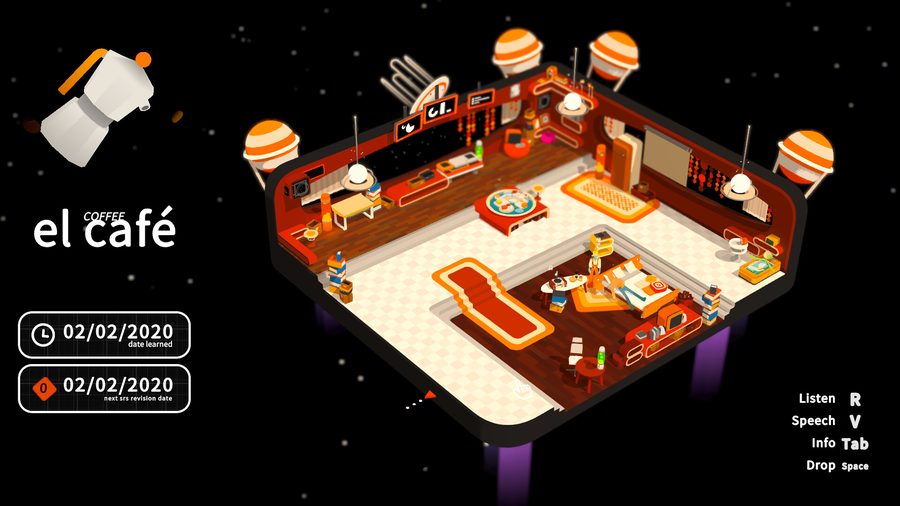
Screenshot from the Noun Town Steam store page, showing a Spanish word tracked through spaced repetition
Spanish verb conjugation is where a lot of vocabulary study quietly falls apart. Knowing that "hablar" means "to speak" is one thing. Correctly producing "hablo," "hablas," "habla," "hablamos" and the rest across multiple tenses under time pressure in conversation is a different skill entirely, and it needs repeated retrieval practice, not a single memorisation pass.
Spaced repetition, reviewing a word or form right before you are likely to forget it, is one of the better supported techniques for this kind of retrieval learning. It is significantly more efficient than rereading a static conjugation table, because it concentrates your review time on exactly the forms you are close to forgetting rather than spreading it evenly across everything, including words you already know cold.
A practical habit that helps: when you add a new verb to your study routine, add it alongside two or three of its most common conjugated forms, not just the infinitive. This front-loads the retrieval practice you would otherwise need to do separately later.
Even with cognates doing some of the work for you, vocabulary attached to a real sentence, a spoken audio clip, or a visual scene sticks better than the same word sitting alone on a flashcard. This is one of the more consistent findings across vocabulary acquisition research, and it holds regardless of how closely related the target language is to your own.
This is the thinking behind how Noun Town approaches Spanish vocabulary: words are attached to objects and characters inside a 3D world, spoken by native speakers in both Spain and Mexican Spanish, then resurfaced through spaced repetition rather than shown once and left behind. Context does not replace repetition, but it makes each repetition more effective.
A few practical ways to build context into ordinary study, even without a dedicated tool:
| Goal | Approximate word count |
|---|---|
| Basic travel phrases and greetings | 100-250 words |
| Simple everyday conversation | 500-1,000 words |
| Comfortable conversational fluency | 2,500-4,000 words |
| Reading native newspapers and novels comfortably | 8,000+ words |
These figures track loosely with the proficiency bands described in the Common European Framework of Reference for Languages, widely used for benchmarking European language ability. Spanish tends to require fewer total words than languages without shared roots to reach the same conversational level, partly because cognate recognition fills in comprehension gaps that would otherwise need to be filled by direct study.
The practical takeaway is that Spanish rewards a slightly different balance than a language like Japanese or Russian. Less time needs to go into pure vocabulary volume, and more time can go into pronunciation, verb conjugation and actually producing sentences out loud, since the raw word recognition tends to come more easily.
Want to try Spanish vocabulary learning with native audio from Spain and Mexico, set inside a real 3D world? There is a free demo on Steam.
Try Noun Town on SteamLean on cognates early since Spanish shares a huge number of words with English through Latin roots, then move to spaced repetition combined with real audio and context. Beginners who study a little consistently, most days, tend to outperform those who cram occasionally for longer sessions.
A large share of Spanish vocabulary shares Latin roots with English, producing thousands of recognisable cognates like informacion, telefono and importante. This gives English speaking beginners a real head start on vocabulary compared to languages with no shared roots, though pronunciation and grammar still take separate practice.
Learn the article alongside the noun rather than the noun alone, so you store "la mesa" instead of just "mesa". Most nouns ending in -o are masculine and most ending in -a are feminine, but there are enough exceptions that pairing the article with the word from the start is more reliable.
Either is a fine starting point, since the core vocabulary overlaps heavily between regions. Pick based on who you plan to speak with or where you plan to travel, and be aware that some everyday words differ, such as "coche" in Spain versus "carro" in much of Latin America.
Around 500 to 1,000 of the most frequent words, along with basic verb conjugations, covers most everyday conversation. Comfortable conversational fluency generally requires somewhere between 2,500 and 4,000 words, noticeably fewer than languages without shared vocabulary roots with English.
Yes. Spaced repetition schedules a word for review right before you are likely to forget it, which is far more efficient than repeatedly rereading the same static list. It works particularly well for Spanish verb conjugations, which benefit from repeated retrieval practice rather than one-time memorisation.
Yes, particularly when words are attached to objects, characters and native audio inside an interactive scene rather than a flat translated list. Games such as Noun Town combine spoken Spanish, visual context and spaced repetition so words are reinforced through repeated exposure instead of a single flashcard pass.
Yes, Noun Town includes both Spanish from Spain and Mexican Spanish as separate options among its 12 supported languages, each with its own native speaker audio, so players can choose the variant that matches who they actually want to communicate with.
Learning words in isolation without their article, gender or a sentence of context. This makes recall weaker and creates gaps that show up later in speaking, since a word learned without grammar attached to it has to be relearned properly the first time it is actually needed in conversation.
Yes. Noun Town is a one-time purchase on Steam with no adverts and nothing locked behind an additional paywall once you own the game, across all 12 supported languages including both Spanish variants.