
Photo: Jebulon / Wikimedia Commons (CC0)
Short answer: Yes. Noun Town is a 3D exploration game on Steam that teaches Greek alongside 11 other languages, using native speaker audio, spaced repetition and speech recognition instead of a lesson-and-quiz format. It costs $19.99 as a one-time purchase, with a free demo available first, and Greek is taught using the real alphabet rather than a romanised stand-in.
Greek is not one of the languages most learning platforms treat as a priority. Search for Greek resources and you will find plenty of phrasebooks and a handful of tutoring sites, but far fewer interactive tools compared to what exists for Spanish or French. If you have been looking for something more engaging than flashcards, the good news is that a proper game option does exist.
I work on Noun Town, so I want to be upfront that this is not a neutral review of the category. But the question of whether a game can genuinely teach Greek is worth answering honestly, alphabet and all, because it is different from teaching a language that already shares your alphabet.
Unlike French, German or Spanish, Greek does not share the Latin alphabet, which means a beginner is dealing with two separate hurdles at once: new words and new letterforms. The Greek alphabet has 24 letters, some of which look deceptively familiar (P is actually "rho," B is "veeta") while others are entirely new shapes.
This is part of why Greek gets ranked as more difficult than the big Western European languages. The Modern Greek language also has grammatical features, like a case system for nouns, that do not map cleanly onto English sentence structure, so a resource that only drills vocabulary in isolation tends to leave gaps.
| Letter | Name | Sounds like |
|---|---|---|
| Α α | Alpha | "a" in father |
| Β β | Veeta | "v" in van |
| Γ γ | Ghamma | soft "gh" sound |
| Δ δ | Thelta | "th" in this |
| Ε ε | Epsilon | "e" in bet |
A well-designed game does not throw the whole alphabet at you on day one. In Noun Town, Greek vocabulary is introduced attached to objects in a 3D world, so you see the Greek word, hear it spoken by a native speaker, and interact with the thing it refers to, all in the same moment. The letters get absorbed as a byproduct of that repeated exposure rather than through rote memorisation of a chart.
This matters because alphabet memorisation done in isolation is notoriously easy to forget within days. Attaching each letterform to a word you have already heard and used gives your memory more to hold onto. It is slower to feel "complete" than sitting down and drilling all 24 letters in an afternoon, but it tends to stick better over weeks and months.
Speech recognition is the other piece that matters specifically for Greek, since its pronunciation includes sounds that do not exist in English, like the soft "gh" in gamma or the "th" sounds that split into two distinct letters (delta and theta). Getting feedback on whether you are actually producing the right sound, rather than just recognising it when you read it, closes a gap that text-only tools cannot.
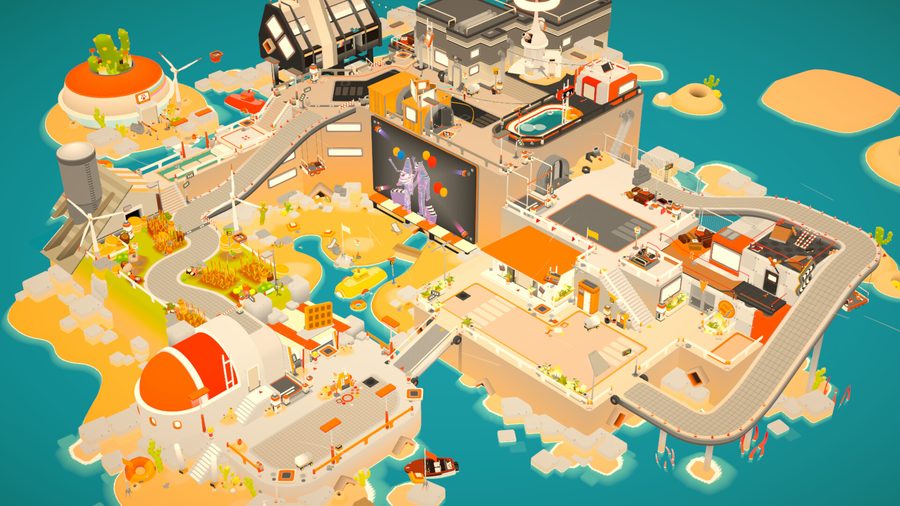
Screenshot from the Noun Town Steam store page, showing the open world map
Beginner Greek content in most well-structured tools, games included, tends to follow a fairly predictable path: greetings and courtesy phrases, numbers, everyday nouns like food and household items, then simple present-tense verbs. Games have an advantage in the "everyday nouns" stage specifically, since a 3D environment gives you dozens of real objects to attach words to naturally, a market stall, a kitchen, a street scene, rather than a static image list.
None of this replaces a grammar reference for the deeper case system Greek uses, but it gives you a real working vocabulary faster than most learners expect, especially compared to starting from a blank textbook page.
The Foreign Service Institute places Modern Greek in Category III, estimating roughly 44 weeks of full-time study, around 1100 class hours, to reach professional working proficiency. That figure is for intensive, full-time classroom learning, so a casual learner doing 20 to 30 minutes a day should expect a much longer runway to that level, but a shorter one to reach basic conversational ability.
Using the CEFR framework that most European language programmes reference, a consistent learner using a mix of tools can typically reach A2, enough for simple travel conversations, within three to six months. Reaching a comfortable B1, enough to hold a real conversation about everyday topics, usually takes closer to a year.
A language game will not shortcut that timeline dramatically, no serious tool can, but it changes how the time feels. Sessions that would be a chore in a flashcard app become something people actually choose to sit down and do, which in practice means more total hours logged over a year, not fewer.
The Centre for the Greek Language, an official body under the Greek Ministry of Education, publishes free grammar and vocabulary resources that are worth pairing with any interactive tool, since they cover the case system and verb conjugation in more depth than a game reasonably can. Evening classes and conversation exchange partners fill a similar gap for spoken practice beyond what any single app or game provides.
Where Noun Town and tools like it earn their place is in the vocabulary and listening stage, and specifically in keeping beginners engaged long enough to get past the point where most people give up on a new alphabet entirely. Combining a game for vocabulary immersion with a grammar reference for the structural side is the pattern most learners we hear from end up settling on.
Curious what learning Greek in a game actually looks like? Try the free demo on Steam.
Try Noun Town on SteamYes. Noun Town is a 3D open world game on Steam that includes Greek as one of its 12 supported languages, teaching vocabulary through spatial context, native speaker audio and spoken practice rather than flashcard drills alone.
No. Most beginner-friendly Greek resources, games included, introduce the alphabet gradually alongside vocabulary rather than requiring you to memorise all 24 letters first. You will pick up the shapes and sounds faster once you see them attached to real words and objects.
The US Foreign Service Institute places Modern Greek in its Category III group, estimating around 44 weeks or 1100 class hours for a working proficiency, harder than French or Spanish but easier than Japanese, Korean, Arabic or Chinese.
Games that include speech recognition, like Noun Town, give you a way to practise pronunciation and get feedback, which text-only apps cannot do. Speaking confidence still needs regular use beyond any single tool, ideally with real conversation practice added over time.
Yes, a free demo is available on Steam so you can try the Greek content before deciding whether to buy the full game, which is a one-time purchase of $19.99 covering all 12 supported languages.
Structured coursebooks, apps with subscription models, university evening classes and immersion trips to Greece are all common routes. Most learners who make real progress combine more than one method rather than relying on a single resource.
With regular practice, most learners reach a basic conversational level, roughly CEFR A2, in three to six months. Reaching a comfortable B1 level for travel and everyday conversation typically takes closer to a year of consistent study.
Noun Town teaches using the real Greek alphabet alongside audio and visual context, rather than relying on a romanised transliteration as a crutch, since transliteration tends to slow down real reading progress in the long run.
Many Greeks in tourist areas speak English, but even basic Greek noticeably changes how locals respond to visitors, especially outside Athens and the main islands, and it makes reading menus, signs and transport information much easier.
No. There are no adverts and nothing locked behind an additional paywall once you own the game. The team built it this way deliberately after getting frustrated with ad-supported and freemium mobile apps themselves.