
Photo: Sgroey / Wikimedia Commons (CC BY-SA 4.0)
Short answer: Beginners build usable Korean vocabulary fastest by learning Hangul first, which only takes a few hours, then studying a core of high-frequency words in context and reviewing them with spaced repetition. Korea uses two separate number systems and shifts vocabulary depending on formality, so both need attention early rather than later. Most consistent learners reach a functional beginner vocabulary of 600 to 800 words within about three months.
Korean vocabulary has picked up a huge new audience over the last few years, driven largely by K-pop, K-dramas and Korean cinema reaching bigger global audiences than ever. A lot of that motivation is genuine and lasting, but it also means a lot of learners jump straight into vocabulary apps without ever properly learning to read Hangul first, which usually costs them time later rather than saving it.
This post is about the specific habits that make Korean vocabulary stick for people starting from zero, including the parts of the language that genuinely do trip beginners up.
A huge share of new Korean learners in 2026 did not start with a textbook. They started with a drama, a group's discography, or a variety show clip that got stuck in their head. That is a genuinely useful starting point for vocabulary, not just a fun one. Song lyrics and dialogue repeat common words constantly, and hearing them said naturally, with real intonation and pacing, does more for listening comprehension than reading the same word off a page ever will.
The catch is that media Korean skews heavily casual. Drama dialogue and song lyrics lean on informal speech, slang, and shortened forms that do not map cleanly onto textbook Korean, and idol interviews often mix in English words and Konglish that a beginner has no way to sort from "real" vocabulary yet. Someone who learns Korean entirely from K-pop can end up with a lopsided vocabulary, strong on emotional and everyday words, weak on the polite, formal register they will actually need to survive a first real conversation with a stranger or an older person.
The fix is not avoiding media, it is treating it as one input among several. Use dramas and music for listening practice and vocabulary reinforcement, and pair it with structured study, or a tool like a game or app, for the plain and polite forms media alone will not reliably teach you.
Hangul, the Korean writing system, has a reputation for looking intimidating, mostly because the shapes are unfamiliar to English speakers at a glance. In reality it was deliberately designed in the 15th century under King Sejong the Great to be learned quickly by ordinary people, replacing reliance on Chinese characters for writing Korean. Most learners can read the basic characters within a few hours of focused study, since the system is phonetic and highly consistent once the building blocks click.
The mistake a lot of beginners make is skipping Hangul and studying vocabulary in romanised form instead, because it feels faster at first. It almost always backfires. Romanisation hides pronunciation details that Hangul shows directly, and every word learned in roman letters eventually has to be relearned in the actual script anyway. Spend the first few hours on Hangul itself and the vocabulary that follows goes noticeably faster.
Once the individual Hangul characters click, the next thing that trips beginners up briefly is how they are arranged. Unlike an alphabet that runs left to right in a single line, Hangul groups consonants and vowels into square syllable blocks, each block representing one spoken syllable.
Take the word Hangeul itself, written 한글. It is built from two blocks: 한 (han) and 글 (geul). The first block combines the consonant ㅎ, the vowel ㅏ, and the consonant ㄴ, stacked to form a single syllable. The second combines ㄱ, ㅡ and ㄹ the same way. Once you know the roughly 40 individual characters, reading a new block is mostly a matter of recognising the pieces and sounding them out in order, top to bottom, left to right, which is exactly why the system trains so quickly compared to writing systems with thousands of characters to memorise individually.
This matters for vocabulary specifically because it means a genuinely new word is never a genuinely new set of shapes, it is a new combination of pieces you already know. That is a real head start most beginners do not expect going in.
One thing that catches almost every beginner off guard is that Korean uses two completely separate sets of numbers, and both are used constantly in daily life.
| Number | Native Korean | Sino-Korean |
|---|---|---|
| 1 | hana | il |
| 2 | dul | i |
| 3 | set | sam |
| 4 | net | sa |
| 5 | daseot | o |
Native Korean numbers are used for counting objects, people, hours and age. Sino-Korean numbers, borrowed from Chinese centuries ago, are used for dates, money, minutes and phone numbers. There's no shortcut around learning both, so it's better to accept early on that vocabulary building in Korean means two parallel number systems rather than one, and to practise them side by side from the start rather than treating one as optional.
A few mistakes show up often enough with new Korean learners that they are worth naming directly.
None of these are difficult to avoid once you know to watch for them. They are just the specific ways vocabulary building tends to go sideways for Korean beginners rather than generic study advice.
Korean has a system of speech levels and honorifics that directly affects vocabulary choice, not just grammar. The word for "eat," for instance, changes depending on whether you're speaking casually to a friend or respectfully to someone older or in a formal setting. This isn't just politeness dressing, it's baked into which word you reach for.
Beginners don't need to master every register immediately, but ignoring the concept entirely causes real confusion once you start listening to native speech or dialogue in a game or show, since the "same" word can sound completely different depending on the level being used. A practical approach is learning the plain, everyday form of a word first, then noting the polite form alongside it once it comes up, rather than trying to learn every register for every word upfront.
A concrete example makes this less abstract. The plain form of "to eat" is 먹다 (meokda). Said to a close friend, you would use 먹어 (meogeo). Said politely to someone you do not know well, it becomes 먹어요 (meogeoyo). Speaking formally, to an elder or in a business setting, that shifts again to 드세요 (deuseyo), which is not just a conjugation change but a genuinely different, more respectful word. Three different sounds for the same basic idea, all of which a beginner will hear within their first few weeks of exposure to real Korean.
English speakers get one advantage in Korean that rarely gets mentioned early on. A large number of everyday Korean words are direct loanwords from English, adapted to Korean pronunciation. 버스 (beoseu) is bus. 커피 (keopi) is coffee. 컴퓨터 (keompyuteo) is computer. 아이스크림 (aiseukeurim) is ice cream. These words, often called Konglish, are genuinely part of everyday Korean vocabulary, not slang or shortcuts.
The catch, much like false friends in other languages, is that Konglish does not always mean what the English word means. 핸드폰 (haendeupon), literally "hand phone," is the standard word for mobile phone, which English speakers can usually guess. But 서비스 (seobiseu) often means a free extra or a discount thrown in by a shopkeeper, not "service" in the general English sense, and 원룸 (wonrum), literally "one room," refers to a studio apartment. Loanwords are a genuine shortcut, but like cognates in any language, they need occasional verification rather than blind trust.
A flashcard with a Korean word and its English translation works, but it's a thin memory on its own. A word encountered in a sentence, attached to an image, or heard from a native speaker in a specific scene gets stored with far more surrounding detail, which is exactly what makes it easier to recall later under real conversational pressure.
This is where games and interactive tools genuinely add something textbooks can't. In Noun Town, Korean words are attached to objects and characters inside an explorable 3D world rather than presented as a bare list, each one paired with native speaker audio and a speech recognition check, so pronunciation gets practised from the very first word rather than bolted on later.
This matters more in Korean than in a lot of languages, precisely because context is what teaches you which register a word belongs to. A textbook glossary entry rarely tells you whether a word is casual, polite or formal, but a scene, a conversation, or a piece of dialogue does that automatically, the same way native speakers pick it up.
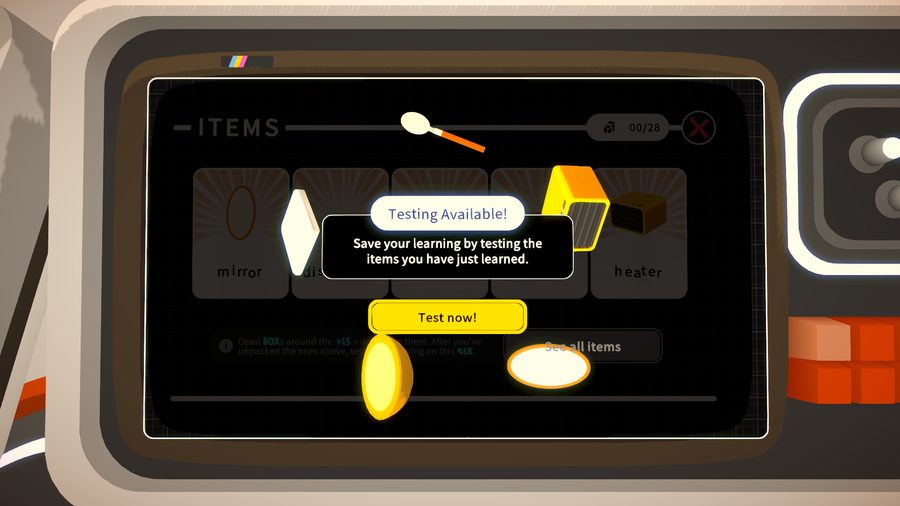
Screenshot from the Noun Town Steam store page, showing the in-game vocabulary review screen
New vocabulary fades quickly without review, particularly with a language as unfamiliar to English speakers as Korean. Spaced repetition, reviewing a word right before you're statistically likely to forget it rather than on a fixed schedule, is the single most effective habit for making vocabulary stick long term.
This is worth taking seriously in Korean specifically because there is more to hold onto per word than in many languages. A single Korean verb might come with a plain form, a polite form and a formal form all worth knowing eventually, which means each review session is doing double duty, reinforcing the word itself and reinforcing which situations it belongs in.
With consistent short daily sessions, most beginners reach a functional vocabulary of around 600 to 800 words within roughly three months. That's enough for basic everyday exchanges, though real fluency with honorifics and natural speech takes considerably longer. The U.S. Foreign Service Institute places Korean in its most challenging category for English speakers, alongside Japanese, Mandarin and Arabic, largely because of how different the vocabulary, grammar and writing system are from English. That makes consistency even more important than it is for closer languages, since there's less overlap to lean on early.
That said, the timeline is not uniformly slow. Because Hangul is fast to learn and Konglish provides an early foothold most learners do not expect, the first month of Korean vocabulary building often feels faster than people are braced for, even if the honorific system means the following months take real, sustained effort rather than passive absorption.
Want to see Korean vocabulary taught this way in practice? There's a free demo on Steam.
Try Noun Town on SteamLearn Hangul first since it takes far less time than people expect, then build a core of high-frequency words in context and review them with spaced repetition. Skipping straight to romanised word lists slows almost everyone down later.
Around 800 to 1,000 of the most common Korean words cover most everyday conversation, though the exact figure shifts depending on how much formal versus casual speech you need, since Korean often uses different vocabulary for each register.
No, and this surprises most beginners. Hangul was deliberately designed to be learned quickly, and most people can read the basic characters within a few hours of focused study. Building real vocabulary and fluency afterward takes much longer than learning the alphabet itself.
Korean uses native Korean numbers for counting objects, age and hours, and Sino-Korean numbers borrowed from Chinese for dates, money and minutes. Both systems are used constantly, so beginners typically need to learn both sets fairly early rather than choosing one.
You need at least a basic grasp early on, since Korean vocabulary and verb endings genuinely change depending on who you're speaking to. You don't need to master every speech level immediately, but recognising formal versus casual forms prevents a lot of early confusion.
Both play a role, but context tends to produce stronger recall. A word met in a sentence, scene or spoken example is stored with more surrounding detail than a bare flashcard translation, which makes it easier to retrieve later.
With consistent short sessions, most learners reach a functional beginner vocabulary of 600 to 800 words within about three months. Korean is rated more challenging than many European languages for English speakers, so steady pacing matters more than speed.
Yes. Games that attach words to objects, characters and native audio inside an explorable world give vocabulary more context than a typical drill screen, and research into digital game-based learning generally shows better retention for words learned this way.
Yes, particularly for listening comprehension and natural pronunciation, since both expose you to real intonation and commonly repeated words. The catch is that media Korean skews casual and often mixes in slang or Konglish, so it works best paired with structured study that also covers polite and formal vocabulary.
Yes, Korean is one of the twelve languages included in Noun Town, taught through a 3D open world with native speaker audio, spaced repetition and speech recognition, playable on PC and Mac via Steam.