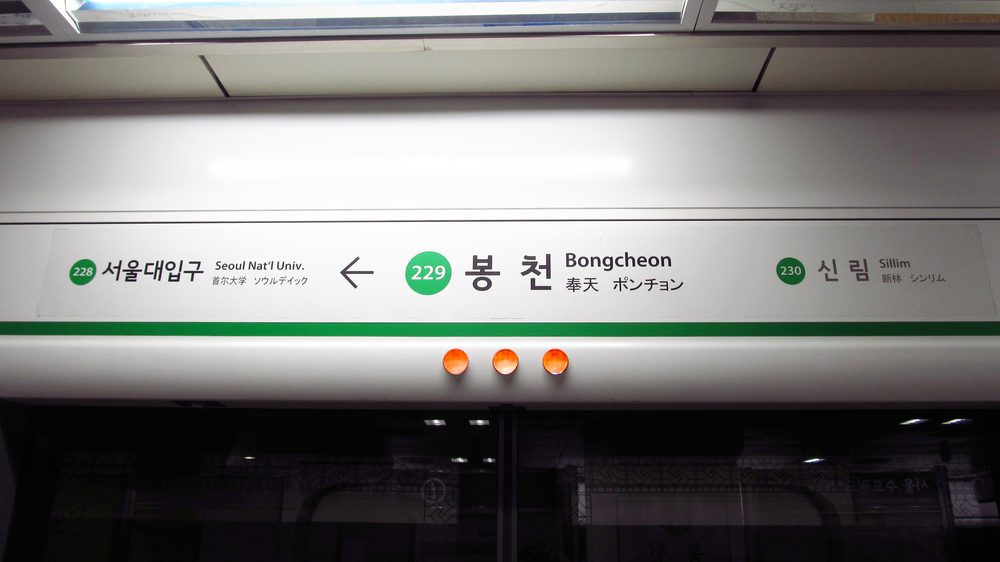
Photo: Seoul Metro Line 2 station sign / Wikimedia Commons (CC BY-SA 4.0)
The US Foreign Service Institute puts Korean at roughly 2,200 hours of classroom study for an English speaker to reach professional working proficiency, placing it in the same hardest tier as Japanese, Mandarin and Arabic. That is nearly three times the 600 to 750 hours needed for Spanish, French or Italian. Most learners are not aiming for professional proficiency though, and the honest answer to "how long" depends heavily on what you actually want to be able to do, and how many hours a day you can realistically put in.
Short answer: Around 2,200 hours to reach professional working proficiency, according to FSI data. At one hour of study per day, that is roughly six years. At two hours per day, a strong conversational B2 level is realistic in about two years, with professional proficiency around three years away.
The Common European Framework of Reference (CEFR) gives the most widely recognised scale for language ability. Here is roughly how the levels map to hour estimates for Korean specifically, assuming consistent and reasonably active study.
| Level | What you can do | Hours needed |
|---|---|---|
| A1 | Read Hangul, greetings, numbers, very simple exchanges | 100 to 150 hours |
| A2 | Simple conversations, travel situations, familiar topics | 400 to 500 hours |
| B1 | Hold a real conversation on everyday topics, follow most spoken Korean | 700 to 900 hours |
| B2 | Fluent conversation, understand most TV and film, discuss complex topics | 1,300 to 1,600 hours |
| C1 | Professional fluency, nuanced writing and speech, near-complete comprehension | 2,000 to 2,200 hours |
These are estimates, not guarantees. Korean does not have an official CEFR-mapped breakdown the way some European languages do, so the ranges above are drawn from the overall 2,200 hour FSI benchmark and general findings from university and government Korean programmes. Someone studying with full attention and regular speaking practice will move through these bands faster than someone passively reviewing flashcards on a commute.
Framing the total in daily terms makes the commitment more concrete. At 30 minutes of study a day, you put in about 180 hours a year. At that pace, B1 sits around four and a half years away, and full professional proficiency is a genuinely long-term project, well over a decade. Thirty minutes a day is a fine starting habit, but it is worth knowing upfront that it will not get you to fluency quickly.
At one hour per day, roughly 365 hours annually, the picture improves substantially. B1 arrives in around two years, B2 in about four years, and C1 in roughly six years. One hour a day is achievable for most working adults without major disruption, which is why it tends to be the realistic baseline for serious learners who are not studying full time.
Two hours per day compresses the timeline considerably. B1 lands around the 13 month mark, B2 arrives at roughly two years, and C1, full professional proficiency, becomes realistic in about three years. Two hours daily requires real commitment, and learners who sustain it tend to have made Korean a genuine priority rather than a side hobby.
A fully intensive schedule of three to four hours daily, the kind of pace used at residential language institutes, can bring B1 within seven to eight months and C1 within 18 months to two years. This is not realistic alongside a full time job for most people, but it shows how much the total time compresses when hours per day increase.
Three structural features account for most of the extra time Korean requires compared to a language like Spanish or Italian, and understanding them helps explain why the hour estimates look the way they do.
Noun Town builds Korean vocabulary through native speaker audio attached to objects in a 3D world, which gives words a spatial and auditory anchor rather than just a translation pair to memorise, something that matters more in Korean than in a cognate-rich language where guessing sometimes works.
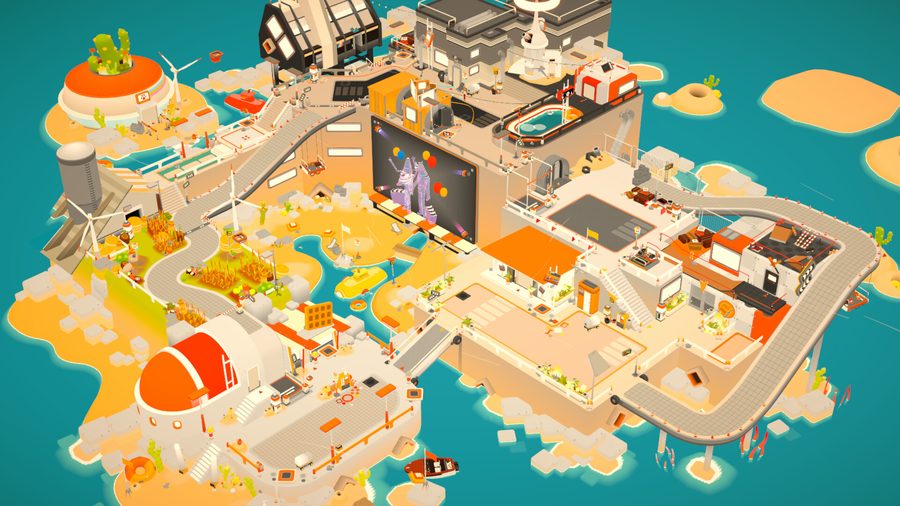
Screenshot from the Noun Town Steam store page, showing the open 3D world
Hangul, the Korean alphabet, was deliberately designed in the 15th century to be learnable in a matter of days rather than years. Most learners can read simple Hangul words within their first week of focused study, which stands in sharp contrast to the 2,200 hour headline figure that describes the language as a whole.
This matters for how you plan your first month. Unlike Chinese or Japanese, where the writing system itself is a multi-year undertaking, Korean lets you get the reading barrier out of the way almost immediately, freeing up the rest of your study time for vocabulary, grammar and the honorific system covered above, the parts that genuinely take the full 2,200 hours to master. If you want the fuller picture of Korean's difficulty profile, our separate breakdown of what makes Korean hard covers this in more depth.
Given that vocabulary and grammar patterns, not the alphabet, are where most of the 2,200 hours actually go, the habits that move the needle fastest are the ones that target those two areas directly.
The most honest answer to "how long does it take to learn Korean" is that it depends on your goal, your daily hours, and whether your study methods are actually working. The 2,200 hour FSI figure is a useful reference point, not a guarantee. Some learners reach comfortable B2 conversation in far fewer hours by focusing on active speaking and listening practice rather than passive review. Others put in 2,000 hours of inconsistent, distracted study and remain closer to B1.
What the data does make clear is that Korean is genuinely one of the longer investments among major world languages for an English speaker, roughly three times what Spanish or Italian require for the same level of proficiency. That is not a reason to avoid it, but it is a reason to set a study pace you can actually sustain for years rather than months, since consistency over a long stretch matters more than any burst of early intensity.
Want to start building Korean vocabulary through native speaker audio in a 3D world?
Try Noun Town on SteamThe US Foreign Service Institute estimates around 2,200 class hours to reach professional working proficiency in Korean, roughly 88 weeks of full time study. At one hour of study per day, that works out to about six years. At two hours per day, a strong conversational B2 level is realistic in around two years. With a fully intensive schedule of four or more hours daily, professional proficiency in under two years is achievable.
Yes. The Foreign Service Institute places Korean in its hardest tier, alongside Japanese, Mandarin, Cantonese and Arabic. The main difficulties are sentence structure, an honorific system that changes vocabulary and grammar based on who you are speaking to, and vocabulary that shares almost no roots with English. Hangul, the alphabet, is the one genuinely easy part.
A few days to two weeks for most learners studying consistently. Hangul was deliberately designed to be learned quickly, and it is one of the fastest writing systems in the world to pick up, even though everything else about Korean sits in the FSI's hardest category.
It is possible but demanding. B1 requires somewhere in the 700 to 900 hour range for Korean, which at two hours of daily study puts it around 12 to 13 months. At one hour per day it takes closer to two years. Reaching B1 within a single year requires close to two hours of consistent daily study.
Around 2,000 to 3,000 high frequency words covers most everyday conversation, similar to other major languages. The difference with Korean is that almost none of them will feel familiar the way Spanish or French cognates do for English speakers, so vocabulary has to be built essentially from zero.
Research supports contextual, game based vocabulary learning generally. Words encountered in immersive environments with native speaker audio are retained at higher rates than words drilled in isolation, which matters even more for Korean since there are so few cognates available to give learners a shortcut.
Highly variable, but many learners report meaningful comprehension of Korean television and film somewhere past the 600 to 900 hour mark, well below the full 2,200 hour professional proficiency figure. Genre matters too. Casual dramas with everyday dialogue tend to be more accessible earlier than historical dramas using archaic language.
No, the FSI rates them the same, both in the 2,200 hour category. Korean's alphabet is faster to learn than Japanese's three writing systems, but Korean's honorific system and unfamiliar sentence structure offset that advantage for most learners.
Thirty minutes to one hour of focused, active study daily tends to outperform occasional multi hour sessions, because vocabulary retention depends on spaced repetition rather than cramming. More time per day naturally speeds up the total timeline, but consistency matters more than any single day's total.
No. Many learners reach strong conversational Korean through self study, apps, games, tutors and exchange partners without ever living in Korea. Regular exposure to native speaker audio and consistent speaking practice, even online, can substitute for a meaningful part of what immersion provides.