
Photo: Myeongdong shopping street, Seoul / Wikimedia Commons (CC BY-SA 3.0)
Korean is officially one of the hardest languages for English speakers to learn. The US Foreign Service Institute, which trains American diplomats, places it in its most demanding category alongside Japanese, Mandarin, Cantonese and Arabic, estimating around 2,200 class hours, roughly 88 weeks of full time study, to reach professional working proficiency. But that number hides an odd detail: the Korean alphabet itself, Hangul, is one of the easiest writing systems in the world to pick up. The difficulty lives almost entirely in the grammar and the vocabulary, not the script.
Short answer: Yes, Korean is hard for English speakers by official estimates, needing around 2,200 class hours to reach fluency. However, Hangul takes most learners only a few days to learn to read, which is far faster than most people expect.
The Foreign Service Institute groups languages into difficulty bands based on how long it typically takes an English speaking adult with an aptitude for language study to reach professional working proficiency, roughly the level needed to work comfortably in that language. Korean sits in the hardest band, alongside Japanese, Mandarin, Cantonese and Arabic, at approximately 2,200 hours of classroom instruction.
To put that in context, Spanish, French and Italian sit at around 600 to 750 hours. German comes in at roughly 750 hours. Russian and Greek land in the middle, around 1,100 hours. Korean's 2,200 hour estimate is nearly three times the figure for Spanish, which is a genuinely useful benchmark if you are trying to set realistic expectations before you start.
| Language | Approx. class hours | FSI category |
|---|---|---|
| Spanish, French, Italian | 600 to 750 | Easiest |
| German | 750 | Second easiest |
| Russian, Greek | 1,100 | Middle |
| Korean, Japanese, Mandarin, Cantonese, Arabic | 2,200 | Hardest |
It is worth being clear about what these numbers measure. They describe classroom instruction time for adults training toward a government proficiency test, not the point at which someone can hold a casual conversation or enjoy a TV show without subtitles. Plenty of self taught learners get to a comfortable conversational level in Korean well before the 2,200 hour mark, especially if they are living somewhere Korean is spoken or practising daily.
Three things do most of the work in making Korean difficult for an English speaking beginner, and none of them is the alphabet.
Pronunciation adds a further layer. Korean distinguishes between plain, tense and aspirated versions of certain consonants, a distinction that does not exist in English and that many beginners struggle to hear clearly at first, let alone produce. This is one of the reasons native speaker audio matters so much early on. Reading a romanised pronunciation guide only gets a learner so far when the actual sound categories do not exist in their native language.
Noun Town teaches Korean vocabulary through native speaker audio attached to objects in a 3D world, which sidesteps a lot of the guesswork that comes from learning pronunciation purely from text.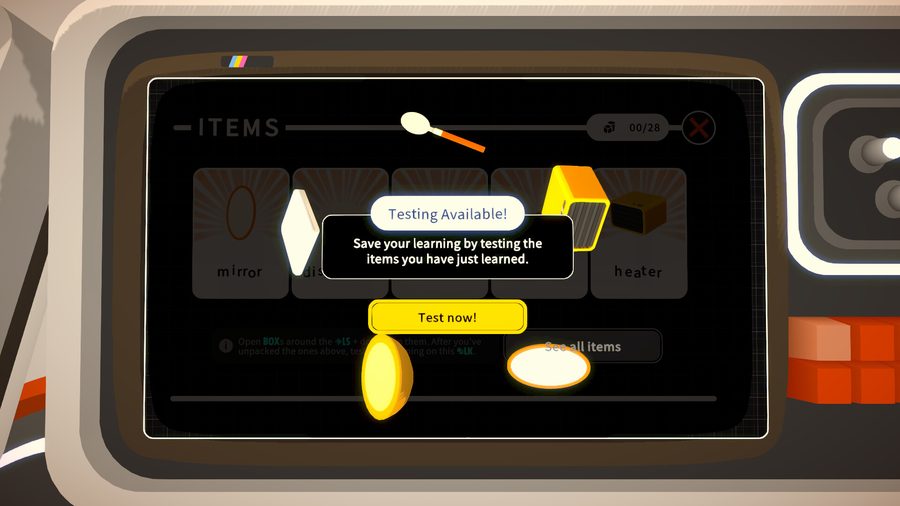
Screenshot from the Noun Town Steam store page, showing the vocabulary testing prompt
Hangul, the Korean alphabet, was created in the 15th century under King Sejong the Great specifically so that ordinary people, not just the educated elite who read Chinese characters, could become literate quickly. It is a featural alphabet, meaning the shape of each letter reflects something about how it is pronounced, which makes it unusually logical to learn compared to most writing systems.
Most learners can memorise all 24 basic Hangul letters and start sounding out simple words within a few days, and reach comfortable reading speed within a couple of weeks of regular practice. This is dramatically faster than learning to read Japanese, which requires two syllabaries plus a working knowledge of thousands of kanji characters, or Chinese, which requires memorising thousands of individual characters with no alphabet at all.
Modern Korean is written almost entirely in Hangul. Hanja, the Chinese-derived characters once used more widely in Korean writing, still appear in some newspapers, academic texts and official documents, but a learner can read the vast majority of everyday Korean, menus, signs, texts, subtitles, without ever studying Hanja. This is one of the more pleasant surprises for beginners who assumed Korean would be as visually daunting as Japanese or Chinese.
Since Korean, Japanese and Mandarin all sit in the FSI's hardest category, it is a fair question to ask which one is actually harder in practice, even if the official hour estimate treats them the same.
Japanese has an easier grammar structure than Korean in some respects (fewer irregular verbs, a more forgiving sentence structure once you learn the particle system) but a genuinely harder writing system, requiring hiragana, katakana and roughly 2,000 commonly used kanji for functional literacy. Mandarin has comparatively simple grammar, no verb conjugation and no grammatical gender, but demands memorising thousands of characters with no alphabet to fall back on, and its tonal system is a serious hurdle for English speakers who have never had to distinguish meaning by pitch before.
Korean's honorific system is arguably the steepest learning curve of the three for a beginner, since getting formality levels wrong is socially noticeable in a way that a slightly clumsy Japanese sentence often is not. But Korean's writing system is by far the easiest to learn of the three, which evens things out considerably over the first few months of study.
The 2,200 hour FSI figure is a ceiling, not a starting point, and it describes a specific kind of professional fluency most learners are not actually aiming for. A more useful way to think about Korean study is by goal.
Consistency tends to matter more than raw study intensity. Thirty minutes a day, every day, generally produces better results over a year than occasional multi-hour sessions, largely because vocabulary retention depends on spaced repetition rather than cramming.
Given that vocabulary and grammar, not the alphabet, are where most of the real difficulty sits, the most effective early habits tend to be the ones that address those two areas directly.
Want to start building Korean vocabulary through native speaker audio in a 3D world?
Try Noun Town on SteamYes, in terms of official time estimates. The US Foreign Service Institute places Korean in its hardest language category, alongside Japanese, Mandarin, Cantonese and Arabic, at around 2,200 class hours to reach professional working proficiency. That said, one part of Korean, its writing system, is widely considered one of the easiest scripts in the world to learn.
The FSI estimate is about 2,200 class hours, roughly 88 weeks of full time study, to reach professional working proficiency. Conversational ability for travel or casual use comes much sooner, often within a few hundred hours of consistent practice.
Yes. Hangul was designed in the 15th century specifically to be learnable quickly, and most learners can read the alphabet within a few days to a couple of weeks. It is one of the few genuinely easy parts of learning Korean.
Sentence structure (subject-object-verb rather than subject-verb-object), a complex honorific system that changes verb endings and vocabulary depending on who you are speaking to, and vocabulary that shares almost no roots with English are the three biggest factors. Grammar particles attached to nouns also work differently to anything in English.
The FSI rates them the same, both in the 2,200 hour category. Korean's alphabet is easier to learn than Japanese's three writing systems, but Korean's honorific system and consonant sound changes are arguably more demanding for a beginner than Japanese grammar.
Yes. Many learners reach conversational Korean through self study using apps, games, textbooks and exchange partners, without ever taking a formal class. Consistency matters more than the specific method, though speaking practice with feedback speeds progress considerably.
No. Modern Korean is written almost entirely in Hangul. Hanja, the Chinese-derived characters once used more widely, appear occasionally in newspapers, academic writing and some official documents, but everyday reading and most media do not require them.
Manageable but not trivial. Korean has consonant sounds that do not map cleanly onto English, including distinctions between plain, tense and aspirated consonants that can be hard to hear at first. Regular listening practice with native audio is the fastest way past this.
Many learners start exactly this way, and it works as motivation, but subtitles and translated lyrics will get you further than grammar study alone for pure consumption. If you want to actually understand dialogue and lyrics without subtitles, you will still need real vocabulary and grammar study.
Starting with high frequency nouns learned in context, alongside spaced repetition to review them, tends to work better for beginners than memorising grammar tables first. Games and apps that pair words with images and native audio can make this stage less tedious than flashcards alone.