
Photo: Wikimedia Commons contributor (CC BY 2.0)
Short answer: Nouns are the fastest starting point because they are concrete, easy to attach to a mental picture, and make up roughly half of everyday vocabulary in most languages. Learning 300 to 500 common nouns gives you enough raw material to name your surroundings, ask basic questions and start building sentences, well before you have any solid grip on grammar.
If you have ever opened a new language course and been handed a grammar chart before you have learned a single word for "table" or "water," you already know the problem. Grammar without vocabulary is a set of empty rules. You need something to hang them on.
That something is usually a noun. Bread, dog, door, phone, street. These are the words a small child learns first, long before they can conjugate a verb, and there is a good reason adults benefit from following roughly the same order.
Linguists who study word frequency across languages consistently find that nouns make up the largest single word class in everyday speech and writing, typically somewhere around half of the total vocabulary an adult uses regularly. Verbs, adjectives, and the various connecting words come in well behind.
This matters practically. If you are choosing which 500 words to learn first in a new language, picking from the noun category gives you the most coverage per word learned. You are simply working with a bigger, more useful pool.
It also matters for communication. A tourist who knows fifty nouns and no grammar can point, gesture and get a coffee, find a bathroom, or ask for directions. A tourist who knows fifty verb conjugations and no nouns is stuck, because there is nothing to conjugate around.
There is a well documented effect in memory research where concrete words, ones you can picture or point to, are recalled more easily than abstract words. A noun like "chair" activates a mental image almost instantly. An abstract concept, or a grammatical rule about verb tense, does not give your brain the same hook to hang onto.
This is part of why dual-coding theory, the idea that pairing a word with a mental image strengthens memory more than the word alone, keeps showing up in language learning research. Nouns are naturally suited to this kind of pairing, since most of them refer to something you can literally see.
Verbs and grammar rules can eventually get the same treatment, through example sentences and repeated use, but it takes more scaffolding to get there. Nouns give you a shortcut.
of everyday vocabulary in most languages is made up of nouns
high-frequency nouns needed to describe most everyday surroundings
months of steady practice to reach that noun base at a casual pace
Knowing that nouns come first is one thing. Doing it in a way that sticks is another. A flat alphabetical list from a textbook glossary is technically a list of nouns, but it rarely produces lasting recall, because there is nothing tying the words together or giving them context.
This is close to the approach we built into Noun Town, where instead of a glossary, words are attached to objects inside a 3D world. You see a cow in a farmyard, hear the word spoken aloud, and the label appears attached to the animal itself rather than floating on a flashcard. The context does a lot of the memory work for you.
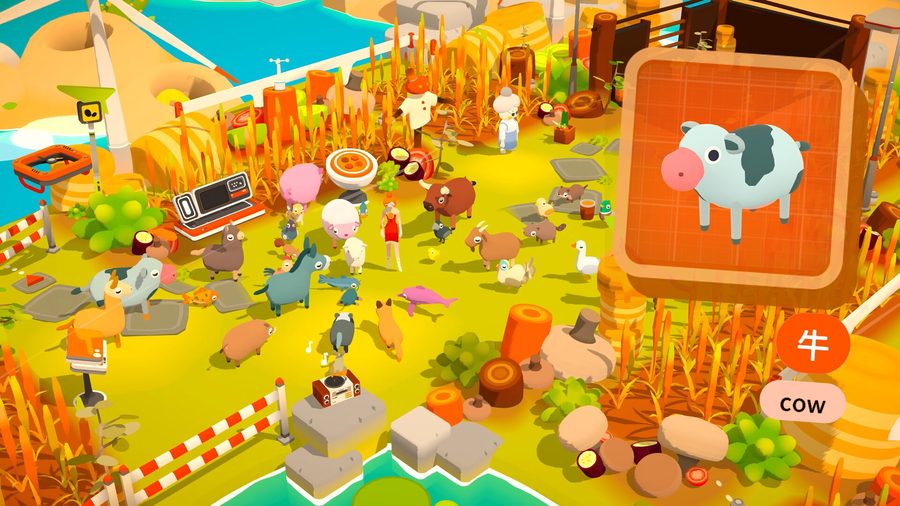
Screenshot from the Noun Town Steam store page
None of this is an argument for skipping grammar forever. It is an argument about sequencing. Once you have a working set of nouns, grammar rules suddenly have something to attach to. Learning that adjectives change form to match gender or number is abstract until you already have a stock of nouns to practise it on.
Structured resources like the Common European Framework of Reference for Languages still put basic vocabulary, largely nouns, at the very start of the beginner level for exactly this reason. Grammar is layered on top of a noun foundation, not the other way around.
Verbs and connecting words do need attention eventually, and the sooner you can build full sentences the better. But there is a reason "nouns first" keeps appearing across language courses, immersion methods and children's natural acquisition patterns. It is not a shortcut for the sake of being easy. It is the order that produces working vocabulary the fastest.
One advantage of learning nouns through a game world rather than a flashcard app is that the object doing the teaching is right there in front of you, in a specific place, doing a specific thing. A word learned while looking at a market stall, hearing a shopkeeper say it, and interacting with the scene tends to be stickier than the same word seen in isolation on a card.
It also removes some of the tedium. Grinding through five hundred flashcards feels like a chore. Wandering a town, picking up the words for what you see along the way, feels closer to how you actually picked up your first language as a child, just compressed and made deliberate.
We built Noun Town around this idea specifically, with no ads and nothing locked behind an extra paywall once you own the game, because we wanted the noun-first approach to actually be pleasant to sit through for hours, not just efficient on paper.
Want to see noun-first vocabulary learning in action? Try the free demo on Steam.
Try Noun Town on SteamNouns let you name and point at things immediately, which means you can communicate basic needs and ideas even without full sentences. They also tend to be more concrete and easier to attach to a mental image than verbs or grammatical rules, so they stick faster in memory.
Roughly 300 to 500 high-frequency nouns cover most everyday objects, people and places you would need to describe your surroundings and basic situations. That is a realistic target for the first one to two months of consistent study.
Not quite. Memorising a list out of context works for short term recall but fades quickly. A noun-first approach that ties each word to an image, an object or a real scene tends to produce much stronger long term retention than a flat alphabetical list.
Yes. In most languages nouns make up the largest single word class, often estimated at around 50 to 60 percent of the total vocabulary a fluent adult uses. Verbs, adjectives and function words make up the rest.
No, grammar still matters, but sequencing matters too. Building a base of concrete nouns first gives you something to attach grammar to later, rather than trying to learn abstract rules with no vocabulary to apply them to.
Yes. Noun Town places vocabulary, mostly nouns, directly into a 3D world so you learn a word by encountering the object it names, hearing it spoken by a native speaker, and reviewing it later through spaced repetition.
Start with objects in your immediate environment, home, kitchen, street, then move outward to categories like food, transport and work. Pairing each word with an image or the real object, rather than a translation alone, speeds up recall.
Children are constantly surrounded by objects being named for them in context, which is exactly the kind of repeated, situational exposure that helps nouns stick. Adults can replicate this by deliberately learning vocabulary attached to real scenes rather than isolated word lists.
Spaced repetition works well for nouns because they tend to have a clear, stable meaning that does not shift much with context, unlike some verbs or idioms. That stability makes nouns some of the easiest vocabulary to lock in through scheduled review.