
Photo: Tony Webster / Wikimedia Commons (CC BY 2.0)
Educational games for kids on Mac are harder to find than the endless "best educational games" roundups suggest, mostly because those lists get written and tested on Windows and nobody checks whether the games actually run on macOS. As of 2026, a solid number of well reviewed educational and logic based games on Steam do support Mac natively, covering language learning, programming logic, chemistry and space engineering, and none of them need Boot Camp, Parallels or an emulator. Every game in this guide has been checked directly against its Steam store listing.
Short answer: The best educational games for kids on Mac in 2026 are Noun Town ($19.99, language learning), Human Resource Machine ($14.99, programming logic), Baba Is You ($14.99, logic puzzles), 7 Billion Humans ($14.99, programming), Kerbal Space Program ($39.99, physics and space engineering) and Opus Magnum ($19.99, chemistry and engineering puzzles). All six run natively on macOS through Steam, no extra software required.
Most gaming roundups are written on a Windows PC by someone who never opens the System Requirements tab on the Mac side of a Steam listing. It is an easy mistake to make, since Steam shows the same store page to everyone, and a game can look perfectly playable right up until you notice the platform icons at the top only show a Windows logo.
The result is that parents searching for something educational to install on the family Mac end up clicking through five or six recommended titles before finding one that actually installs. That is a frustrating way to shop, particularly when the whole point was to get a kid started on something useful in the next ten minutes rather than troubleshoot a virtual machine.
Every game below has a Mac icon on its Steam page and a macOS entry in its system requirements, checked directly rather than assumed from the Windows listing.
"Educational" gets slapped on a lot of packaging that does not deserve it. A game that teaches nothing beyond how to click faster than the last level is not educational just because it has a school themed skin. The games in this guide were chosen against a more specific bar, closer to what researchers studying digital game-based learning look for when they assess whether a title actually teaches anything.
A 3D open world game where vocabulary in one of 12 languages is learned in context, through native speaker audio, spaced repetition reviews and speech recognition practice, rather than through flashcard style drills. No ads and nothing paywalled once you own it. A free demo is available on Steam.
You play an office worker solving puzzles by arranging simple commands into a working program. It is one of the more approachable ways to build real computational thinking skills like loops and variables, built by Tomorrow Corporation, without writing a line of actual code syntax.
A puzzle game where the rules of the level are themselves objects you can push around and rearrange, which teaches a genuinely unusual style of lateral, rule based thinking. Widely praised by critics and a strong pick for kids who like taking a problem apart from a different angle.
The follow up to Human Resource Machine, this time coordinating a crowd of office workers using parallel instructions at once. A natural next step once a kid has outgrown the first game, and a gentle introduction to the idea of parallel processing.
Design, build and launch rockets while genuine orbital mechanics decide whether they fly or explode. It is more of a commitment than the other titles here, both in price and learning curve, but few games teach physical intuition about thrust, mass and gravity as directly.
You design automated machines that transmute and assemble alchemical elements, which in practice teaches sequencing, efficiency and spatial reasoning skills that map closely onto real engineering and chemistry problems. Best suited to kids who already enjoy a challenge.
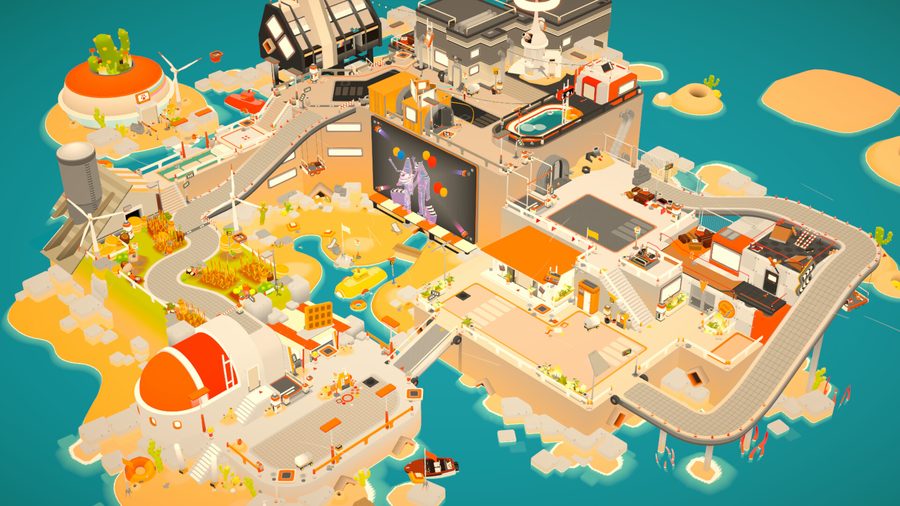
Screenshot from the Noun Town Steam store page, showing the explorable open world
Steam does not hide this information, but it is easy to miss if you are used to shopping on Windows. A minute of checking avoids a refund request later.
A lot of educational software marketed to parents is built iPad first, then ported to other platforms as an afterthought, if at all. That leaves a real gap for families whose main household computer is a Mac rather than a tablet.
Steam games, by contrast, are desktop titles from the ground up. They are generally built for longer sessions, deeper mechanics and a proper keyboard and mouse or controller setup, which suits a family Mac used at a desk far better than an app designed around a five minute tablet check-in.
Neither format is strictly better across the board. Apps tend to win on short bursts and bite sized lessons. Steam games tend to win on depth, sustained attention, and the sense of playing something rather than completing an assignment, which for a lot of kids is the actual difference between sticking with it and giving up after a week.
macOS has a built in Screen Time feature under System Settings that lets a parent set daily app limits, downtime windows and content restrictions per user account, which is worth setting up before installing anything new rather than after a disagreement about bedtime.
Creating a separate macOS user account for each child, rather than sharing one login for the whole family, also makes it far easier to keep game saves, screen time limits and purchase permissions specific to the right age group.
Steam itself has a Family View setting inside its own preferences, which works as a form of parental controls that restrict store access and community features independently of macOS's own settings, so the two can be layered together for a more complete setup.
Want to see the Mac native language game from this list in action? There is a free demo on Steam.
Try Noun Town on SteamThe best educational games for kids on Mac in 2026 include Noun Town for language learning, Human Resource Machine and 7 Billion Humans for programming logic, Baba Is You for general logic puzzles, Kerbal Space Program for physics and space engineering, and Opus Magnum for chemistry and mechanical engineering. All six are confirmed to run natively on macOS through Steam.
No. A large share of Steam's library is Windows only, and roundups that do not check platform compatibility routinely recommend games that will not run on a Mac without extra software like Boot Camp or a virtual machine. Always check the platform icons on a game's Steam store page before buying.
Yes. Noun Town runs natively on Mac and Windows through Steam, with no Boot Camp, Parallels or emulator required.
Most of the games on this list suit ages 8 and up, since they involve reading instructions and multi-step problem solving. Noun Town and Baba Is You are the most approachable for younger kids around 6 to 8, while Kerbal Space Program and Opus Magnum are better suited to ages 10 and older.
No. Steam prices are the same regardless of platform. A Mac native game costs exactly the same as the Windows version of the same title.
Check the platform icons directly under the game's title on its Steam store page, where a small Apple icon indicates Mac support, then scroll to the System Requirements tab and confirm a macOS section is listed with a minimum OS version.
No. Every game on this list runs natively on macOS. Boot Camp and Parallels are only needed for Windows only games, none of which are recommended here.
Research into game based learning generally shows better retention for skills practiced through repeated, active problem solving than for material covered through passive instruction. Games that require a player to actually apply a skill, rather than just watch or read about it, tend to teach more effectively than static apps covering the same material.
Kerbal Space Program, Human Resource Machine, 7 Billion Humans, Baba Is You and Opus Magnum can all be played offline once installed. Noun Town also plays offline after its initial download, with periodic updates delivered when you reconnect.
None of the six games on this list are free, though several offer free demos on Steam, including Noun Town. If you specifically want free options, Steam's browsable free to play educational and puzzle category is worth checking separately, though quality varies widely.