Photo: Shixart1985 / Wikimedia Commons (CC BY 2.0)
"Kids who hate school" is usually shorthand for kids who hate one particular way of being taught, not kids who hate learning itself. Across OECD countries, almost half of students say they struggle to motivate themselves to do schoolwork at least once a week, and disengagement climbs even higher among boys and kids who find sitting still and following instructions genuinely difficult. The good news is that the same child who switches off during homework will often sit still for an hour with a game, unasked. The right educational game does not feel like a lesson. That is really the whole trick.
Short answer: Games that reach reluctant learners tend to share three traits: no fail state that punishes mistakes, short loops so progress shows up fast, and enough player choice that nothing feels assigned. Open world exploration games, low pressure puzzle games, and games built around spaced repetition (like Noun Town, $19.99 on Steam with a free demo) consistently outperform anything that looks like a worksheet with better graphics.
Every parent of a reluctant learner has seen the contradiction up close. A child who cannot sit through twenty minutes of assigned reading will happily spend two hours researching a game's crafting system, memorising football statistics, or working out how to beat a boss fight nobody told them to beat. That is not a discipline problem. It is a sign that the child's brain works fine when the material is chosen, paced, and delivered in a way that respects how they actually take in information.
School, for entirely practical reasons, cannot be that flexible. A class of thirty needs a shared pace, a shared format, and a shared set of instructions, and for a lot of kids that works well enough. For others, it is a mismatch that gets read as laziness or defiance when it is closer to a delivery problem. The American Academy of Pediatrics has written at length about play as a genuine developmental need, not a reward for finishing real work, and that framing is useful here. Play is not the opposite of learning. For a lot of kids it is the format learning needs to arrive in.
None of this means school is the enemy or that a game should replace it. It means that when a child resists one format, a second format aimed at the same underlying skill, vocabulary, logic, spatial reasoning, pattern recognition, can succeed where the first one stalled, and it can do that without a single argument at the kitchen table.
The evidence on gamified learning is genuinely encouraging, with some real caveats worth knowing before you buy anything. A systematic review of gamified learning strategies found consistent improvements in student motivation, engagement, and participation compared with non-gamified instruction. A separate 2024 meta-analysis covering studies from 2008 to 2023, published in the British Journal of Educational Technology, found meaningful gains in academic performance tied to gamification, particularly when the game rewarded genuine mastery rather than just showing up.
The catch, and it is a real one, is that points and badges alone tend to produce a short burst of enthusiasm that fades once the novelty wears off. What sustains motivation over weeks and months is closer to what psychologists call autonomy, competence, and relatedness: the child feels in control of what they are doing, feels genuinely capable of doing it, and feels some connection to why it matters. A game that just glues a scoreboard onto a worksheet rarely delivers all three. A game built from the ground up around exploration and mastery has a much better shot.
This is worth knowing before spending money on the first thing that looks fun in a trailer. A flashy game with shallow mechanics will hold a reluctant learner's attention for a weekend. A game with real depth underneath the fun tends to hold it for months, because there is always something new to discover rather than the same loop repeated with different skins.
Not every "educational" label on Steam means the same thing, and reluctant learners are unusually good at sniffing out a worksheet in disguise. A few categories consistently perform better than others for kids who resist traditional study formats.
Noun Town was built around the idea that vocabulary sticks best when it is discovered rather than assigned. Words are attached to objects and places inside an open 3D world, spoken by native speakers, and reviewed automatically through a spaced repetition system that runs in the background of ordinary play. There is nothing to fill in, nothing to hand in, and no red pen. The game currently covers 12 languages, including Japanese, Korean, Spanish, French and German, has more than 590 reviews on Steam at 87% positive, and has been played by over 200,000 people across the series.
It is also worth mentioning why there is no subscription and no in-game store selling extra lessons. The team behind Noun Town used the big mobile language apps themselves before building it, ran into the same ads and paywalled lesson tiers that frustrate most learners, and heard the identical complaint from thousands of other players. So the game is a single $19.99 purchase on Steam, with a free demo to try first, and everything is unlocked from day one.
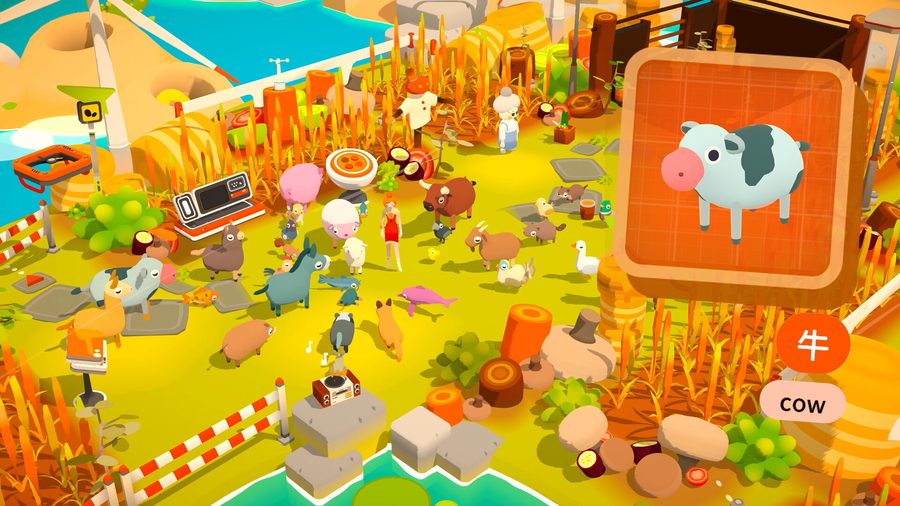
Screenshot from the Noun Town Steam store page, showing how new words are introduced through play rather than a worksheet
How a game gets introduced often matters more than which game gets chosen. A handful of small decisions can determine whether it becomes a genuine outlet or just another chore with a screen attached.
See whether Noun Town clicks with a reluctant learner in your house.
Try Noun Town on SteamGames give immediate, visible feedback and let a child fail privately and try again without an audience. Traditional schoolwork often does the opposite: delayed feedback, a fixed pace, and mistakes that get marked in front of a class. It is rarely a motivation problem in general, it is a mismatch between how the child processes information and how the work is delivered.
Research is mixed but generally positive on engagement and short to medium term learning outcomes, with a 2024 meta-analysis of gamification studies finding real gains in motivation and academic performance. The caveat is that novelty wears off, so a game needs genuine mechanics behind the fun, not just points and badges, to keep working after the first few weeks.
Noun Town has no violence, no chat with strangers, and no in game purchases, which makes it suitable for most children old enough to read simple words or recognise pictures, roughly age 7 and up depending on the child. Younger children often enjoy exploring the 3D world alongside a parent even before they are reading independently.
Yes. Every word is paired with native speaker audio and a 3D object in the world, so a child can learn and recognise vocabulary by sound and image before they need to read it fluently. This tends to help kids who find text heavy worksheets discouraging.
Fifteen to twenty five minutes of focused, self directed play tends to beat an hour of half attention, especially early on. Noun Town's spaced repetition system is built around short daily sessions rather than long cramming, so there is no benefit to forcing longer sessions than a child wants.
Often yes, for the same reasons they work for reluctant learners generally: short feedback loops, movement and exploration instead of sitting still, and no penalty for losing focus and coming back later. Every child is different, so it is worth trying a demo before committing to a full purchase.
That is common with any new game and is not necessarily a sign it failed. Try playing alongside them for a session or two rather than handing it over and checking back later, since a lot of the appeal comes from feeling like an activity rather than an assignment. If interest genuinely does not return after a fair trial, it is fine to try something else.
Yes, a free demo is available on Steam alongside the full $19.99 one time purchase version. There is no subscription and nothing is paywalled once the game is owned.
Yes, Noun Town runs natively on both PC and Mac through Steam. There is no VR requirement and no separate console version needed.
Noun Town includes 12 languages in one purchase, including Japanese, Korean, Spanish, French, German and more, so siblings can each pick their own language or switch between them freely without buying separate copies.