
U.S. Navy photo by Chief Photographer's Mate Spike Call (public domain), via Wikimedia Commons
Short answer: The best educational Steam games to gift are ones that work as real games first, with learning built in rather than bolted on. Good picks span language learning (Noun Town, 12 languages, $19.99), coding (Human Resource Machine, around $10), and space engineering (Kerbal Space Program, around $40 but frequently discounted). Steam lets you gift any of these directly to someone's account or as a redeemable code.
Buying a gift for someone who already has everything is hard. Buying a gift that is actually good for them, rather than just another thing to own, is harder still. Educational games sit in a strange, useful spot here: they read as a normal, fun gift, but they also quietly do something useful, which makes them a good answer to "I don't know what to get them."
We make one of the games on this list, so full disclosure there. But most of what follows covers other titles, because a gift guide that only mentions its own product is not actually a gift guide.
A language app subscription is an odd gift, because it usually needs the recipient to keep paying after the first year to keep using it. A language learning game like Noun Town avoids that problem by being a single purchase. It covers 12 languages including Spanish, French, Japanese, Korean and Mandarin, teaches vocabulary through a 3D open world with native speaker audio, and uses spaced repetition to keep words from fading once learned.
It costs $19.99, works on PC and Mac, and has no ads or additional paywalled content once purchased, which matters for a gift specifically: nobody wants to give something that later starts asking the recipient for more money to keep working.
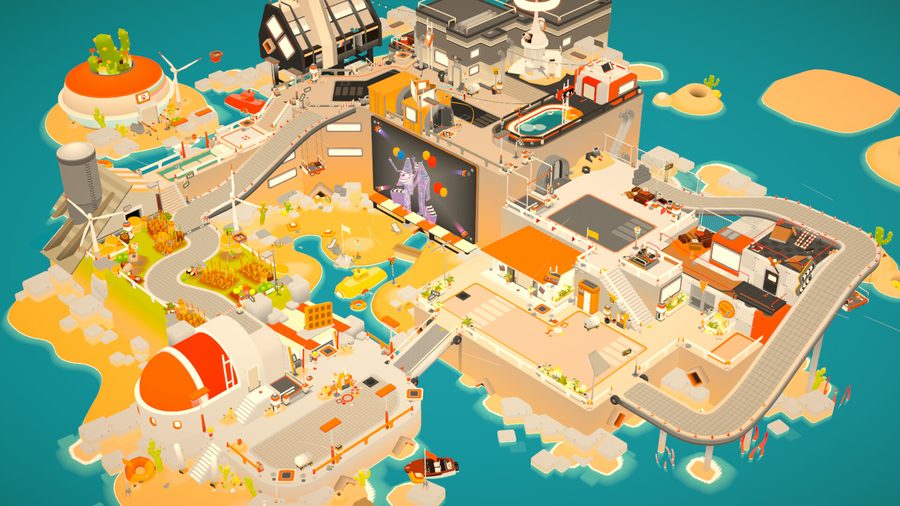
Screenshot from the Noun Town Steam store page
Human Resource Machine and its sequel 7 Billion Humans, both by Tomorrow Corporation, teach real computational thinking concepts through puzzle solving rather than a formal coding language. They are approachable for someone with zero programming background but still satisfying for someone with some experience, which makes them a safe gift when you are not sure of the recipient's exact skill level.
Kerbal Space Program is the classic pick here. Players design, build and launch rockets, learning genuine orbital mechanics concepts through a long process of trial, error and dramatic failure. It rewards patience more than the other games on this list, so it suits someone who already enjoys tinkering or simulation games rather than someone looking for a quick session.
Strategy games set in real historical periods, such as the Total War series or Europa Universalis IV, teach a surprising amount of incidental history and geography through repeated play, even though neither is marketed as educational software. They suit an older teenager or adult who already enjoys strategy games, since both have a real learning curve before they become genuinely fun.
| Game | Best for | Approx. price | Learning curve |
|---|---|---|---|
| Noun Town | Language learners, all ages | $19.99 | Gentle |
| Human Resource Machine | New programmers | ~$10 | Gentle to moderate |
| 7 Billion Humans | Programmers with some experience | ~$15 | Moderate |
| Kerbal Space Program | Space and engineering fans | ~$40 (often discounted) | Steep |
| Total War / Europa Universalis IV | History and strategy fans | $20 to $50 | Steep |
Steam offers two ways to give a game as a present, both straightforward once you know they exist.
If you are not sure whether a game will land well, check whether it has a free demo first. Playing a short session yourself before buying it for someone else is a good way to confirm the pacing and difficulty actually suit them.
Thinking of gifting a language learning game? There is a free demo on Steam.
Try Noun Town on SteamYes. Steam lets you buy a game directly for another user's account if you know their Steam ID or profile link, or you can purchase a digital gift that they redeem themselves. Both options work for every game mentioned in this article, including Noun Town.
It depends on the recipient's interests, but Noun Town works well for anyone learning a language, Kerbal Space Program suits people interested in space and engineering, and Human Resource Machine is a good pick for someone curious about coding without wanting a full programming course.
The best ones genuinely hold up as games first. They are built around exploration, puzzles or open worlds that people would enjoy even without the learning angle, with the educational content woven into the experience rather than bolted on as a quiz screen.
Prices in this list range from free demos up to around $25, with most sitting between $15 and $20. That is generally in line with other indie titles on Steam and often cheaper than a year of a subscription-based learning app.
Yes, particularly for someone planning travel, reconnecting with a heritage language, or who has tried and abandoned an app-based course before. A game format removes some of the classroom feeling that puts adults off traditional lessons.
Most of the games in this list suit ages ten and up, with a few, including Noun Town, working well for adults specifically. Always check the store page's content descriptors for the exact recipient before buying, especially for younger teenagers.
Yes. It covers 12 languages, works on PC and Mac, and is a single $19.99 purchase with no ads and nothing paywalled afterwards, which avoids the awkwardness of gifting someone a subscription that then needs ongoing payment to keep working.
For games with a free demo, including Noun Town, you can play the demo yourself first to judge the quality before buying it for someone else. This is a useful step if you are not familiar with the game already.
Most single-player titles on this list, including Noun Town, can be played offline once downloaded and installed, though the initial download and any Steam account verification does require a connection.
Check the system requirements on the game's Steam page first. Most of the titles in this list, including Noun Town, run comfortably on modest laptops and Mac computers, not just high-end gaming rigs, so a dedicated gaming PC is not required.