Photo: Wikimedia Commons (CC BY-SA 4.0)
Short answer: The best gifts for someone learning Spanish match how they already like to learn. Readers do well with graded readers or short story collections. Listeners do well with podcast subscriptions or audio courses. Gamers do well with a language learning game like Noun Town, which costs a one-time $19.99 and covers both Spain Spanish and Mexican Spanish. Below are ten options across a range of prices, from small stocking fillers under $10 up to bigger centrepiece gifts.
Buying a gift for someone learning a language is trickier than it looks. Get it wrong and you end up with an unused textbook sitting on a shelf. Get it right and you have handed someone a tool they actually reach for on a quiet Tuesday evening.
We put this list together after asking around, including our own community of Spanish learners who play Noun Town. A few of these come from us, most do not, and none of the non-Noun Town picks earn us anything if you buy them.
Graded readers are written specifically for learners, using simplified vocabulary and grammar that scales up with skill level. They are one of the most consistently recommended tools by Spanish teachers, because they let a learner read something that feels like a real book without the frustration of needing a dictionary for every third word.
Look for collections aimed at your recipient's level, roughly matching the CEFR scale if the packaging mentions it. A1 to A2 suits complete beginners, B1 upward suits someone who already has a year or two of study behind them.
$10-$18 per book, or look for a boxed set for slightly better value.
If the person you are buying for already owns a gaming PC or a Mac, a language learning game solves a real problem: most learners quit not because the material is too hard, but because they get bored of the format. A game changes the format entirely.
Noun Town is a 3D open world where players pick up Spanish vocabulary through exploration, native speaker audio and spaced repetition reviews, rather than flashcard drilling in isolation. It covers Spain Spanish and Mexican Spanish as separate options, so check which dialect fits before buying.
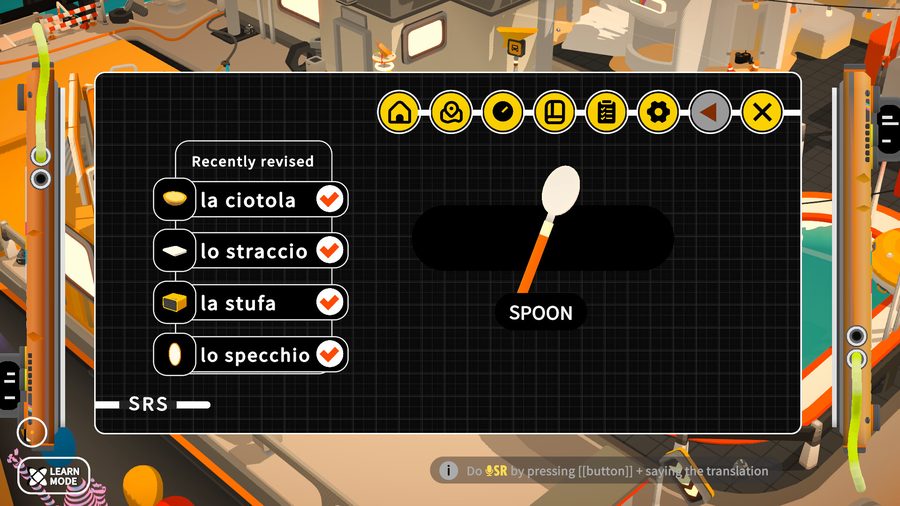
Screenshot from the Noun Town Steam store page, showing the spaced repetition review screen
Because it is a single $19.99 purchase on Steam with no ads and nothing locked behind an extra paywall, gifting it is simple: buy a Steam gift card or send the game directly, and the recipient has everything from the moment they open it. There is also a free demo, useful if you want them to try it themselves before you commit to buying.
Listening comprehension tends to lag behind reading for most learners, simply because natural speech is faster and messier than textbook Spanish. A subscription to a dedicated learner podcast, several of which offer ad-free premium tiers with transcripts, is a genuinely useful gift for someone past the absolute beginner stage.
$4-$8 per month, often available as an annual gift subscription.
Unglamorous, but reliable. A well-made pocket dictionary or phrasebook is small enough to travel with and does not depend on battery life or wifi. It is a natural pairing gift alongside something bigger, like a game or a course.
$8-$15
Watching Spanish-language film and television with subtitles is one of the more enjoyable ways to build listening skills and pick up natural phrasing. If the recipient already has a streaming service, gifting a few months of a language-focused add-on, or simply a gift card earmarked for this, is low effort and genuinely used.
Flashcards get a mixed reputation, mostly because drilling isolated cards for hours is tedious. But a small, well-illustrated set covering everyday nouns is a nice low-pressure stocking filler, especially for visual learners or children just starting out.
$8-$14 for a themed deck of 50 to 100 cards.
For a bigger, more personal gift, a block of sessions with a native-speaking tutor is hard to beat. This is a good option for someone who has plateaued with self-study and needs conversation practice with real-time correction, something no app or game currently replicates well.
$60-$200+ depending on session count and tutor experience.
Small, playful items are underrated as add-on gifts. A mug printed with common Spanish phrases, a notebook with vocabulary prompts, or a sheet of Spanish word stickers cost very little and add a bit of daily, low-effort exposure to the language around the house.
$5-$15
If the recipient prefers a more traditional lesson structure over a game or reader, a subscription to a course-based app is still a solid choice. The main gifting caveat is that most run on recurring billing, so a prepaid gift code or gift card is more considerate than handing over a login.
An unusual but well-loved option among intermediate to advanced learners. Recipes combine vocabulary with a tactile, rewarding activity, and regional cookbooks from Mexico, Spain or elsewhere in Latin America double as a small cultural deep dive.
$18-$35
| Gift | Best for | Typical price |
|---|---|---|
| Graded reader | Readers, quiet study time | $10-$18 |
| Noun Town (language game) | Gamers, PC/Mac owners | $19.99 |
| Podcast subscription | Commuters, intermediate learners | $4-$8/mo |
| Phrasebook or dictionary | Travellers, beginners | $8-$15 |
| Streaming add-on | Film and TV fans | Varies |
| Flashcards | Visual learners, kids | $8-$14 |
| Tutoring package | Learners who have plateaued | $60-$200+ |
| Themed mug/stickers | Low-cost stocking filler | $5-$15 |
| Course app subscription | Structured learners | Varies |
| Cookbook | Intermediate to advanced | $18-$35 |
If a game feels like the right fit, there is a free demo of Noun Town on Steam so they can try before you commit.
Try Noun Town on SteamGood options include a graded reader or short story collection in Spanish, a subscription to a Spanish podcast or listening app, a language learning game like Noun Town, a pocket dictionary, or a Spanish-language streaming subscription. The best gift usually matches how the person already likes to learn, whether that is reading, listening or playing.
It can be, though many apps run on subscriptions, so a gift card or a prepaid year is more useful than logging into someone else's account. A one-time purchase option like a language game avoids this problem entirely, since the gift is complete the moment it is given.
Avoid heavy grammar textbooks unless you know the person specifically wants one, since most beginners find them dry as a first gift. Also be cautious with subscription products that lock content behind a paywall after a free trial, as this can feel like a gift with strings attached.
There is a genuinely useful gift at almost every price point. A pocket phrasebook or set of flashcards can cost under $10. A well-reviewed graded reader or a language game typically falls between $15 and $25. Premium tutoring packages or annual app subscriptions run considerably higher, often $100 or more.
Yes, particularly for someone who already enjoys gaming on PC or Mac. Noun Town covers both Spain Spanish and Mexican Spanish, costs a one-time $19.99 with no ads or paywalls, and comes with a free demo, so the recipient can try it before you commit to the full purchase.
Beginners tend to benefit most from vocabulary-building tools, visual aids and gentle, low-pressure practice like a game or graded reader. Advanced learners often prefer authentic media, such as a Spanish-language novel, film subscription or a subscription to a Spanish news outlet, since they are past the stage of needing simplified material.
This guide does not use affiliate links. Noun Town is our own product and is included because we genuinely think it fits this list, but every other recommendation here is included on merit alone, with no commercial relationship behind it.
The two dialects share the vast majority of vocabulary and grammar, but differ in accent, some slang, and a handful of everyday words. If you know which region the learner is focused on, choose a resource or game edition that matches it. Noun Town offers both Spain Spanish and Mexican Spanish as separate options.
Neither is objectively better. Physical gifts like books, flashcards or a themed mug feel more personal and unwrap well, while digital gifts like a game key or app subscription are often more genuinely useful day to day. Many people combine one of each in a single gift.
A pack of illustrated Spanish vocabulary flashcards, a small phrasebook, Spanish-language stickers or a fridge magnet set with common words are all inexpensive options that add a bit of daily exposure without being the centrepiece gift.