Photo: Brian Wong / Wikimedia Commons (CC BY-SA 2.0)
Short answer: Most idle games only teach you to watch numbers climb, but a handful genuinely teach real subjects while you play. Our picks: Cell to Singularity (evolutionary biology), Bitburner (JavaScript programming), Idle Champions of the Forgotten Realms (D&D lore), Melvor Idle and Screeps: World (systems thinking and automation), and Noun Town: Learn & Chill, built specifically to teach vocabulary in 12 languages through short idle sessions.
Idle games get a bad reputation for being mindless. You tap a button, a number gets bigger, you come back six hours later and the number is bigger still. For most of the genre that reputation is fair. But a small, growing slice of idle and incremental games have started wrapping that same addictive progression loop around a real body of knowledge, so the time you spend watching numbers climb is also time spent actually learning something.
We went looking for the best examples currently on Steam, verified pricing and platform support directly against the store, and picked five that hold up. We also included Noun Town: Learn & Chill, our own idle take on language learning, because it was built to solve exactly this problem for vocabulary specifically.
Not every idle game with an educational veneer counts. A game that slaps a science-sounding name on generic resource icons is not teaching anything, it is just theming. For a game to make this list, the subject matter has to be accurate, the game has to present real information rather than vague flavour text, and the learning has to happen as a natural byproduct of playing rather than a separate quiz bolted onto the side.
That ruled out a lot of contenders. It also meant checking each entry against Steam's own store data rather than relying on marketing copy, since idle games in particular tend to get their pricing and platform support out of date on third-party lists.
Cell to Singularity takes you from a single cell to the emergence of complex life, technology and beyond, with short factual entries attached to each stage of the tree of life you unlock. It is the most directly educational game on this list, built around a real, if compressed, timeline of evolutionary biology. Expansions have added dinosaurs, mammals and deeper cosmology content over time.
Bitburner is an idle and incremental game where your progress is driven by writing actual JavaScript. You automate hacking targets, manage servers and optimise scripts, and the game does not hide the code from you, it makes writing and improving it the entire point. Plenty of players who picked it up out of curiosity have come away with a working grasp of loops, functions and basic scripting, the same fundamentals covered in beginner resources like the MDN JavaScript documentation.
This one teaches lore rather than a hard skill. Idle Champions assembles a roster of characters pulled directly from the wider Dungeons & Dragons multiverse, and playing through its campaigns is a genuinely thorough, if unconventional, introduction to decades of D&D characters, settings and storylines for anyone who has never touched the tabletop game.
Melvor Idle strips a full RPG down to its skill and resource systems: mining, crafting, combat, farming, all running on interlocking progression curves. It will not teach you a textbook subject, but it is a genuinely useful hands-on introduction to systems thinking, the kind of resource allocation and opportunity cost reasoning that shows up in economics and operations. If you want to understand why a supply chain or a tech tree behaves the way it does, building one yourself teaches it faster than reading about it.
Screeps takes the Bitburner idea and turns it into a persistent multiplayer world. You write JavaScript that runs your colony 24 hours a day, competing against other players' code for territory and resources. It is a steeper learning curve than Bitburner, aimed more at people who already know some programming and want to apply it somewhere with real consequences, but it is one of the few games anywhere that treats writing production-style code as the actual gameplay.
We built Noun Town: Learn & Chill after noticing the same gap ourselves: idle games teach evolution, code and lore, but nothing in the genre was built specifically around vocabulary acquisition. It takes the audio, spaced repetition and native speaker recordings from the main Noun Town language game and drops them into a shorter, lower-pressure idle loop, so a language session can fit into the same few spare minutes you would otherwise spend clicking a cookie.
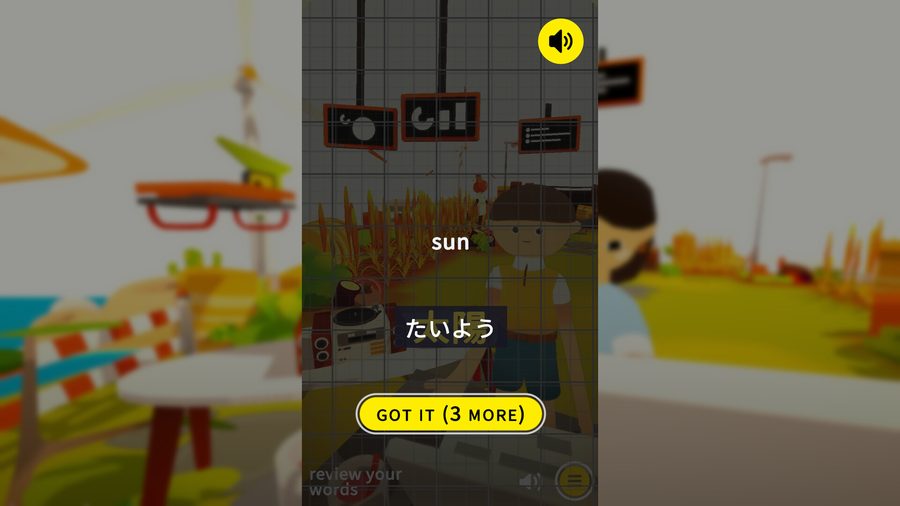
Screenshot from the Noun Town: Learn & Chill Steam store page, showing a spaced repetition review card
It currently covers all 12 of the languages the main Noun Town game supports and runs on Windows only for now. It is not trying to replace a deep, structured language learning session, but as an idle game specifically, it fills the same role Cell to Singularity fills for evolution or Bitburner fills for code.
Want to see what an idle language game actually looks like?
Try Learn & Chill on SteamAn idle game, also called an incremental game, is a game where progress continues even when you are not actively playing. You check in periodically, spend resources that built up while you were away, then leave it running again. The genre grew out of browser experiments like Cookie Clicker and now has a large presence on Steam.
Most idle games are built purely around number progression and do not teach anything beyond resource management. A smaller group of idle games wrap that same progression loop around a real subject, such as evolutionary biology, programming, or vocabulary, so the numbers going up are attached to actual knowledge rather than arbitrary currency.
Cell to Singularity: Evolution Never Ends is the clearest example. It walks players from single-celled organisms through the tree of life to modern technology, with short factual write-ups attached to each evolutionary stage you unlock.
Yes. Bitburner is an idle and incremental game where progress is driven by writing real JavaScript to automate tasks inside a simulated computer network. Players who finish the game have usually written working scripts, loops and functions along the way, even if that was not their original goal.
Yes. Noun Town: Learn & Chill is an idle game built specifically to teach vocabulary in 12 languages, using spaced repetition and native speaker audio dropped into a relaxed, low-pressure idle loop rather than a formal lesson screen.
Three of the five games covered here, Cell to Singularity, Bitburner and Idle Champions of the Forgotten Realms, are free to start on Steam. Melvor Idle and Screeps: World are paid, and Noun Town: Learn & Chill is a low-cost one-time purchase.
That is the appeal of the genre. Most sessions are two to ten minutes of active decisions, spread across a day, with the game continuing to progress in the background. Total daily time investment for an idle game rarely needs to exceed 15 to 20 minutes to see steady progress.
It varies by title. Cell to Singularity, Bitburner, Melvor Idle, Screeps: World and Idle Champions of the Forgotten Realms all support Mac. Noun Town: Learn & Chill currently supports Windows only.
The terms overlap a lot. A clicker game usually emphasises active clicking to generate resources, while an idle game emphasises resources accumulating whether you are present or not. Many modern titles, including all five covered here, blend both, with clicking speeding things up but idle progress carrying you the rest of the time.
Yes. Noun Town: Learn & Chill is a separate, lighter idle experience built around the same vocabulary and audio content as the main Noun Town language learning game, but structured around short, low-pressure idle sessions instead of an open 3D world to explore.
Match the game to the subject you want. Cell to Singularity for evolution and cosmology, Bitburner for programming fundamentals, Idle Champions of the Forgotten Realms for D&D lore and characters, and Noun Town: Learn & Chill if the goal is a new language rather than a specific subject.