
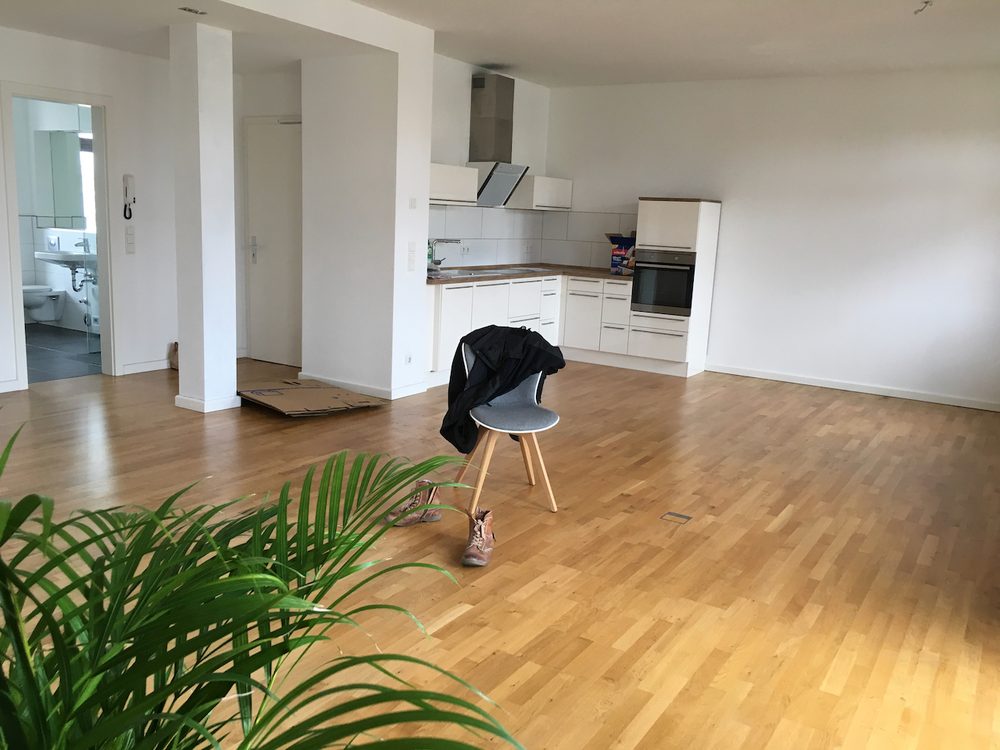
Photo: SmashingIt99 / Wikimedia Commons (CC0)
German household vocabulary covers the everyday nouns you need to describe a home: things like der Tisch (table), der Stuhl (chair), das Bett (bed) and der Kühlschrank (fridge). Learning around 20 to 30 of these core words is usually enough to describe most rooms in a house and hold a basic conversation about where things are. Household objects are also one of the easiest places to start learning German, since every word can be attached to something you can physically point at.
Short answer: Around 40 to 60 German words cover furniture, appliances and rooms in enough detail for everyday conversation. Every noun needs its article (der, die or das) memorised alongside it, and many household words, like der Kühlschrank and der Staubsauger, are built by combining two smaller words.
Beginners are often told to learn common verbs first, but nouns you can see and touch have a real advantage: they don't need context to make sense. You can point at a chair, say der Stuhl, and the meaning is immediate. There's no tense, no conjugation, and no ambiguity about what's being referred to.
This is part of the thinking behind teaching vocabulary through nouns in spatial context rather than through abstract word lists. When a word is tied to an object in a specific place, your brain has more to hold onto than just a translation pair, which tends to make the word stick for longer.
Household vocabulary also comes up constantly in real life, whether you're renting an apartment, describing your living situation to a German speaking friend, or just narrating your day. It's practical vocabulary from the very first lesson, not something you'll only need in a specific niche situation.
Every noun on this list carries one of three genders: der (masculine), die (feminine) or das (neuter), and there's no dependable shortcut for guessing which one applies. Der Tisch (table) is masculine, die Lampe (lamp) is feminine, and das Bett (bed) is neuter, and none of that follows from anything in the English translation.
A few loose patterns exist. Many nouns ending in -e, like die Lampe or die Küche, tend to be feminine, and diminutive nouns ending in -chen or -lein are always neuter. But these are tendencies rather than rules, and relying on them too heavily will eventually trip you up, so the safest approach is still to learn the article with the noun as a single unit from the start.
This is one of the areas where German grammatical gender differs sharply from English, which lost noun gender centuries ago. Spending extra time on articles early tends to pay off, since fixing gender mistakes later, once a word is already memorised without its article, is much harder than learning it correctly the first time.
In der Küche (in the kitchen)
Im Wohnzimmer (in the living room)
Im Schlafzimmer (in the bedroom)
Im Badezimmer (in the bathroom)
Once you're comfortable with these four rooms, most everyday descriptions of a home are within reach. Furniture and appliance vocabulary doesn't change much between apartments and houses, so this same core list carries you a long way regardless of what kind of home you're describing.

Screenshot from the Noun Town Steam store page, showing how a single object becomes a vocabulary flashcard in context
German has a habit that trips learners up at first and then quietly becomes one of the most useful things about the language: it builds new words by sticking existing ones together rather than borrowing or coining something new. Once you notice the pattern, a lot of long, intimidating looking words turn out to be two or three simple words in a trench coat.
Take der Kühlschrank. Break it into kühl (cool) and der Schrank (cupboard), and it translates literally to "cool cupboard," which is exactly what a fridge is. Der Staubsauger works the same way, built from der Staub (dust) and saugen (to suck), giving you "dust sucker" for a vacuum cleaner. Der Fernseher comes from fern (far) and sehen (to see), so a television is literally a "far-seer."
This matters practically because it means vocabulary growth in German isn't purely additive. Once you know a decent set of base words like Schrank, Staub, and sehen, you can often guess the meaning of a compound word you've never seen before, or at least remember a new one more easily because it's built from pieces you already recognise.
Household vocabulary has one big advantage over almost any other category: you're surrounded by the objects it describes all day, every day. That makes it one of the easiest categories to reinforce without any extra study time.
Resources like Deutsche Welle's free Deutsch lernen course and the Goethe-Institut both have themed vocabulary units around the home that pair well with this kind of practice, and a dictionary like Duden is worth bookmarking for checking gender and plural forms as you go, since German plurals don't follow one consistent rule either.
Games that place vocabulary inside a real scene take this a step further by doing the labelling for you. Noun Town teaches household words inside actual 3D kitchens, living rooms and bedrooms, complete with native speaker audio for each object, and brings words back for review through a built in spaced repetition system rather than leaving that scheduling up to you.
Want to learn household vocabulary the way it sticks best, attached to the actual object?
Try Noun Town on SteamCommon household words include der Tisch (table), der Stuhl (chair), das Bett (bed), der Kühlschrank (fridge), das Sofa (sofa), die Lampe (lamp) and der Schrank (cupboard or wardrobe). Learning around 20 to 30 of these covers most everyday conversation about a home.
German inherited grammatical gender from older Germanic languages, and it survives today as a required part of the grammar. Every noun is classified as masculine (der), feminine (die) or neuter (das), and the article changes depending on the noun's role in a sentence.
Kitchen is die Küche in German. It's a feminine noun, so it always pairs with die, and with der in the dative case, as in in der Küche, meaning in the kitchen.
Furniture is die Möbel in German, and it's almost always used in the plural, similar to how English can treat furniture as a mass noun. A single piece of furniture is ein Möbelstück.
Refrigerator is der Kühlschrank, a compound of kühl (cool) and der Schrank (cupboard), so it translates literally to cool cupboard.
German freely combines existing words to name new objects rather than borrowing or inventing separate words. A vacuum cleaner becomes der Staubsauger, from Staub (dust) and saugen (to suck), and a television becomes der Fernseher, from fern (far) and sehen (to see).
Label objects in your own home with sticky notes showing the German word and its article, then quiz yourself by walking through each room. Pairing a word with the physical object and reviewing it again after a short gap works better than memorising a plain word list.
Around 40 to 60 words covers furniture, appliances and rooms in enough detail to describe a home in conversation, including basic rooms, main furniture pieces, and common appliances.
Yes. German is one of the 12 languages in Noun Town, and household objects are taught inside 3D scenes such as kitchens and living rooms, with native speaker audio and spaced repetition review.
Starting with concrete nouns, especially ones you can see and touch around the house, gives beginners an immediate, low pressure way to build vocabulary before tackling verb conjugation, which is one of the more complex parts of German grammar.