
Photo: Shixart1985 / Wikimedia Commons (CC BY 2.0)
Short answer: Work with your attention instead of scheduling against it. That means shorter, more varied sessions, permission to stop when interest drops, tools that change shape rather than repeat the same drill, and treating hyperfocus as a bonus rather than something you can plan around. ADHD does not make a language harder to learn, it just makes certain delivery formats a much worse fit than others.
I've had this conversation more times than I can count, usually with players who message us after finishing a Noun Town session that ran way longer than they intended. A common line is something like "I have ADHD and I've never sat still with a language app for more than five minutes, what happened here." It's a fair question, and it's worth answering properly rather than just taking the compliment.
None of what follows is medical advice. I'm not a clinician, I build learning tools. But building tools for people means paying close attention to why some formats hold attention and others quietly get abandoned, and that's the angle this post comes from.
Most language advice assumes a fixed daily block: fifteen minutes every evening, same time, same place. That structure works for a lot of people. For a lot of ADHD brains, it creates a new obligation to fail at, which adds guilt on top of the original difficulty of learning the language.
A more workable frame is treating language exposure as something that happens in whatever pockets of genuine interest show up during the day, rather than a scheduled appointment. Some days that's two minutes. Some days it's an hour and a half because something clicked. Both are fine.
"Fun" gets used loosely in this space and doesn't always mean much. What actually matters is whether the tool's format changes moment to moment. A flashcard app dressed up with animations is still, underneath, the same repeating loop. A tool where you're listening one minute, exploring the next, and talking to a character after that gives your attention something new to latch onto continuously.
Open whatever app or game you're considering and time how long you go before the screen layout repeats itself in a way that feels identical to five minutes ago. Tools with a short repeat cycle tend to lose ADHD attention fastest.
This is where a lot of people find that games fit better than traditional apps, and it's part of why we built Noun Town the way we did. A 3D world gives you a constant stream of new things to look at and interact with, and the vocabulary rides along with that rather than being the entire point of every screen. That's not a universal fix. Some people concentrate better with less visual stimulation, not more. But if flashcard apps have consistently failed you, an exploration-based format is worth trying before assuming the language itself is the problem.
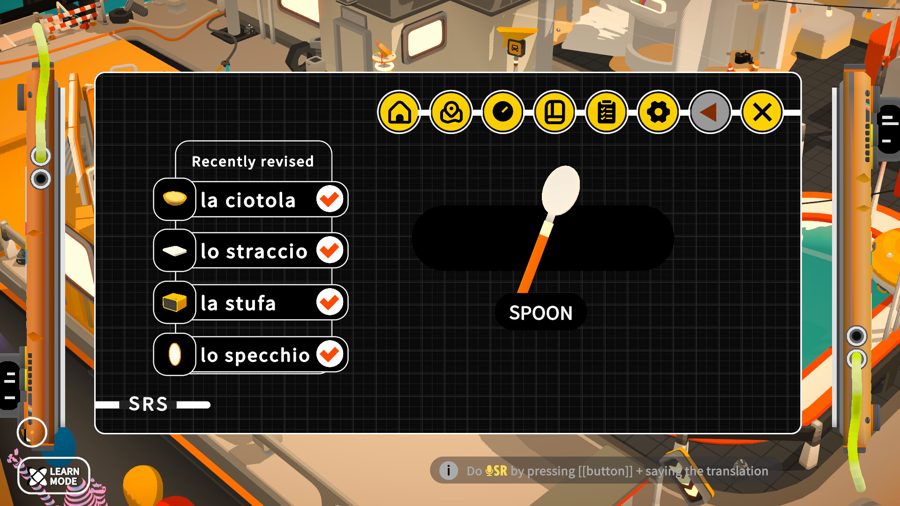
Screenshot from the Noun Town Steam store page, showing the in-game vocabulary review screen
If you occasionally lose two hours to something language-related without noticing the time pass, that's not a distraction from your plan, that's the plan working better than usual. Don't cut a session short just because it's run past whatever number you had in your head. The mistake most people make is treating hyperfocus sessions as unreliable and therefore not worth counting on, when actually the better move is removing anything that would interrupt one if it starts. Silence notifications, don't schedule anything for an hour after a session begins if you can help it, and let it run.
The flip side matters too: don't expect hyperfocus on command. Build a lighter, low-stakes baseline habit for the days it doesn't show up, so progress doesn't depend entirely on unpredictable good days.
One number worth knowing if you're weighing up whether to buy a language game versus subscribing to another app: Noun Town is a single $19.99 purchase covering all 12 supported languages, with no ads and nothing locked behind a later paywall. That matters more than it sounds for anyone with ADHD, since an ad interrupting a session you were finally locked into can undo twenty minutes of hard-won focus in about four seconds.
Stop blaming yourself for not sticking with tools that were never built with your attention in mind. Try a few different formats deliberately, notice which one you return to without being nagged by a notification, and build your routine around that instead of the one a generic study guide recommends. For background on attention and how it's typically described clinically, the Wikipedia entry on ADHD is a reasonable starting point, and the British Council has solid general resources on language learning approaches if you want a second opinion outside gaming entirely. The Wikipedia page on spaced repetition is also worth a look if you want to understand why short, repeated exposure works regardless of which tool delivers it.
Want to see whether an explorable world holds your attention better than a flashcard deck? There is a free demo on Steam.
Try Noun Town on SteamIt can be harder with tools designed around long, repetitive routines, but ADHD does not lower someone's capacity to learn a language. The difficulty usually comes from a mismatch between how the material is delivered and how attention naturally works, not from ability.
There is no single best method, but short, varied, low-pressure sessions tend to outperform long scheduled study blocks. Mixing formats, listening one day, an interactive game the next, a conversation the day after, keeps the material feeling new rather than repetitive.
Ten to twenty minutes of genuinely engaged practice most days tends to beat one long weekly session, because consistency matters more than duration for vocabulary retention. If a session naturally runs longer because it is holding your attention, that is a good sign, not something to cut short.
Several tools used deliberately often works better than one tool used out of obligation. Rotating between a vocabulary game, a grammar resource and occasional conversation practice gives the brain variety while still covering the different skills a language actually needs.
It can help enormously when it happens, since a genuine hyperfocus session can cover more ground than days of forced short sessions. The catch is that hyperfocus cannot be scheduled reliably, so it works best as a bonus on top of a lighter regular routine rather than the whole plan.
Well-designed games can teach vocabulary and listening comprehension effectively, particularly when words are tied to objects, sounds and actions rather than presented as isolated flashcards. Games are generally weaker than structured courses at explicit grammar teaching, so they work best alongside a grammar resource rather than replacing one entirely.
Stop, rather than forcing through it. A short session that ends while you still feel neutral about the material is easier to return to tomorrow than a long session that ends in frustration. Forcing focus that has already left tends to build resentment toward the whole habit.
No, Noun Town was not designed as a clinical or accessibility tool. It is a general language learning game built around an explorable 3D world, and its variety and pacing happen to suit some ADHD attention patterns well, based on player feedback we have received directly.
No. It is a single $19.99 purchase covering all 12 supported languages, with no ads and nothing paywalled afterward. That was a deliberate choice, since interruptions like ads can be especially disruptive to attention that is already working hard to stay engaged.