
Photo: Árni Dagur / Wikimedia Commons (CC0)
Short answer: Language learning is hard with ADHD mainly because most study methods rely on repeated, low-novelty practice held together by willpower, and that is exactly the combination the ADHD brain struggles to sustain. It is not a lack of ability. The fix is usually to change the format of practice, not to try harder at the same format.
If you have started three language apps this year and finished none of them, you have probably already been told the problem is discipline. That explanation is common, and it is mostly wrong. ADHD affects the systems in the brain responsible for sustaining attention on tasks that do not deliver quick, varied reward, and traditional language study is built almost entirely around exactly that kind of task.
A pattern shows up again and again in accounts from adults with ADHD: strong, genuine motivation to learn a language, paired with an inability to actually open the app or sit down with the textbook on a given day. If discipline were the missing ingredient, more effort would fix it. For most ADHD learners it does not, because effort was never the thing running short.
It is worth separating this from laziness or lack of interest, because the two get confused constantly, including by the person experiencing it. Someone can be deeply motivated to learn Japanese and still avoid their study app for two weeks straight, not because they stopped caring, but because wanting to do something and being able to reliably start doing it are handled by different systems in the brain.
This gap between intention and action is sometimes called task initiation difficulty, and it is one of the more consistently reported executive function challenges associated with ADHD, according to organisations like CHADD, the US National Resource Center on ADHD. Consistency, not motivation, is usually the actual bottleneck. Study plans that assume steady daily effort tend to collapse quickly, then get quietly blamed on the learner rather than on a plan that never matched how they operate.
Layered on top of that is repetition. Vocabulary acquisition leans heavily on it: you see a word, you are tested on it, you see it again later, and eventually it sticks. That is not optional, it reflects how memory consolidation actually works for everyone. The problem is that repetition without variation is one of the least rewarding activities for a brain that regulates attention through novelty and dopamine, which is a defining feature of ADHD according to neurobiological research summarised by groups such as the Attention Deficit Disorder Association. A flashcard deck presents the same format over and over, and even useful, well designed repetition can feel unbearable after the fifth near-identical screen in a row.
Beyond attention, ADHD is also associated with differences in working memory, the mental workspace used to hold and manipulate information in the moment. Grammar in particular often requires holding a rule in mind while applying it to a new sentence, which draws directly on working memory capacity. This is separate from vocabulary difficulty and can make grammar-heavy lessons feel more draining than they would for a learner without ADHD.
Sound, movement, story and interactivity all recruit more of the brain than static text does, which is part of why they tend to hold attention longer for ADHD learners specifically, though the benefit is not exclusive to ADHD. A lesson that requires listening, watching and responding is doing more of the attentional work for you than a page of vocabulary you have to force yourself to read.
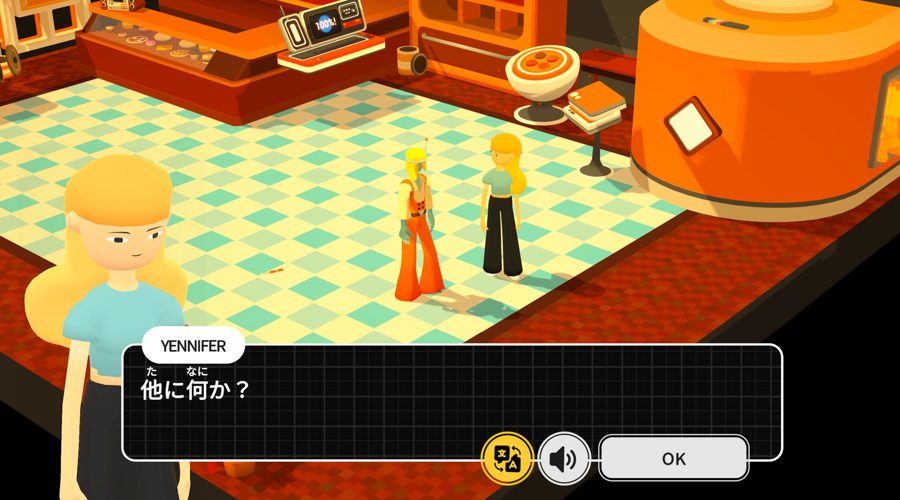
Screenshot from the Noun Town Steam store page, showing a spoken dialogue exchange with an in-game character
This is part of the reasoning behind Noun Town's approach. Rather than a lesson list, the game puts vocabulary into a 3D world you explore, with native speaker audio attached to objects and characters rather than isolated on a flashcard. You can look at our language learning game to see the format directly. It is not a treatment for ADHD and we are careful not to suggest otherwise, but the engagement-first design happens to line up well with what actually helps attention regulate itself during study: shorter natural stopping points, built-in novelty, and no punishment for pausing or coming back late.

Screenshot from the Noun Town Steam store page, showing the open explorable world
Spaced repetition is a scheduling technique where words are shown again right before you are statistically likely to forget them, rather than on a fixed daily schedule you have to remember to follow yourself. It is genuinely powerful, and it gets recommended constantly. But recommending the technique on its own quietly assumes the person will keep opening the app to use it, which is precisely the part ADHD makes hardest.
A perfect scheduling algorithm attached to a boring interface still gets abandoned. The format wrapped around spaced repetition matters as much as the technique itself, sometimes more.
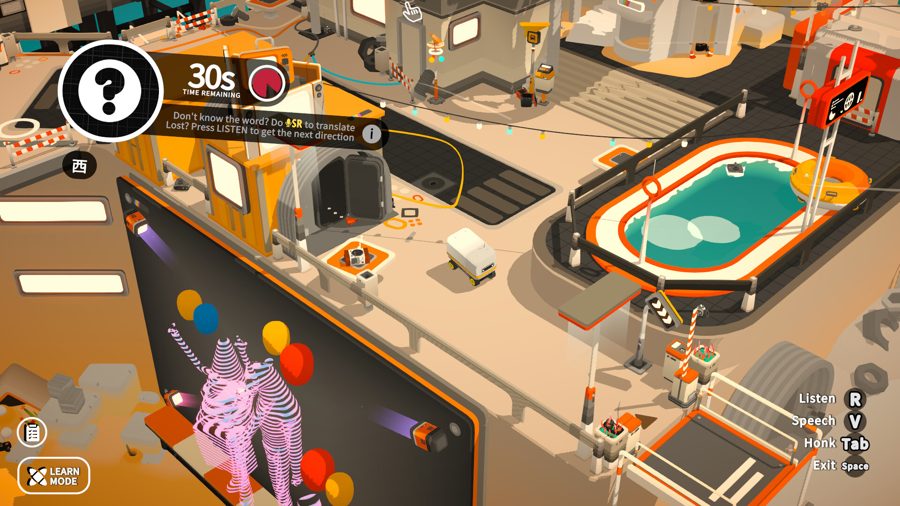
Screenshot from the Noun Town Steam store page, showing a timed in-game challenge that adds novelty to review
Long, structured study blocks are the format most likely to be planned and then skipped. A more realistic approach for many ADHD learners is short, frequent, varied contact with the language rather than one demanding session a week.
In practice this might mean fifteen minutes in a game world, some passive listening to native audio during a commute, and a quick vocabulary review triggered by a notification rather than a calendar entry. None of these individually looks like a rigorous study plan. Together, over weeks, they tend to produce more consistent exposure than a single planned session that gets cancelled half the time.
One number worth holding onto: research on memory generally suggests that around 82 percent of newly learned information is at risk of being forgotten without a review within a week if there is no reinforcement, a figure often cited alongside Hermann Ebbinghaus's classic forgetting curve research. That number is the actual argument for short, repeated contact over infrequent long sessions, regardless of ADHD status. For an ADHD learner it is also the argument for making sure those short contacts are pleasant enough to actually happen.
Friction compounds for anyone prone to task avoidance, and an ad break or a paywalled lesson tier is exactly the kind of small obstacle that turns "I was going to study today" into "I will do it tomorrow." We built Noun Town without ads and without paywalled content behind the initial purchase, partly because we personally found that friction frustrating in other apps before we built our own, and partly because we heard the same complaint from thousands of learners while researching the game. It will not fix every barrier ADHD creates around study, but it removes a few unnecessary ones.
Curious whether a game-based format fits your attention better than an app? Try the free demo.
Try Noun Town on SteamLanguage learning usually asks for two things ADHD makes difficult: repeated low-novelty practice and sustained attention over weeks or months. Vocabulary drills and grammar drills are repetitive by design, and the ADHD brain's dopamine and executive function differences make repetitive, low-stimulation tasks much harder to stick with, even when the person genuinely wants to learn.
Not in terms of raw ability. There is no strong evidence that ADHD reduces someone's capacity to acquire a language. The difficulty is mostly about consistency and working memory load during study sessions, not about intelligence or aptitude for languages themselves.
Short, varied sessions tend to outperform long single sessions. Spaced repetition helps because it resurfaces words at the point you are about to forget them rather than relying on willpower to review consistently. Anything that adds novelty, sound, movement or context, such as audio, video or interactive practice, tends to hold attention better than flat text or flashcard lists alone.
For many people yes, because games provide the novelty, immediate feedback and context that plain repetition lacks. A game is not a treatment for ADHD, but a well designed one can make the practice itself easier to return to, which matters more than any single study technique when consistency is the real obstacle.
Task paralysis is the experience of knowing what you should do but being unable to start, often because the task feels large, undefined or unrewarding in the moment. With language study it commonly shows up as opening an app, staring at a lesson list, and closing it again without doing anything, even when the person cares about the goal.
Some people report that stimulant medication improves their ability to sit through structured study sessions, but this varies a great deal by individual, and medication decisions should be made with a doctor rather than based on a learning goal alone. Medication is not a requirement for learning a language successfully with ADHD.
Mostly not directly, although features like streaks and short lessons happen to help some ADHD users. Many apps also use notifications, guilt-based messaging and paywalled lesson tiers, which can add friction and frustration rather than reduce it, particularly for anyone already prone to avoidance around a task.
Progress speed is driven far more by total consistent exposure than by ADHD status itself. Someone who manages twenty scattered minutes a day across a game, some audio and occasional review will usually outpace someone who plans one long weekly session and skips it half the time, regardless of diagnosis.
No. Noun Town has no adverts and nothing locked behind an extra paywall once you own the game. The team built it this way after finding ad breaks and paywalled lesson tiers in other apps frustrating themselves, and after hearing the same complaint from thousands of other learners.