
Photo: Ввласенко / Wikimedia Commons (CC BY-SA 4.0)
Short answer: Yes. There are PC games built specifically to teach Italian, not just games that happen to be set in Italy. Noun Town is one of them, a 3D open-world game on Steam where Italian vocabulary is attached to objects, characters and situations, spoken by native speakers, and reinforced with spaced repetition. It will not replace a grammar course for advanced fluency, but for building real vocabulary and listening skill it holds up well against apps.
People type some version of this question into Google constantly, usually after getting bored of an app streak or realising a phrasebook only gets them so far. The honest answer is that yes, this exists, and it has existed for a few years now, it just is not always where people expect to find it.
I work on one of these games, so take the specifics with that in mind. But the broader question, whether a game can teach a language at all, is worth answering properly rather than just pointing at our own product.
There is a difference between a game set in Italy and a game designed to teach the Italian language. Plenty of games use Italian scenery, an Italian-inspired restaurant level, a gondola ride, background chatter in Italian. That is flavour, not instruction.
A genuine language-teaching game is built around the language as the mechanic. In Noun Town, for example, you cannot progress through a scene without engaging with the vocabulary attached to it, an object is labelled, a character speaks a line, and the game expects you to recognise or repeat it before moving on. The Italian is not decoration sitting on top of the gameplay, it is the gameplay.
the bowl
the cloth
the stove
the mirror
Those four words are a small sample of the kind of everyday household vocabulary a game like this covers, words tied to a room, an object and a spoken sentence, rather than a flat list to memorise.
Underneath the 3D world, the mechanics are fairly standard for language acquisition, they are just delivered differently to an app.
None of these ideas are new on their own. Spaced repetition has been used in language learning software for decades. What is comparatively new is putting it inside a full 3D world people actually want to spend time in, rather than a flashcard deck they have to force themselves to open.
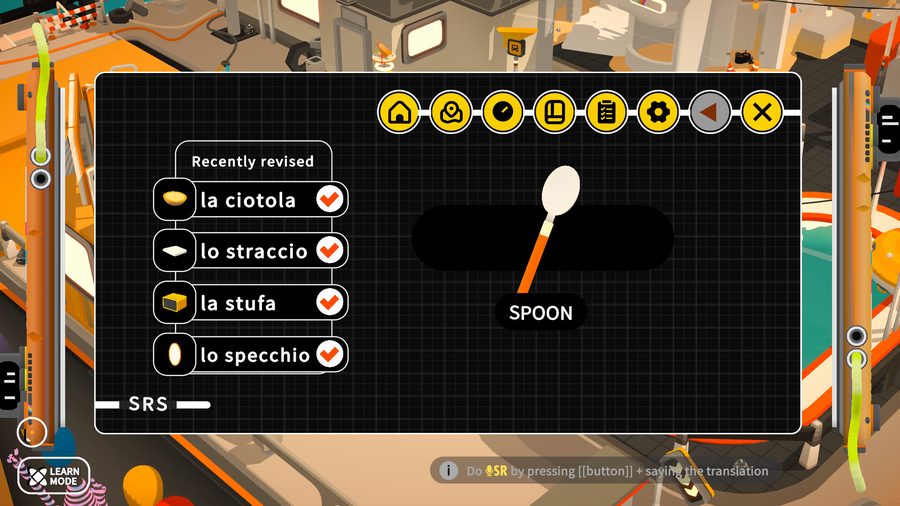
Screenshot from the Noun Town Steam store page, showing the Italian vocabulary review screen
This depends heavily on how much time you put in, same as any method. A focused vocabulary game will typically cover several hundred to a couple of thousand core words and common phrases across everyday categories, food, travel, the home, work, greetings, numbers. That is enough to handle a lot of practical situations: ordering in a restaurant, asking directions, basic small talk, reading simple signs.
What it will not do on its own is take you to advanced fluency or teach the finer points of Italian grammar, subjunctive mood, the full range of past tense forms, formal register in professional writing. For that, most learners eventually bring in a grammar-focused resource or a tutor alongside the game. That combination, game for vocabulary and listening, structured resource for grammar, tends to cover more ground than either used alone.
The US Foreign Service Institute places Italian among the easiest languages for native English speakers to learn, estimating roughly 600 class hours to reach professional working proficiency. A game is not a substitute for those hours, but it can make a meaningful chunk of them feel less like studying.
A lot of people who ask this question have already tried an app and lost interest. That is common, and it is not really a discipline problem, it is a design problem. Apps are built for short, repeatable sessions, which is efficient but also easy to abandon once the streak breaks.
Games are built to hold attention for their own sake. You are not opening Noun Town to "do your Italian," in the way you might open an app out of obligation, you are playing a game that happens to teach you Italian while you play it. For learners who have struggled with app fatigue specifically, that shift in framing tends to matter more than any individual feature.
This is one of the reasons we built our language learning game the way we did, prioritising a world worth spending time in over a lesson structure worth completing.
Not every game marketed toward language learners is built the same way, so a few things worth checking before committing time or money.
A game will not replace years of structured Italian study if that is your goal, and it will not teach you formal grammar the way a textbook does. But if the question is whether a game can genuinely teach you real, usable Italian vocabulary and get you speaking with reasonable pronunciation, the answer is yes, and it has been proven out by thousands of players already doing it. The bigger question is usually not whether it works, but whether you will actually enjoy showing up to do it, and that is where a well-made game tends to win.
Want to see the Italian content for yourself? There is a free demo on Steam.
Try Noun Town on SteamYes. Noun Town is a PC and Mac game on Steam that teaches Italian vocabulary, listening and speaking inside a 3D world, using native speaker audio and spaced repetition rather than a lesson-and-quiz format.
You can build real vocabulary and listening skill, and games with speech recognition let you practise pronunciation directly. Games are less suited to explicit grammar rules, so most learners pair a game with a grammar resource for a complete picture.
No, relatively speaking. The US Foreign Service Institute places Italian in its easiest category for native English speakers, estimating around 600 class hours to reach professional working proficiency, similar to Spanish and French.
Words are attached to objects and characters in a 3D open world, spoken aloud by native Italian speakers. A spaced repetition system resurfaces words right before you would naturally forget them, and speech recognition lets you practise saying words back.
A focused game will cover several hundred to a few thousand core words and phrases, which is enough to handle everyday situations like ordering food, shopping or basic conversation. It will not replace a full course for advanced fluency or specialised vocabulary.
Yes, there is a free demo on Steam so you can try the Italian content before deciding to buy the full game, which is a one-time purchase of $19.99 covering all 12 supported languages.
No. Noun Town has no adverts and nothing locked behind an extra paywall once purchased. The team built it this way after finding ad-supported and freemium mobile apps frustrating themselves, and hearing the same complaint from thousands of other learners.
Better is the wrong frame, they do different things well. Duolingo is convenient for short daily streaks. A game like Noun Town suits longer sessions and tends to produce stronger vocabulary retention because words are learned in context rather than as isolated flashcards.
Noun Town is available on PC and Mac through Steam. There is no VR requirement and no console version currently, just a standard desktop or laptop install.