
Photo: A. Savin / Wikimedia Commons (CC BY 4.0)
Short answer: Yes. Several video games, including Noun Town, are built specifically to teach Russian vocabulary, Cyrillic reading and pronunciation through gameplay rather than through flashcards or grammar drills. They work by pairing spoken Russian with objects, characters and situations in an explorable world, then using spaced repetition to bring words back before you forget them.
If you have typed this question into a search bar, you have probably already tried an app or two and found the experience a bit dry. Russian in particular scares people off early because of the Cyrillic alphabet, and a lot of apps ask you to memorise that alphabet as a standalone task before you get to anything interesting.
Games take a different route. Instead of an alphabet chart, you get a word attached to something you can see, hear and interact with. That difference matters more for Russian than it does for a language that already uses the Latin alphabet, because the reading and the vocabulary get learned together instead of in two separate stages.
The Cyrillic alphabet has 33 letters, and roughly a third of them look like Latin letters but represent completely different sounds. That mismatch is exactly what trips up self-taught learners staring at a chart. A game sidesteps this by showing you the same handful of letters over and over, attached to words you are also hearing spoken aloud.
In Noun Town, a Russian word appears as a label in the 3D world, spoken by a native speaker, tied to the object or character it describes. You see яблоко next to an apple stall, hear it pronounced, and interact with the scene. That single moment covers reading, listening and meaning at once, rather than three separate exercises.
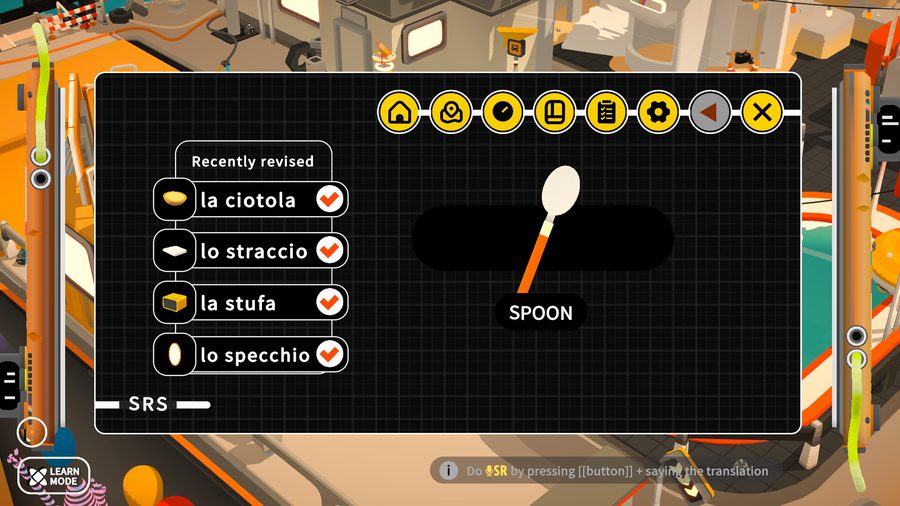
Screenshot from the Noun Town Steam store page, showing the spaced repetition review screen
Part of what makes Russian feel intimidating is not knowing how much of the alphabet is actually unfamiliar. In practice, it is a smaller hurdle than it looks.
| Letter type | Example | What to expect |
|---|---|---|
| Looks and sounds like Latin | К, М, О, Т | Fastest to learn, roughly a third of the alphabet |
| Looks like Latin, sounds different | Р (R sound), Н (N sound), В (V sound) | The main source of early confusion |
| Entirely new shapes | Ж, Я, ф, щ | Unfamiliar but no harder to memorise than any new symbol |
Russian sits in a middle tier of difficulty for English speakers. It is generally rated tougher than Spanish, Italian or French, mostly because of its six grammatical cases, which change noun endings depending on their role in a sentence. It is also rated noticeably easier than Japanese, Korean or Arabic, where the writing systems themselves are a much bigger undertaking, often involving thousands of characters or an entirely different reading direction.
The U.S. Foreign Service Institute places Russian in its "hard language" category for English speakers, estimating roughly 1,100 class hours to reach professional working proficiency. That number covers full fluency, not casual conversational ability, which most self-directed learners reach in a fraction of that time.
Cases are the part that trips people up most, not the alphabet. Once you can read Cyrillic comfortably, which usually only takes a few weeks of regular exposure, the harder work of learning noun endings begins. Games are honestly a weaker tool here than a dedicated grammar guide, since cases are a rule-based system that benefits from explicit explanation.
None of this looks like a lesson screen. That is deliberate. The goal in Noun Town's language learning game is for the Russian vocabulary to feel like a byproduct of playing rather than the entire point of every screen, which tends to keep people coming back for longer sessions than a flashcard app usually manages.
Apps like Duolingo and Babbel do teach Russian, and they are genuinely useful for structured grammar notes, something Russian benefits from given its case system. Where they struggle is holding attention for long stretches. Most app sessions run a few minutes before the format itself starts to feel repetitive.
Games solve the attention problem but not the grammar problem. The practical answer for most people learning Russian seriously is combining both: a game for vocabulary, Cyrillic reading and pronunciation, and an app, textbook or tutor for working through the case system methodically. Neither format alone currently covers everything Russian requires.
Curious what learning Russian through play actually looks like? There is a free demo on Steam.
Try Noun Town on SteamYes. A handful of Steam titles, including Noun Town, are built specifically to teach Russian vocabulary, Cyrillic reading and listening skills through gameplay rather than flashcard drills.
Yes, if the game consistently pairs Cyrillic text with spoken audio and visual context. Repeated exposure to the same letters in different words is one of the more reliable ways to internalise a new alphabet, and games can deliver that repetition without it feeling like rote memorisation.
Players explore a 3D open world where Russian words are attached to objects and characters, spoken aloud by native speakers. A spaced repetition system schedules review of each word right before it is likely to be forgotten, and speech recognition lets players practise pronunciation out loud.
Russian is generally considered more demanding for English speakers than languages like Spanish or Italian, mainly because of its case system and unfamiliar alphabet. It is usually rated easier than Japanese, Korean or Arabic, which involve entirely different writing systems with thousands of characters or unfamiliar scripts written right to left.
No. A well-designed game introduces Cyrillic gradually alongside spoken audio, so you are reading and hearing the same words together from the first session rather than memorising an alphabet chart in isolation first.
Most players notice they can read simple signs and recognise common words within a few weeks of regular play. Building a working vocabulary of a few hundred words typically takes a few months of consistent sessions, similar to the timeline for app-based study.
No. Noun Town is a one-time $19.99 purchase on Steam covering all 12 supported languages, including Russian, with no ads and no content locked behind an additional paywall.
Not in the explicit, rule-by-rule way a textbook does. Games are strongest at vocabulary, listening and reading recognition. Russian's six-case system is easier to absorb through games once you already recognise a solid base of nouns, but most learners still benefit from a dedicated grammar resource alongside the game.
Neither is universally better. Games tend to hold attention longer and embed vocabulary in context, which helps retention. Duolingo and similar apps offer bite-sized daily sessions and explicit grammar notes. Many learners use a game for immersive vocabulary sessions and an app for quick daily maintenance.
Yes. Noun Town has a free demo available on Steam, so you can try the Russian vocabulary and Cyrillic reading mechanics before deciding whether to buy the full game.