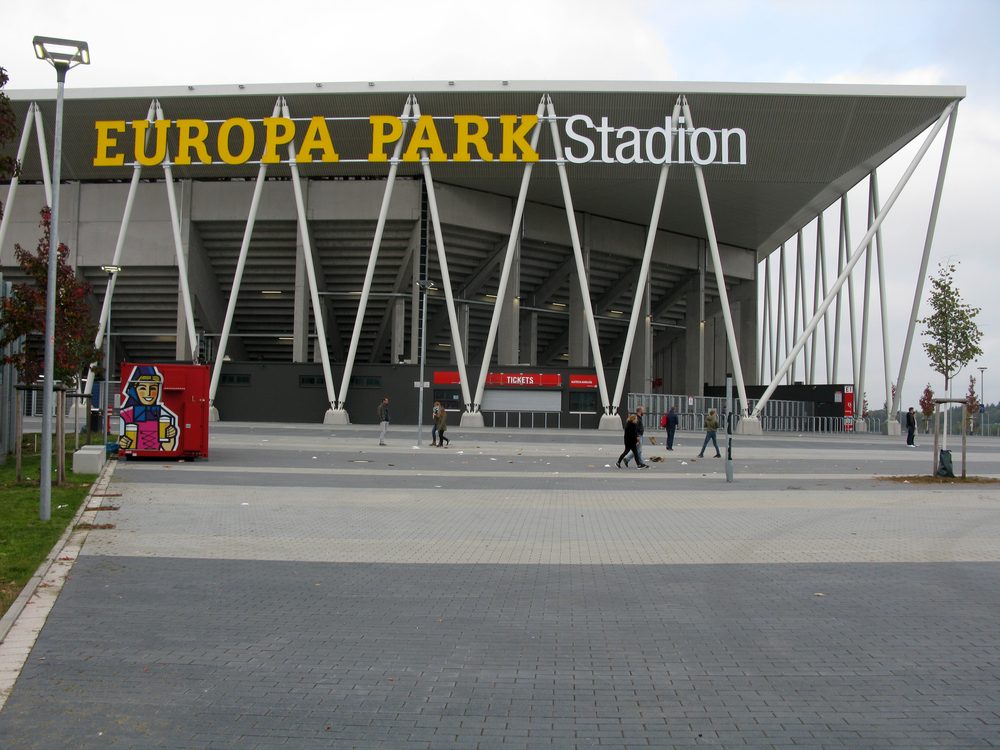
Photo: Andreas Schwarzkopf / Wikimedia Commons (CC BY-SA 4.0)
Germans call football Fußball, a compound of der Fuß (foot) and der Ball (ball). It's the same sport known as soccer in the United States, and Fußball is the word used everywhere in Germany, Austria and German speaking Switzerland, from playground kickabouts to the Bundesliga. There is no separate German word for soccer, because the confusion between football and American football simply doesn't exist there in the same way.
Short answer: Germans call football Fußball. American football is called American Football to tell it apart. The top league is the Bundesliga, and most learners can pick up 50 to 100 core sports words in about 2 to 3 weeks of regular practice.
English speakers in the US, Canada and Australia use the word soccer partly because football already meant something else in those countries, whether that's the American or Australian version of the game. Germany never had that problem. Football has always meant Fußball there, so there was never a need for a separate name.
When German speakers do talk about the American sport, they usually just say American Football, sometimes shortened to Football in casual conversation when the context already makes it obvious which sport is meant. You'll see this on German sports channels that broadcast the NFL, where the coverage is labelled American Football rather than translated into something else.
This matters for learners because it means you can use Fußball with total confidence in any German speaking country. It isn't a regional term or a formal one reserved for commentary. It's simply the word, used the same way from a school playground in Munich to a Bundesliga broadcast.
Once you know Fußball, the next useful step is the small set of nouns that come up constantly around the sport. German football vocabulary leans on everyday words rather than borrowed English terms, which makes it a good entry point into the language's logic of compounding words together.
Notice how most of these are native German words rather than English loanwords, with das Foul being one of the few exceptions. Der Elfmeter is a good example of how German prefers to describe things literally: rather than borrowing "penalty," it names the distance the ball is placed from the goal.
Learning vocabulary like this in context, attached to an actual scene rather than a bare list, tends to stick better than memorising the words on their own. That's part of why sports and hobby vocabulary works so well as an early target for beginners, since it comes with a built in visual and situational context.
The Bundesliga is Germany's top professional football division, founded in 1963 and currently made up of 18 clubs. It's widely recognised for having some of the highest average matchday attendances of any football league in the world, a reputation built on ticket pricing and standing terraces that keep games accessible to ordinary fans rather than pricing them out.
Clubs like Bayern München, Borussia Dortmund, and RB Leipzig are the names most learners will recognise, but part of learning the vocabulary is getting comfortable with how German handles club names and results. A scoreline is read out with "zu" between the numbers, so 2 zu 1 means 2 to 1, and a match report will typically use das Spiel or die Partie for the game itself.
Following Bundesliga commentary is a genuinely useful, low pressure way to practise listening comprehension once you know the core vocabulary above. Commentators repeat the same fifteen or twenty words constantly across a ninety minute broadcast, which gives your brain far more natural repetition than a textbook dialogue ever could.
According to Wikipedia's overview of the Bundesliga, the league has been contested since the 1963 to 1964 season and remains organised by the Deutscher Fußball-Bund (DFB), Germany's football association.
Football dominates German sports culture, but it isn't the only game with vocabulary worth learning. A handful of other sports show up constantly in conversation, on television, and in casual small talk, so it's worth knowing their names even if you never plan to watch a match.
Handball deserves a special mention because it genuinely surprises a lot of learners. Germany has a well supported national handball league, and the sport draws crowds and TV audiences that dwarf its profile in the UK or US. If you're chatting with a German sports fan, don't assume the conversation is automatically about Fußball.
Winter sports vocabulary is also worth a mention, especially das Skifahren, given Germany's Alpine regions and the country's strong record at international skiing and biathlon events. These words follow the same compounding logic as football vocabulary, built from familiar smaller words stuck together rather than borrowed wholesale from another language.
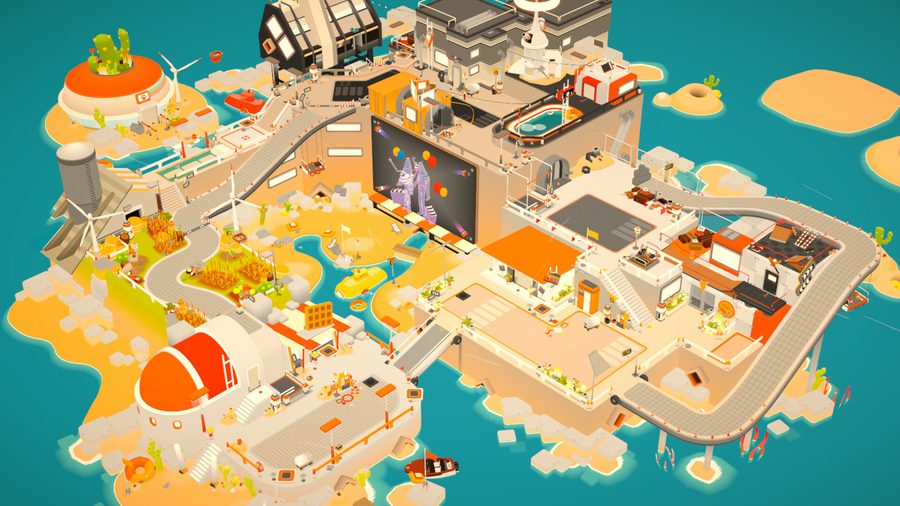
Screenshot from the Noun Town Steam store page, showing the open 3D world where vocabulary like this is taught in context
Every noun in the list above comes with der, die or das attached, and that isn't optional decoration. German grammatical gender requires the correct article whenever you use a noun in a sentence, and getting it wrong is one of the most common mistakes English speaking learners make, since English dropped grammatical gender centuries ago.
There's no reliable shortcut for guessing gender from meaning. Der Ball is masculine, das Tor is neuter, and die Mannschaft is feminine, and none of those choices map onto anything intuitive in English. The only dependable method is to learn the article together with the noun from day one, treating "der Ball" as a single unit of vocabulary rather than "ball" plus a grammar rule to apply later.
This is exactly the kind of detail that a spaced repetition system is good at reinforcing, since it forces you to retrieve the full noun phrase, article included, rather than just the English translation. Flashcard apps that only test the bare word and its meaning can quietly let gender errors slide for months without you noticing.
Sports vocabulary is a genuinely good starting point for German because it's concrete, visual, and repeated constantly in real media. The Goethe-Institut, Germany's official cultural and language institute, also publishes free learning resources organised by theme, and sport is one of the topics they cover for exactly this reason. Here's a practical approach that works whether you're using an app, a game, or plain old flashcards.
This is the same underlying method Noun Town uses across its full vocabulary set, not just for sports. Words are introduced attached to a specific 3D scene with native speaker audio, then brought back for review through a built in spaced repetition system, with speech recognition so you can practise saying them rather than just recognising them on a screen.
Want to build vocabulary like this the same way native speakers pick it up, through context rather than lists?
Try Noun Town on SteamThe German word for football is Fußball, a compound of der Fuß (foot) and der Ball (ball). It refers to the same sport that is called soccer in the United States.
No, not in everyday speech. Fußball covers the sport in German. When Germans talk about the American sport played with an oval ball and pads, they call it American Football, keeping football itself for what most of the world knows as soccer.
The Bundesliga is Germany's top professional football league, home to clubs such as Bayern München and Borussia Dortmund. It regularly has some of the highest average matchday attendances of any football league in the world.
Goal is das Tor in German. The same word can also mean gate or doorway, which gives a clue to its older meaning of an opening you send the ball through.
A male player is der Spieler and a female player is die Spielerin. A team is die Mannschaft, which is also the word used for a national squad, as in die deutsche Nationalmannschaft.
Handball, tennis, athletics (Leichtathletik), cycling (Radfahren) and winter sports such as skiing all have large followings in Germany. Handball in particular draws bigger crowds in Germany than in most other countries.
Every German noun carries one of three grammatical genders: der (masculine), die (feminine) or das (neuter). There is no reliable way to guess the gender from meaning alone, so most learners memorise the article together with the noun rather than the noun by itself.
With short daily practice, most learners can comfortably pick up 50 to 100 core sports words and phrases in about 2 to 3 weeks, which is enough to follow a match commentary or talk about a game with a German speaker.
Yes. Seeing a word attached to a specific object or scene, then being asked to recall it again after a gap, is a well documented way to make new vocabulary stick. Games that place words in context and space out review sessions are using the same principle that language teachers rely on.
Yes, German is one of the 12 languages supported in Noun Town, alongside Japanese, Korean, Mandarin Chinese, Spanish, French, Italian, Russian, Greek and Egyptian Arabic.